Friday, 20 January 2012

'Victoria: The place to be'

Despite almost missing our flight from Darwin to Melbourne because of a huge thunder storm and a spot of flash flooding, I skipped onto Victoria soil with excitement. The Airey clan would be arriving at the very same airport in four days time.

"It's all the best parts of London," we decided as we spent the first day exploring the nooks and crannies of this beautiful city. The hidden lanes, gorgeous architecture, world class museums and quirky neighborhoods all combine to make Melbourne an instant hit. Magnificent Tudor and Victorian buildings and gorgeous iron lace balconies graciously reflect the city’s colourful history, while impressive skyscrapers and other buildings by world-renowned architects boast the city’s prosperous present.

'Victoria: The place to be' is the slogan that festoons the car number plates. I wouldn’t disagree. We lost hours wandering the strange and labyrinthine system of laneways and arcades that make Melbourne so distinctive before heading to the beautiful, beachside Barwen Heads, just south of Geelong, to visit friends we made on one of our treks in Nepal. Damo and Sarah treated us to a delicious barbie, beers and some beach time while we reminisced about Nepal. Thanks guys!

After a sweet taste of Aussie domesticity, it was back to the city to take on Melbourne's greatest challenge: the hook turn. We picked up the hire car that would take us to Sydney, I learned how not to drive an automatic, and took on the 'hookie'. If you want to turn right in the city centre, you have to go into the left lane. Then, it seems, wait for the split second while the lights are changing from green to red, hold your breath, hope there isn't a tram coming down the centre and slam your foot on the accelerator as you swing across to the other side.

Needless to say, from then on, we planned our route so we could use entirely left turns.

Sunday, 15 January 2012

Hitting the Northern Territory

The drive from Broome to Katherine (the first town you hit in Northern Territory) is about 1600kms and the road (Highway 1) goes through three towns. So that's like driving from Lands End to John O'Groats and only going through three places the size of English villages on the way, with perhaps two or three petrol stations (or roadhouses, in Australia) in between these. It is an experience we will never forget.

It is a boundless void: inhospitable, oven hot, empty - with threats of cyclones imminent. We saw nothing for miles, just red soil, scrubby vegetation, termite mounds (some with painted faces or shoes hanging off them), the odd mailbox signalling a cattle station, kangaroo corpses, huge skies and the occasional, skeletal eucalpyt tree.

We passed through many primarily Aboriginal towns on the road up to Darwin. I have to say that, although this is something we couldn't fully appreciate or understand, we felt uneasy here. Many Aboriginal people seem to sit around, under the shade of trees or in small shopping centres, quite outcast from modern, Australian society.

Australia's indigenous population (or 'Aboriginal', which comes from the Latin, Aborigines, derived from ab (from) and origo (origin)) have led quite a disrupted life since the First Fleet of British convicts and officials arrived at Botany Bay in 1788. There has been a great deal of conflict and mistreatment since that time, the most horrifying being 'The Stolen Generations'.

From 1869 until as late as the 1970s, children of the Aboriginal people were forcibly removed from their families by the Australian government and church missions, through fear of miscegenation (the mixing of racial groups). A formal apology was only offered by the Australian government in 2008.

There are still huge health and economic difficulties facing Aboriginal people, with both remote and urban populations having adverse rates of lack of education, unemployment, poverty, crime and even child suicide. There is also a big alcohol problem. In towns where Aboriginal people live, bars are scarce and there are strict rules for the purchase of alcohol, including a kind of license system only enforced on the Aborigine people. What's more, jobs in these towns seem to have evaded the Aboriginals, with many foreigners taking roles in roadhouses, shops and tourist information centres (where they sell black dolls painted with Aboriginal markings, and didgeredoos that are made in Indonesia).

We don't know the whole story, and we know that they receive financial support from the Government, but it was quite unsettling to see large groups of people trying, and failing, to fit in with the local community. Of course, there are many Aboriginals who have chosen to avoid the westernisation of Australia and live in much the same way as their ancestors: we saw one man sat on a stool, under a tree, in the middle of nowhere.

We took five days to cross the barren expanse from Broome to Darwin, and they usually went like this.

-Wake up with the sun around 5am, soon be in a pool of your own sweat, so you get up.

- Perhaps bucket-shower off the sweat. Usually not, if we're being honest here. Water was precious and everything we owned was already dirty.

-Hit the road before 6am and have two hours of a fairly comfortable driving temperature.

-Ignore the sweat dripping from the backs of your knees by 9am.

-Watch the fuel guage and continuously keep checking the map to reassure yourself that we weren't going to get stranded in the bush.

-Drink copious amounts of water that started the day cold would be hot and taste like chlorinated soil by midday.

-Lunch would be somewhere nice in the shade, but the sandwiches would be almost cooked.

-Hold your breath as a beast of a road train overtakes you and spews dust and stones at the windscreen.

-Get back into the Beatle wagon and repeat the morning, with the drinking water temperature increasing.

-Find a camp site before it gets dark.

-Hang up the day's clothes to dry off.

-Brave the bush toilet in the dark and hope for the best.

-Wait for the temperature to drop a few degrees before making the bed, all the while trying not to be bitten by mosquitoes.

-Lay in a pool of your own sweat until falling asleep. Attempt to squat said mosquitoes.

-Fantasise about ice and other cold things. Consider ways of getting cool. Sometimes eat some ice from the cool box and place one piece on your forehead.

-Repeat.

We stopped off in Katherine, and then drove to Kakadu - a National Park the size of Israel. It's full of crocs, especially at this time of year, oh, and there are dingoes too! I got food poisoning from some red wine that had all but boiled in the heat (I thought it would make me sleep - how wrong I was!) and had to run in and out the van in 30 degree heat at night to be sick - fearing crocs, dingos, and the electrical storm overhead. 24 hours I will never forget.

But it was all part of an unforgetable journey and to drive on the cusp of the Kimberly region and experience the vastness of the area (twice the size of the UK) and it's remoteness was a true adventure. This was real Australia: remote, wild and free.

Wild, wild west

After a brief stop off in Perth for a night with Mark and Aoife (and our weekly shower), we headed north, and would be heading north on the Great Western Highway for the next three weeks. It was a road trip of epic proportions, armed with just a map, our 'Free campsites' book, one already-overplayed C.D, lots of canned food and a big, emergency supply of water.

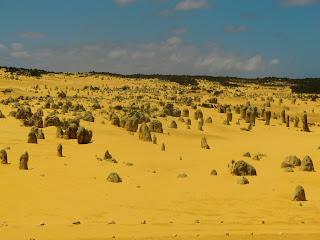
Our first major stop was The Pinnacles, in the Nambung National Park. Like eerie figures erupting from a desert wasteland, the Pinnacles are said by those indigenous to the area to be inhabited by evil spirits. And I see why, the creeping shadows of these natural phenomenon follow you around.

These incredible towers of limestone have taken thousands of years to form in this vast, baking desert, made all the more breathtaking as they are surrounded by sapphire blue waters, sunburned sand and perfect blue skies. We followed around the tiny footprints of their inhabitants and then drove the camper over the sand dunes.

The next day saw us on the road to Kalbarri National Park, stopping off on route at coastal view points overlooking incredible cliff formations, each one more breathtaking than the next. Rich, terracotta stone reflected in the raging, turquoise waters at every turn.

This would be a pattern we would follow all the way up the coastline, like a game of top trumps with rocks, sea and sand, and where we were always the winners.

Australia is the driest, flattest, hottest and infertile of all the inhabited continents (only Antarctica is more hostile to life). The road through Kalbarri was the longest, straightest and most barren we had encountered so far and, again, this was a taster of what was to come. We walked to the deep, echoing gorges of 'Hawkshead' and 'Ross Graham' - extending as far as the eye could see.

Next, was a few days in the beautiful Shark Bay, where we got acquainted with our first emus, snakes and sharks. We camped at Eagle Bluff, right where the crystal blue waters lapped the bay of this World Heritage listed area.

In these clear waters we spotted sharks and rays, almost missing the big lizard and even bigger snake at our feet (thankfully, separated by a wooden barrier!). In our secluded spot (except for the emus and roos) with our own private beach, we pinched ourselves at how good life can be as we drank ice cold beer at sun down.

One of Shark Bay's main attractions is Monkey Mia. Some decades ago when Monkey Mia was just a hideaway for locals, families would feed a local pod of dolphins as they camped in the area. The dolphins, realising the benefits of the free food (who wouldn't?), hung around and before long things started to get a little carried away.

Today, Monkey Mia is regulated by the Department of Conservation and Environment and there are regulations in place to protect the dolphins who are still loyal to the beach. We snorkeled and swam and, while I was in the water, a group of dolphins swam over and started having a good old scratch on a boat's mooring rope.

The next morning was feeding time and, true to form, the friendly female dolphins and their young (they stopped feeding the males as they got too aggressive) came into the shallows. There was a one-week old calf in their midst and
we saw her tiny fin breaching throughout the morning. We sat back on the beach to watch them play by the shore. How are you going to trump this one, Western Australia?

The answer was Quobba (so many great place names in Oz!). A smiling Grey Nomad had recommended this little-known camp site by a deserted beach and huge blow hole.

We pulled up in a ghost town of corrugated iron huts (apparently summer houses for locals - as one of them, who called herself 'Spider', informed us) and drove further in to find out own camp spot by the never-ending beach. But the real treat was the snorkeling in 'The Aquarium', where hundreds of fish swam around us, taking us along in their whirlwind. Our new friend, Spider, showed us how to feed them with bit of bread, and they snapped it right out of our hands, both on the surface and underwater. But this was just a warm up to the next page of our adventure.

Coral Bay is at the heart of the Ningaloo Range (of which Quobba is just the start). The Ningaloo Reef, the 604,500 hectare marine of the Ningaloo Coast, is the largest fringe reef in the world and is greatly overshadowed by it's eastern brother, the Great Barrier.

Coral Bay is paradise. On one side, the land is barren and arid cattle country, where cows roam and truckers try to avoid hitting roos. On the other side, the water is the clearest you'll ever see, the beach is white and infinite and the shore-side reef, with its abundance of marine life, is one of the best snorkeling spots in the world.

It was certainly the best snorkeling we had ever experienced. There are so many turtles, fish, sharks and rays and the coral itself is spectacularly vast and beautiful. No matter how far out we swam, it didn't get any deeper or look like it was coming to an end. This was pure, unadulterated bliss. Here's hoping that the Ningaloo doesn't suffer the same perils of the Great Barrier. Nothing that perfect lasts forever.

Further up the Ningaloo coast lies the little town of Exmouth, and the Cape Range National Park. We camped in the park, beside beaches where turtles were in their nesting period. Med spent a day diving the Naval jetty (too expensive and difficult a dive for me, much to my misery), but the snorkeling was still good, seeing big turtles and black and white-tipped reef sharks.

We travelled on, this time heading inland to Karijini National Park, where the temperature was heating up and the flies were multiplying. Both the van and ourselves got coated in the stubborn red dust that is renowned in this remote, mining area of Australia, but it was well worth the scrubbing and rounds of laundry in the aftermath. Sadly we didn't get to climb Mount Bruce and Mount Sheila (real names, I promise!), but we did get to see Weano Gorge, which is dizzyingly deep and one of the oldest rock formations on earth.

When we could bear the heat no longer, we walked down into the depths of Dales Gorge until we found a waterfall and cool, freshwater pool. This was one of many pools in Karijini that are held sacred by the Aboriginal people, who believe they were made millions of years ago by huge serpents, much like the rest of the land formations.

In one of the pools, the fish nibbled at the hardened skin on my feet (caused by 3 months of wearing flip flops) - you'd pay good money for this at home! Hiking through and up the gorge was beautiful (and very sweaty) and we couldn't help but feel some of the spirituality the Aboriginal people cherish here. Now, it was off to the campsite in dingo territory...

Things heated up from then onwards, and so did our engine as we covered some serious ground through the outback over the next few days.

In Broome, we arrived on the world famous Cable Beach at 8.35am, only to call it a day by 9am as it was too hot! Normally, swimming is our salvation, but the waters up here are infested with dangerous jellyfish. In fact, Australia's (and therefore the world's, of course) most deadly sea creature is the box jellyfish - step aside, ye Great Whites.

Talking of deadly creatures, next, we were heading to croc territory. Big, sharp-toothed, man-hunting, salt water crocs, that is.

Saturday, 17 December 2011

Our Wicked Oz adventure

So where was I? Ah yes, a garage in Perth suburbia, where we picked up our west coast wheels: an infamous 'Wicked' campervan. With its peeling, Beatles paint job on the outside and the elaborate doodles and musings from happy campers on the inside, this was not just our transport: this was home for the next month.

And how we cherished our Beatle wagon, from the single-ringed, portable stove and classroom-style table to the ancient foam mattresses and safety-pinned curtains.

We turned up the radio, wound down the windows and headed south of Perth to explore the Margaret river area for the next week. The south-west coast of Australia is a land of vineyards and world-famous surf, where our first lunch-stop over-looking Geographe Bay served up accidental whale and seal watching across the blue, blue ocean. Life was good on the road, down under.

We pulled up in campsites on the cusp of the brilliant, turquoise coastline and in the heart of stunning National Parks, only meeting a handful of 'Grey Nomads' - exuberantly friendly Aussies who have been on the road since retirement.

We also met our first roo on arrival at our first National Park campsite. Right next to our camper was a mother and her baby joey, who immediately alerted their ears and eyes to our arrival.

The joey bounded around but, as we got closer, decided to hide and climbed right into his mum's pouch for safety. "How lucky we are!" we gasped. In fact, we would see hundreds of roos thereafter and we were surrounded each night we camped in Margaret River territory. Who needs television for evening entertainment?

We quickly got used to the bush-style, compost toilets in the National Parks and I soon forgot to check every toilet for spiders, snakes, unknown flying insects, massive biting ants and everything else before sitting down.

Australia has more things that can kill you than anywhere else and as many as a third of its species remain entirely unknown to scientists. Of the world's ten most poisonous snakes, all are from Australia. Not to mention the spiders, jellyfish, the blue-ringed octopus, the most lethal of their type in the world (to mention just a few). At this point, before any of you start thinking how brave I am, I have to admit that on my first day in Australia, I could be found erratically
checking the room, beds, even our clothes and bags for spiders - and we were still in the city centre. Camping in the bush for a month soon bashes that fear our of you; there would be no sleeping or exploring if you had man-eating spiders on the brain.

We certainly explored the area: sea, sun, surf, towering forests and vineyards. We learned how it felt to have our own private beach (we wouldn't have to share many all the way up the coast to Darwin) and there was no better feeling than watching the Australian sun bounce off the huge surf as the breeze tousled with our unwashed hair. Or perhaps there is: drinking locally produced "goon" (an Aussie term for cheap boxes of wine -"goon" is derived from the word "flagon" (a drinking vessel), but mistakenly thought to be an Aborigine name by tourists (goons!)) and cooking a BBQ by a river with no one else around, just the roos and possums for company.

In this small pocket of south-west Australia, we were free, we had our independence and it was exhilarating. Thankfully, we were heading north the day the controlled bush fires got out of hand and destroyed large areas of forest and people's homes. A reminder of the vast, and often unruly country we are in.

Thursday, 15 December 2011

We're off to see the wizard...

It finally arrived, our flight to Australia. Med had dreamt of this moment since he first picked up a surf board and took to the icy waters of the English channel. I was more excited for him than for myself - he all but kissed the ground as we stepped out into the cloudless sunshine from Perth airport.

Arriving from the whirlwind of dust, chaos, haggling and traffic of S.E. Asia is surely the best way to step foot on Australian soil; the pavements gleam, the windows sparkle and there is an overwhelming feeling of things being familiar, but better. This is Australia, after all. Land of golden sands, turquoise waters, big rocks, even bigger sharks, and Neighbours.

Australia is the world's sixth largest country and its largest island. It is the only island that is also a continent, and the only continent that is also a country (thanks, Bill Bryson). So it's big, exuberantly big. And there's no place on earth like it.

We skipped around the glittering streets of Perth, embracing the novelty of supermarkets, green parks and breezy, sunny days. However, there was nothing novel about the prices. Watching Neighbours at 5.35pm for 13 years does not teach you how astronomically expensive Australia is. Food, beer, accommodation, clothes all threatened to eat through our savings in one big, greedy gulp. Time to get thrifty, or as the Aussies say, "povo".

Thankfully, the best things in life are free, and that has never been more true than in Australia. We took in the views of high rises and the Swann river from King's Park, and pottered around the former convict port of Fremantle (or "Freo" to locals - if in doubt, just add an 'o') - a relaxed, eclectic and eco-conscious hang out across the river. And then came a moment we had salivated over when picking at stringy, indiscriminate meat in Asia: our first Aussie barbie.
Really, this was an Irish barbie shindig as we met up with Mark and Aoife, our travelling friends from Vietnam and Cambodia, and they introduced us to a whole bunch of their Irish pals for a feast and singalong. Perth is half Irish, it turns out. Thanks guys, we miss you!

With great relief, we checked out of our doss house of a hostel and went to a garage on the outskirts of town. And it was in that dirty, dilapidated garage that our Western Australia adventure began.

Tuesday, 13 December 2011

Malaysia, truly Asia

So you've seen the advert on the telly, with the nauseatingly sung strapline: "Malaysia, truly Asia."

Yes, it is Asia, but mostly it's all the bad parts of Asia. The rip offs, the rudeness, the daily frustrations, the engine fumes, the lorry-loads of tourists descending on beautiful landscapes. So, Malaysia and I didn't get off to the best start, but it was intended as a week of relaxing and recharging by the sea - and for that, it lived up to expectations.

There were of course great positives, and we ate our way through most of those. Roti, dosas, iced Milo (a sweet, chocolate drink), grilled salted corn, chicken satay. We eagerly looked forward to our next opportunity to stuff our faces.

But, despite the cheap, delicisou food, the island of Langkawi seemed like one money making scheme after another. Although the island is 478 square kilometers and it’s filled to the brim with tourists, public transportation is conspicuously absent. Instead, visitors can use the over-priced taxis governed by one hell of a well-organized taxi mafia.

Then, if you want to escape the island, you have to join an over-priced island hopping tour, each one carbon copy of the next but everyone pays a different price. Thankfully, we were the ones being told to keep quiet about how little we paid for the trip.

We had high hopes of going diving around the smaller islands - but not for more than double the price you would pay across the water on a Thai island.


So, in the spirit of independent travel (and thriftiness), Med and I decided to rent a motorbike and drive around the island on our own. We wound our away along the well-paved streets past gas stations, hotels and shopping centers until we came to parts of the island that were refreshingly green and impressively undeveloped. There we found our tropical beaches, unspoilt views of soaring karst mountains and emerald waters. Peace at last.

We won't be rushing back to Malaysia, but I would give anything for a banana roti for 30p right now.

Thursday, 1 December 2011

Tomb Raiding

Next we journeyed to Siem Reap, gateway to the mighty, mighty Angkor Wat. The very mention of these words conjures up images of lost temples, eastern mysticism and monster trees - no matter where you go in Cambodia, you can not escape the iconic towers of Angkor Wat. The temple is found on the flag, on postcards, on t-shirts, and even on the national beer.

We travelled from our modest, rural homestay to the the bright lights of Siem Reap, seeing the muddy aftermath of the recent flooding of Cambodia's flat, rural terrain. Most traditional Khmer homes are built on stilts, but for some that still was enough to keep them standing. We watched as people took small wooden boats to their front doors or tightroped across spindly bridges built using tree branches that hadn't been engulfed in the huge swell of the Mekong river. Tops of trees peeped out from the water just beyond the houses, and men were still spending their days trying to pull and surviving crops from underwater to feed their families

As we chugged into Siem Reap that night, a tuk tuk driver named Pao took us to our hotel and instantly offered us his services to take us around the temples. Aha, back to the tricks of the tuk tuk trade and like that we were thrust into the city race and chase once more. It was a contrast we weren't prepared for and, over a dinner of traditional amok and loc lac, I heard myself saying to Med: "it's too noisy here, shall we just go back to the hotel?" In my defence, we were still exhausted from our adventure and it was pushing 10.30pm!

After a day adjusting to the Siem Reap scene, we accepted the inevitable and hired Pao's services for a sunset tour of the temples. If you can't beat them (off with a stick), join them.

The great temples of Angkor, which are an UNESCO heritage site, were constructed between
800 and 1200 AD and served as the seat of the mighty Khmer empire. The Angkor complex contains over a thousand weathered temples and is believed to be the largest religious structure in the world. The site supported what would become the largest city of the pre-industrial world. While London had a population of 50,000 and was building cathedrals during this period, one million people lived in the Angkor kingdom during its height. Today, they offer a crumbling window into the life of the time. Hindu symbols mix with serene Buddhist expressions, carving historical reminders of how different religions ebbed and grew with the changing power of kings.

People now use the term 'Angkor Wat' to describe
the whole area, but in fact there are many, many
Wats. Standing tall in big compounds, little compounds, some with sculptures, some stripped bare, all spread out over a large area (all the way into Thailand, actually). The infamous Angkor Wat rises majestic from the forest of temples -
and would be our first glimpse as we journeyed by tuk tuk for some sunset viewing from Phnom Bakheng.

Bakheng Hill is the elevated temple from which almost everyone watches the sunset in Angkor. It's a truly beautiful sight, although incredibly crowded. It was like arriving for a big music concert, with security waiving everyone up a steep path to get us all there in time. We had to do a comedy walk sideways up the narrow stone steps as they have been eroded over thousands of years.

The sun glowed hot and red as it sank down into the treeline, illuminating the sky in a pink spotlight. If you didn't look left or right, or in front or behind you at the other people, and wore ear plugs to block out their murmurings, it was perfect. "Hmm," we thought, maybe we should have followed the advice of something we read online about a temple further away for sunset.
But maybe another 100 people had the same idea. This is Asia sightseeing at it's finest.

The next part of the story nearly didn't happen: sunrise at Angkor Wat. We set our alarm for 4.30am, went for an early night...and then woke up to our hotel phone ringing at 5.20am. A few seconds to realise where we were and we leapt out of bed, threw on some clothes, brushed our teeth (this one is for mum) and hurtled out the door five minutes later to find Pao waiting in his tuk tuk. "Put your foot on it Pao!" and put his foot on it he did!

We arrive just in time to see the striking silhouette of the five towers of Angkor Wat against the milky pink, morning dim. Locals are selling coffee and tea, groups of people hold cameras up to the sky and whispers of tourists float on the hush of silence all around.

The perfect symmetry of the shadowy reflections and the scattering of lotus flowers on the water made for a breathtaking sight. The new morning sun illuminated the temple carvings and intricate spires. Monkeys climbed on the ancient walls, unaware of their significance. A dodgy alarm clock couldn't ruin this moment.

To get ahead of the crowds, and to the confusion of Pao, we leapt out of Angkor earlier than most to head to Bayon, a crumbling complex known for it's gazing stone faces. The main attraction here, Angkor Thom, is decorated with 216 faces of Avalokitshvara (I'll admit I had to look that one up) along with 12,000 meters of bas-reliefs (that too) and around 11000 figures (yep, and that one) all of which add up to a sight even more impressive than the last.

As the sun rose high into the sky, we left Bayon and we tuk tukked on to several other temples, including the Ta Prohm, where the surrounding jungle has moved in a taken up residence amongst the aged stonework.

The film Tomb Raider was famously shot here, and today it's as overgrown with tourists asking about Angelina Jolie as it is with trees. Still, the huge mangled and contorted tree roots engulfing the ruins was a sight to behold; mother nature reclaiming what is rightfully hers.

By 2.30pm, we were templed out and in need of shade. We just don't have the stamina for 12 hours of sightseeing and I am bemused by the

tourists who do. The ones with their multi-functional rucksacks, brimmed hats, expensive walking shoes and suncream hanging from their necks. The ones who seem to evade sweat and dirt in their light-coloured clothing and have a guide who speaks ten languages showing them round. Well, we can't handle that pace, so we headed back to our hotel to reflect on the magnitude of what we had just seen.

Of course, as with any Asian sightseeing experience, there was a downside to our Angkor adventure. Cambodian children are the most persistent and canny sellers in South East Asia, and most of them gather to work the crowds of Angkor. Children as young as three or four are sent out begging or selling postcards, bracelets and fans by their families. Charmingly, they memorise English words and facts about the country you're from: "Your capital city is London, the next biggest is Manchester. You have a Queen and lots of rain." Their brown eyes sit wide on their grubby faces and it's so hard to ignore them. Something needs to be done to give these children the opportunities in life they deserve.

Despite this frustrating sadness, something which is tragically as common in Asia as sticky rice, my lingering thought from our Angkor experience was 'pride'. In a country where politics and poverty can so easily pull people apart, it is the pride in their history and heritage that unites all members of society.