Saturday, 18 February 2012

Christchurch: rising from the rubble

We flew over incredible Fiordland on our flight from Sydney and landed in Christchurch: a city slowly on the mend. There was little visible evidence of quake damage on the way from the airport through the Christchurch suburbs, but as we reached the centre it was a different story.

The first earthquake struck on September 4, 2010, and was a 7.1 magnitude quake that hit 25 miles west of Christchurch. It was, without question, a devastating earthquake, but it was the 6.3 magnitude aftershock that hit on February 22, 2011, which was the real monster. The February quake was centered just six miles south-east of Christchurch and resulted in significant property destruction, particularly in the city’s Central Business District.

As well as horizontal movement, the quake rose directly upward with more power, giving an almighty thump to the surrounding area with unimaginable force. Liquefaction produced 400,000 tonnes of silt, 4,000 buildings in the four avenues of the city centre had to be demolished, nearly 10,000 homes needed to be bulldozed and 185 lives were lost, making it New Zealand's second-deadliest natural disaster on record. It was this quake that changed life forever in Christchurch.

We arrived at our hostel (one of the few surviving ones) and received a map of the city. The helpful man at reception then took a red pen and drew a large block over the city, and scribbled it out. The red zone.

After nearly 12 months, the CBD is still on lock down. The only thing to do was walk and see it for ourselves. I don't know about you, but I've never seen the impact of such a recent natural disaster - it was a unique and unsettling opportunity that left us with few words.

As we began to walk, we are quickly rebuffed by 'danger, keep out' signs, chain-link fences, barricaded streets and construction bulldozers pushing around rubble. It was no mans land, apart from the brave demolition teams. It felt like it had just happened yesterday.

Just beyond the red zone perimeter we could see collapsed buildings, shattered glass and mundane items such as plastic chairs strewn on cracked pavements. We stood, wide-eyed, surveying the scene: half-collapsed shops still holding stock in the foreground and the ominous leaning towers in the background.

Missing from the scene is the Canterbury Television (CTV) building, which collapsed, caught fire and killed 115 of the 185 people who lost their lives. The finger of blame is still being pointed as a known weakness in its structure was not rechecked after the September 2010 earthquake, and now reports emerge that it failed to meet with modern standards for infrastructure in earthquake areas. I can't imagine how this must feel for the families who lost people inside the tower.


We had to zigzag around the edge of no man's land, walking past graffitied signs on every door saying things like 'UK team, CLEAR. 26/2'. First they went in to check for survivors, fires and gas leaks. Then they lift shaft team went to work to check for trapped people in multi-storey buildings. Now they're still stabilising, demolishing and clearing, a year on. And according to someone we spoke to who friend works for minimum wage in the red zone, still finding dead pets, body parts and mouldy food.

Among other buildings outside the main CBD, the Cathedral of the Blessed Sacrament was also severely damaged, with the towers falling. A decision was made to remove the dome because the supporting structure was weakened, and now the building is held up with a combination of hay bails and storage containers while they work out what to do with it. One of the rooms at the front of the building is mostly missing, but a suspended, open safe is still visible. Empty, like the rest of this holy structure.

It was soon 5pm, and the city was empty of workers on their way home. There was no clipping of polished high heels, loosening of ties and cheery colleagues heading for after-work drinks. There were just a few tourists, like us, looking in dismay at the rubble. It’s as if the heart of the city has been removed.

However, among the wreckage there are green buds of hope and renewal. While trying to find some life, we stumbled upon a shopping area that has opened in an ingenious set of shipping containers, re-engineered as temporary shops. Right here, where buildings collapsed and number of people were crushed to death by falling debris, a new life has grown from the rubble.

As the months go by, the red zone is steadily shrinking, and will eventually be replaced by a proposed new city centre. We saw signs everywhere for volunteers to help 'Green the rubble' by planting flowers and shrubs.

Despite the enormous loss, the looming presence of the red zone and continued legal thrashings, the people of Christchurch have remained loyal to their city and are working together to bring about Christchurch’s rebirth. The shrines of sympathy and charitable messages have gone, and been replaced with a positive, united effort to return the city to a place full of spirit, life and opportunity.

Thursday, 16 February 2012

Farewell, Australia

We flew to Sydney for our last few days in this incredible country. It seemed a fitting farewell, in this iconic, unique and vibrant city which marked the very start of Australia as we know it.

Our exceptionally cool, dashingly handsome and extremely generous friend, Kev, let us stay in his studio flat for two nights and took us round the city for our grand, sightseeing finale.

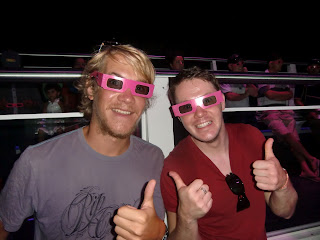
We felt at home walking through the Botanic Gardens with the infamous views of the Opera House and Harbour Bridge. We climbed the Sydney Tower Eye, watching a 4D film (complete with real bubbles and sea splash) and took the lift (ok, so we can't claim to have "climbed" anything) to the dizzying heights of the tower.

From up high, it hit me just how big a space Sydney occupies. As far as the eye can see, there were sprawling suburbs and thriving industrial units. We had got so well acquainted with such a minuscule part of this colourful metropolis, it had tricked us into thinking it was so much smaller.

We followed Kev to a podcast recording for 'Football Fans Down Under', and was challenged to eat 2kg of sausage and mash in the process. It was brutal and the sausages were grisly, but, ever the hero, Kev managed a brave 1kg of stodge, which would come back to haunt him later. Amazing what men will do for football.

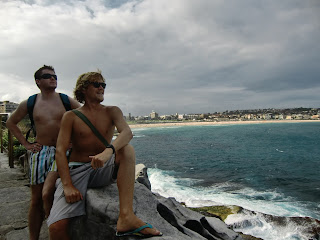
Rather than let Kev digest his heavy belly, we decided upon a two hour coastal walk from Coogee beach to Bondi in the breezy sunshine. It was alive with happy locals and tourists soaking up the afternoon sunshine and the perfect way to spend our last day.

Each city has it’s own vibe and character, but at the heart, the people and the soul are all the same. The Australian people are a particularly friendly and helpful bunch and their dry sense of humor and open honestly gives them the edge.

Still, it's not always smiles down under. As I popped to a public loo on our walk, there was an unusual stand off between two drunk Aboriginal women and a polite, embarrassed queue of white people. The white people, apart from me, avoided looking at the drunk pair who were pushing in and shouting at each other. And, in turn, the drunken duo didn't seem to acknowledge or even see the queue of people. For all the love I have for Australia, this is where it fails.

As I'm penning this, I'm seeing flashing images of Julia Gillard (you can be forgiven for not knowing that this is Australia's Prime Minister) being physically dragged into a car on Australia Day in the midst of a protest about the treatment of Aboriginal people. Perhaps this will be the turning point they need.

These things aside, as a country, Australia is full of brilliance and endless surprises. There's something around every corner and down every road, however long it may take you to find it. And I was surprised myself, surprised by just how much I loved it.

From dodging kangaroos in a campervan to watching the march of the world's smallest penguin; from hiking through empty, red gorges to snorkeling with sharks and turtles; from watching the world's greatest New Year's Eve celebrations, to sailing around peaceful, paradise islands. Australia is a feast for every sense.

Until next time, Australia, thank you.

Wednesday, 15 February 2012

Australia Day on Magnetic Island

We had been using the Greyhound Bus service to get us up the coast, and it always provided solid entertainment. From the stressed-out driver with his little shorts and grey socks pulled up to the knee, to the arguments that ensued over seating and bookings (mostly from Germans or French, everyone loves a stereotype!).

The highlight, though, was when the whole bus started to flood in a storm on the way north to Queensland, creating a river through the gangway and drenching people's seats and curtains. We were glad to escape onto the flooded streets of Townsville and waved off everyone else who had six more hours, overnight, to Cairns.

Thankfully the rain stopped and the sun shone for the next few days we spent with our lovely friend, George (not boy George from Christmas, but girl George this time), who we knew from our Cardiff days too. George and her boyfriend, Dave, moved to Townsville when George was offered a job out there and are enjoying a life of beaches, BBQs and insane humidity.

George and Dave, who had some other friends visiting from home, Tom and Abby, took us over to Magnetic Island - a twenty minute boat ride from Townsville. "Is it magnetic, then?" you're probably wondering. The short answer is no. The name stuck because of the apparent 'magnetic' effect it had on Captain Cook's compass as he passed by the island when sailing up the east coast of Australia in 1770.

People have since explored the general area of Magnetic Island with various instruments to discover what might have caused the effect that Cook reported, but nothing has been discovered. It's now affectionately known as 'Maggie Island'.

It was Australia Day, the national holiday to commemorate the arrival of the First Fleet of British at Sydney Cove in 1788. Naturally, this makes the day a little controversial, with some preferring to call it 'Invasion Day'. But whatever you want to call it, we were happy to head to the beach with some beers and go for a warm swim within the stinger nets.

While further south the floods were setting in, we were sweltering in the sunshine as we made our way to the house George's kind neighbour had let us borrow for a few days - a cute, classic Aussie bungalow with the toilet in a shed outside.


The boys took themselves off to the cyclone-battered pier to fish for our BBQ supper. After more than an hour of trying, they were swiftly upstaged by a seven year old and decided to call it a day. We then did what Aussies across the nation where doing: stuffed our faces with BBQ food and beer, and then fell asleep while watching The Lion King. Ok, most of them probably weren't doing the latter...they were probably watching Crocodile Dundee.


Apparently, Magnetic Island has the biggest koala colony in Australia, with 2500, compared to just 2000 human inhabitants. Unfortunately, they were a lot more conspicuous than the population they outnumbered when the next day we hired a mini Moke (a pink and white open-top Barbie car, no less) and cruised round the island. Despite keeping our eyes open, they managed to hide from us on our walk, but we did manage to sweat out all the meat and beer from the night before.

Taking in the undulating, tropical views, we went swimming at the beautiful, sun-drenched Horseshoe Bay and a few others along the way, then tootled in our toy car to see the rock wallabies, tiny little wallabies that, you guessed it, live amongst the rocks. We watched the miniature families up close and then spotted a turtle bobbing in the water.

Our wildlife watch continued that evening as we went out for Mexican food, where wild possums come for Nachos every evening, I kid you not. We were thankful for our rabies shots, when one of them took a chunk out of Med's finger.

The it was off to meet up with friends we've made along the way up the coast at a full moon party by the sea, where neon paint mixed with a stunning backdrop of tropical mountains and roaring waves.

Tuesday, 14 February 2012

Sailing the Whitsundays

After a relaxing two days in Hervey Bay, recovering from Fraser Island merriment, we headed to Airlie Beach to hit the waves of the Whitsundays.

This is where the Great Barrier Reef starts, although noone can completely agree on this - some say the Great Barrier Reef is bigger than the whole of the United Kingdom. It consists of some 3,000 separate reefs, over 600 islands, at least 1,500 species of fish and 400 types of coral (and counting).

Cairns, and further north in Port Douglas, are the best launch pads to see the Great Barrier. And, due to destruction, pollution, global warming and excessive tourism, these days you have to spend a lot more money to see the part of the reef that can still claim to be one of the Seven Natural Wonders of the World.

On this trip, we decided time and temperature was against us heading further north and we liked the idea of having a reason to come back. Here's hoping the best parts of the reef will still be in all their Wonder-ful glory.


The Whitsundays not only offer a beautiful sailing experience through islands frosted with white sand and tropical ocean, they're also a backdoor to the Great Barrier to give us a salty taste of Australia's most famous tourist attraction.

Our catermarang was quite luxurious by backpacker standards. We lazed on deck as we sailed through the islands, the sun was bouncing off the water. We made several stop offs for swimming and snorkelling, seeing lots of fish around the coral. It has to be said, while many of our group were really impressed with what they saw, for us it was sad to see the dead coral from too many boats and tourists.


It was also peak jellyfish season, so we had to put on stinger suits (sexy wet suits) to protect ourselves.

We had swam in the sea all around Australia and there's always the chance you can get stung, and not just by any ordinary jelly fish. Blue bottles (the Portuguese man-of-war) and the box jellyfish sting can be deadly (to name just two), and the Whitsundays also had some they call 'Snotties' which, yes, could be mistaken for a giant's bogey underwater. But here they were rife and we were all more than happy to wear the suit - plus it saved us wearing suncream which harms the coral and fish.

Hungry from all the swimming, we ate like kings, with three cake stops a day, sunset snacks and huge buffets. That night, after a beautiful dinner, we got to gasp at the spellbinding sight of the Milky Way on deck as we let the tiredness of a day at sea soak into our muscles. Med and I headed for an early night as we were scuba diving the next day.

We were sharing a cabin with six other people, but had a private 'pod' that you could just about sit up in. I slept like a baby (although not like me as a baby, I was nightmare, just ask my mum).

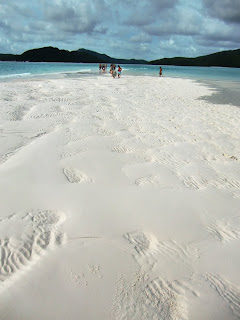
We were up at 6am to beat the other boats to Whitehaven beach. The beach is a wide arc with an inlet on one end, with sand so white your eyes wince and squint in the glare. It's 99.9% silica and they say some of it was used to make the lens on NASA's Hubble telescope (although we're sure we've heard this before, elsewhere). The sea is also an astounding spectrum of turquoise, and in the shallows we watched rays and baby lemon sharks play.

Back on the boat, Med and I headed out on a dive with three others and swam around the vibrant coral and fish. The highlights were lion fish and a lizard fish - sadly no turtles or sharks. The visability was deteriorating by the afternoon and so we didn't do any more dives, including what would have been my first night dive.

Still, we snorkelled and relaxed with new friends in the sunshine, enjoying our slice of luxury at sea.

Friday, 10 February 2012

Danger, dingoes and digging a hole

We had booked the self-drive, tag along 4WD safari to Fraser Island - apparently they are reluctant to let backpackers off on their own in a monster truck on Fraser, the world's largest sand island...I can't imagine why.

Before we were allowed to go we were made to watch a cheesy video that basically reassured you that you will die on Fraser Island. My second favourite piece of advice was the bit where they told you not to sleep in the road. Ok, the road is mainly just along the beach and I've met some stupid backpackers in my time, but still? But my favourite part of the video by far was the 'What to do if a dingo comes near you' section.


So, as the rain poured, we split up into four vehicles and headed for the ferry to take us over to this island of sand and danger (apparently). Riding and driving the 4WD over uneven beach and sand track was so much fun, we bumped, jiggled and flew our way around the island as we got to know our group.The actors, with very straight faces, froze, crossed their arms over their chest and did a kind of moonwalk backwards. I jest, but I did have two dingoes cross my path and yes, I did clap my hands across me and moonwalk backwards, a la Michael Jackson. You don't mess with dingoes.

After pitching our tents, Wayne led us to Lake McKenzie in the middle of the island, the largest lake on Fraser where we got to splash around and do some sunbaking in the first bit of sunshine we had seen for days. After a long, sweaty morning of tackling potholed dirt tracks in a 4×4 with little suspension, it was heaven.

With its fine, white sand, shimmering, green water and its wonderfully remote location in the centre of a desert island, it was well worth the whiplash and sore bottoms inflicted on the way.

Dinner was a mass cook-up and I channeled my bossiness along with a few of the other girls to whip up a stir fry for everyone. Most groups divide the cooking up into four groups, but we decided to cook on four gas stoves for 30 people. I'll be adding that to my CV!

Our campsite was tucked behind a small sand dune only metres from the sea. We had nothing but a tent, a tarp and some cooking gear. Med and I are used to this, but it was funny to see people go the loo in groups, shrieking at the dark and the chance of snakes and dingoes. If you needed a number two, you had to grab the shovel and head off to dig a big hole. It's amazing how quickly you get to know people when you're discussing poo-hole digging methods after less than a day together!

The next morning Wayne, our stout and friendly guide, woke us up at 6.45am and people appeared from their tents in various stages of disarray after drinking too much goon the night before. Wayne just chuckled, he had been on the Bundaberg and Coke himself and had the energy of a five year old.

We headed along the beach, dodging the waves (although often failing and getting a face full of saltwater) and trying to avoid the obstacles of people, dead trees and other unidentified debris. Fraser really is unusual and arrestingly beautiful with its surging sea, flat white sand and lush rainforest. In fact, it's the only place in the world where rainforest grows on sand - it's as strange as it sounds.


We passed some burnt orange, sandy pinnacles perched right along the beach and we went for a wade in Eli Creek, where some of the runoff water from Fraser makes its way over a riverbed, through a creek and into the sea. Then it was on to see a rusty old cruiseliner, Maheno, that had been shipwrecked on the beach a long time ago, which no one had every bothered to move. It was built in 1905, was only second in size to the Titanic and somehow, despite being wrecked for more than 70 years, still had patches of timber left on its umber skeleton.

Next it was on to the Champagne pools, where huge waves crash over the coast and fizz like gallons of champagne into the cracks in the rock pools. This was the only place we were allowed to step foot in the sea, something our danger video had informed us. They tell tourists that the sea is infested with jellyfish and sharks so you can't swim here, but mainly it's the strong rips and currents that will whip you out to sea before you can shout "dingo!" So, we got none of the benefits and all of the disadvantages of our seaside location – salty skin, frizzy hair, crusty sunglasses and sand just about everywhere.

After an exhilirating splash about, we climbed Indian Head where the headland stops abruptly and the shark and killer jellyfish-infested water begins. It's from this height that you really appreciate the wonder of Fraser for the first time; from here you can see the undulating sand dunes interspered with the rainforest.

Tonight we cooked 30 steak dinners, and then danced the night away in the sand.

The next morning, at the end of a long trek through a rainforest and across deep sand dunes, we found Lake Wabby hiding in a hollow between one towering dune and hundreds of thriving trees. Exhausted, parched and covered in a gritty layer of sand and salt, we ripped off our clothes and hurled ourselves down the dune and face-flat into the ice cold water. It was so refreshing we didn't care that the rain had returned and was soaking our only remaining clean clothes.

After a chip buttie, it was back to the mainland, but it would be another five hours before Med and I could shower and put on dry clothes: we had a bus to catch.

Tuesday, 7 February 2012

Australia gets crowded

Some stats for you. Much of Australia is impossibly flat, brown and empty and it is far and away the most thinly peopled nation. At home, the average population density is 660 people per square mile, and the world average is 117. By contrast, the Australian average is 2.8 per square mile. But this is wildly skewed because Australians live in a few clustered spots along the coast and leave the rest of the country mostly undisturbed.

In fact, around 80% of Australians live on the strip of land from Melbourne to Cairns. This is a very different part of Australia, and we'd left it until last. And boy, was it busy!

We had heard that 7,000 backpackers were on the move from Sydney, going north. We, being used to 'winging it' when it came to travelling, hadn't booked any buses or accommodation and we soon realised there was nowhere to sleep in Byron Bay. Thankfully, we had looked into this before we left Sydney so made a brief detour to Port Macquarie, where we bid farewell to George.
I won't bore you with the details, but let's just say there's plenty of accommodation left in Port Macquarie as there's not much going down in "the Port". Still, we made some good friends and rediscovered goon while watching kids karaoke. Oh, and there was a very cute koala hospital.

When we did eventually get to Byron, it was heaving with 'the beautiful people'. And I mean by that the biggest bunch of posers in Australia, per square mile. Still, the beautiful people had chosen a beautiful beach to work on their mahogany tans and we enjoyed the ripple of sea and human traffic from afar. After almost a week in Sydney, a bit of pure laziness did us the world of good. We rented bikes to explore and walked to the most easterly point of Australia, we'd already done the most southerly and almost the most westerly.
Then it was on to Brisbane.......sorry, almost fell asleep there for a second, it was that boring! I'm sure I'm doing it a huge disservice, but Brisbane didn't thrill me at all.

We quickly moved onto Rainbow Beach, where we could catch the boat to the well-trodden Fraser Island.
Rainbow Beach was an apt name for the town, minus the 'bow'. It rained steadily for two days, the worst we'd had in Australia. Let me tell you, a very small coastal town in Australia is not a fun place to be if it rains, there was nothing to do but drink tea, Skype and catch up on world news via the internet.

Wednesday, 1 February 2012

The Blue Mountains

Australian place names – at least those that don’t come from Aboriginal words – have a habit of being obviously, even brutally descriptive. See a big hill somewhere, and the chances are that it’ll be called ‘Big Hill’.

The Blue Mountains are no exception to this rule: they are indeed very blue. You can’t actually smell the sweet scent of eucalyptus when you’re up in the mountains but the blue haze for as far as you can see is your first indication that the forests, north of Sydney, contain such a high density of eucalyptus trees that the air is blue with tiny droplets of eucalyptus oil, rising from the trees.

Ok, so I'm told they're not actually mountains, but uplifted plateaus with vast forested canyons below. No bother, they're still blue, you can't argue with that.

This wasn't the Australian wilderness I had pictured before arriving here, I'd imaged miles and miles of sun-baked, red dirt leading off into the sizzling horizon. For the most part, I was right, but the Blue Mountains offers a whole different kind of wilderness.

Med and I were joined by George and his friend Kev, who has lived in Sydney for a year and has never seen a kangaroo (sorry Kev, if you're reading). We pulled up on the slow, lurching train from Sydney to Katoomba on a Friday afternoon, into the mist. It was freezing, and we were ill-prepared. And so we did what any hardy trekkers do in this sort of weather...we went to the pub.

The Blue Mountains are vast and were once the scene of many ill-fated expeditions by the British as they tried to cross them to see what lay on the other side. To give you an idea of their hugeness, in 1994, some botanist went out for a walk and stumbled on a species of tree long presumed to be extinct. They were Wollemi pines, stout and imposing trees up to 130 feet tall and ten feet round.

We set out early the next morning in sunshine and headed to Echo Point for a view of the Three Sisters, an impressive rock formation with three peaks. The views from the many lookouts were breathtaking, with a rich blue haze reaching right into the distance.

As the bus loads of tourists were herded in, we escaped by hiking down through the canyon for the next few hours, plunging deeper and deeper into the depths of the Blue Mountains and hearing nothing but our own echoes. We then hiked upwards for a dizzyingly spectacular perspective from the Ruined Castle. We nearly missed it, stopping about 100metres shy of it to climb a rock and telling another group of tourists that yes, this was the Ruined Castle. Oops.

Thankfully, we saw more hikers climbing higher and stumbled across a huge rock structure (nothing really like a castle but good enough to sing "I'm the king of the castle!" from). After walking around it a few times, we found a route to clamber up to the very top onto a rock just big enough to fit us all on. And, boy, was it worth it! We were rewarded with a 360 view of the Blue Mountains - it was pure exhilaration to be this high up and surrounded by such an enormous landscape. Never mind being king of the castle, we felt like we were kings of the world at that moment!

We hiked back, returning tired and dirty nearly 9 hours after we set out. We didn't stop there, the following morning we went out for another 3 hour hike to the Katoomba falls and experienced the Blue Mountains as the mist rolled in, white against blue.