Sunday, 11 March 2012

Sounds, seals and sea kayaking

After a rain-washed visit to Kaikoura, we headed to the far north east of the south island, to Marlborough Sounds. Here lies 1,500kms of breathtaking coast - one fifth of New Zealand’s total coastline - a maze of inlets, islands, headlands, peaks, beaches and vast expanses of water known as 'sounds'.

We drove the wiggly, stomach-tightening drive from Picton to the meandering Queen Charlotte Track, which we would spend the next few days dipping into. The whole track is 71kms, stretching from shoreline to ridgeline, exploring the hidden bays and coves of the Marlborough Sounds.

We made three tramps over three days, walking through lush, coastal forest to viewpoints overlooking Queen Charlotte and Kenepuru Sounds. To celebrate, we went for a dip in the sounds in the evening. Almost as good as a shower.

Just as we left Marlborough, the gathering clouds exploded overhead and rainfall erupted. After killing some time in the library and supermarket, we were campervan-bound for most of the day and night. Cheese sandwiches leave a lot to be desired as an evening meal, especially as we had already eaten them for lunch (we hoped the different flavour of pickle would make all the difference - it didn't).

We cowered in the middle of an isolated Lord of the Rings forest (known as 'Chetwood Forest' in the films) and hoped we wouldn't be floating down a newly-formed river when we woke up the next morning.

We awoke to sunshine and came out of our cheese-sandwich hibernation, glad to stretch our legs again with a wet walk to Harwoods hole - a 357m-deep sink hole.

The next day, with blue skies ahead, we were in Manauha to start our sea-kayaking adventure along the coast of the Abel Tasman National Park. We were going at it alone, but had a briefing from the kayak company, teaching us how to paddle, how to put the rudder down and use the foot pedals to work it, how to attach the spray skirt to form a tight lid between our waists and the boat’s opening, and — most important — how to detach the skirt if we capsize so we can swim free.

We should remember to face waves head on, not sideways, and if a wave hits the kayak parallel instead of perpendicular, then lean into it. We went over this last part about five times - anyone would think we were sailing to Australia (perhaps we would be, had they not been so thorough).

We packed all our gear into dry bags (mostly, I mean bin bags), including the tent we had hired, and soon we were on the beach, ready to launch. The water was a serene turquoise - so the chances of us needing the emergency procedures were low - and we set sail in the sunshine.

The Abel Tasman National Park (named after the mid-17th-century explorer who was the first European to site New Zealand, and Tasmania, funny that) crowns the top of the South Island with lush green mountain-sides that sprout tree ferns everywhere. The coastline curves out and in around points and bays, protruding like gnarled knuckles on a fist, and several islands with seal colonies rise up in rocky humps.

We got into our kayaking rhythm, feeling the muscles in our arms slowly getting used to this new exertion. In front of us stretched the aquamarine color of the water, white beach coves and cliffs with rope-like, black vines that hung and tangle around the shafts of giant ferns (called mamaku).

Singing British songstress Adele's back catalogue, we circumnavigated Adele Island and saw our first seal - a big fat one who was having a good scratch, indifferent to his audience.

There are seals all along the coast, and we spotted some tiny seal pups nestling up to mum on the rocks. The older infants played in the water, lying on their backs and flapping their tales in the air as if to poke fun at us.

We spent the day pulling into different bays for a swim, and finally docked up at Anchorage bay to set up camp behind the beach, where hundreds of blue starfish had been washed up in the rainstorm.

That evening, we met a great group of people (French, German, Israeli, American) and went to explore a cave alight like the night's sky with tiny glow worms. Then the stars came out in their thousands and we were unable to take our eyes off them.

After a cold night's sleep in the tent, we were back out on the water to warm up our stiff shoulders. We explored the lagoons along this stretch of coast, calm inlets that in just a couple of hours would be completely empty and dry because of the dramatic ebb and flow of the tides.

We pulled up on a very special beach for lunch: Medland's beach. It is named after the roguish Vernon Arnold Medland (known as 'Meddy) who lived here and refused to leave the island when instructed to by the authorities. In protest (he liked more than the odd tipple), we're told he blew up his house. I'm sure there's more to this story, but it goes without saying old 'Meddy' was a bit of a character.

After more seal-spotting and sun-lounging, we were picked up by a speedboat to take us back to Manauha. We gripped on tightly as it cut through the waves, rising up and slamming down with a force that sprayed water over the sides and sent shockwaves through our tired bodies.

Tuesday, 6 March 2012

The art of camping

After a few weeks living in a basic campervan, I now feel we can count ourselves as seasoned campers. We have perfected the art of cooking on both a tight budget and a single-ringed gas stove; we can sniff out a free campsite and spot a drinking water tap a mile off; and we don't think twice about putting on woolly socks with our flip flops to fend off the sand flies and evening chill.

Our days start by putting away the bed (stacking up the three foam mattresses and folding the duvet), putting on the clothes from the day before (why put on fresh clothes if you aren't clean?!) and then making breakfast. We sit on our fold-out camping chairs in the dewy grass, often surrounded by trees and mountains, miles away from anywhere. Then it's back on the gravel road to hit the main road and start our day of activities, filling up on petrol, water and food along the way.

There are no showers at the Department of Conservation (DOC) campsites, just a vault toilet, sometimes very clean, often not. And there's flies, lots of flies. I've learned that holding your breath to block out the smell only works if you are quick enough; a head torch should be used carefully as, really, you don't want to see too much; and hand sanitiser is a gift from the gods.

On a slightly different note, I've also learned that red wine makes you forget that this is the fourth veggie chilly you've eaten this week; sand flies and mosquitoes will find their way through the smallest gap; and you can never read too many books in a week.

Camping can be quite a lonely affair, especially in the wilds of New Zealand. However, we do get to meet some great people in the busier campsites, from all walks of life. One night when camping by a river, we had finished dinner and were onto our second glass of red, when a woman starts yelling for help. We jumped up and soon saw what the problem was: from where we stood it looked like their caravan was going up in flames.
Med runs over while I run round the campsite, shouting for a fire extinguisher.

Soon, most people are out of their vans or tents and gathering to watch. It turns out their ancient gas lamp had set on fire in the woman's hands, inside the caravan, but luckily she had managed to throw it out. They were very lucky as the flames that shot up into the sky managed to miss the car and caravan by a whisker.

We all watched as it burnt out; people from all across the world coming together to stare at the demise of a gas cylinder, in a field, miles from the nearest town, as the stars came out in the clear night's sky.

Saturday, 3 March 2012

The world's steepest street and rarest penguin

Feeling fully initiated into Kiwi culture after Orepuki, we trundled further south to Bluff (and it is a bluff, mascarading as the southern most point of NZ) and then to the true, most southerly tip of NZ, Slope Point.

Contrary to previous blog posts, we are not addicted to visiting the furthest extremities of countries, but there was something very appealing about knowing that the next large mass of land from where we stood was the Antarctic.

It was a 20 minute walk across farmland to a stubby beacon, and an even stubbier signpost (for our compulsory photograph), where we stood atop a windswept spur of rock with views up and down the wild coast. This also marked the sight of the most southern land Med and I have ever stepped foot on - maybe we should erect our own sign too.

We were now in the Catlins territory - a combination of lush farmland, thick, native forests and lonely, rugged bays. The sunshine soon disappeared, leaving us in the face of a grey, whipping Antarctic southerly, biting at my fingers and "jandal" (the Kiwi word for flip flops)-exposed toes.

Layering up in hoodies and jeans, grateful we had lugged them around in our backpacks all this time, we watched furl seals and sea lions laze along the coastline and walked through rich, damp forests, spotting red and white-spotted toadstools straight out of a storybook.

The sun did eventually come out when we reached Curio Bay, where fossilised, Jurassic-aged trees are visible at low tide. We got a close look at the solid, petrified wood and then, to our surprise, three of the world's rarest penguins.

The yellow-eyed penguins usually only come out at sunset, but there they were, drying themselves off in the midday sun. We watched as one of them waddled his way towards the water, across the petrified forest, and launched himself into the sea to chase after supper.

Hot on the heels of the world's rarest penguin, we then visited Dunedin (the name comes from Dùn Èideann - the Scottish Gaelic name for Edinburgh - and it's trying with all it's might to be just like it) to walk up the world's steepest street: Barlow Street. It was very steep. I'm sure the residents have killer calf muscles.

In a week of the unique and downright unusual, we went to gawp at the Moeraki Boulders - a group of unusually large and spherical stone balls lying along a stretch of Koekohe Beach on the wave cut Otago coast.

According to the sign, the Moeraki Boulders are concretions created by the cementation of mudstone, from which they have been exhumed by coastal erosion. So in lay-mans terms (or rather, how Med explained it to me), they are giant, rock pearls, popped out onto the beach because the sea has worn away the cliffs.

As we moved inland again, we rediscovered the cloud-less blue of the Kiwi summer sky. Eating sultana porridge out of a pan on the morning shore of Lake Tekapo has to beat breakfast even in the finest of hotels.

Under a canopy of sunshine and clear skies, Lake Tekapo is the most astonishing blue colour I have ever seen. The glacial flour from the rocks make it look so clear and inviting, perfectly reflecting the the huge hills and snowy peaks surrounding it.

We walked up a steep, alpine track to the summit of Mount John for a 360 view of the landscape below. Mount Cook and Mount Tasman casually peep over the top of the mountains in the forefront on one side, and the many lakes are blisteringly bright in the midday sun.

New Zealand is endlessly beautiful.


Thursday, 1 March 2012

Home, Sweet, Campervan

And so, it was back to being backpackers once more, in a town that is bursting at the seems with backpackers. People come to bungy jump, water ski, sky dive, ski and snowboard (in winter, sure), hike, mountain bike and more. Queenstown has an adrenalin-fueled atmosphere and you feel the buzz just walking around it's busy streets.

After hiking up steep tracks for lake and mountain views, breathing in the clean, fresh oxygen from the thick foliage all around and greedily devouring more Fergburgers, we picked up our Wicked campervan and bid beautiful Queenstown goodbye.

Having a set of wheels again - be they a tad clunky and exceptionally "well-loved" - reminded us of what real freedom felt like. In a campervan, every hour or every day is your own. There are no lost minutes zoning out in front of a television, no time waiting for a someone to finish in the shower (there are none) and no internet access offering hours of soon-forgotten entertainment.

As we cruised along in our old Toyota Estima, windows down, listening to colourful local radio, we were reminded that, like Australia, real beauty lies firmly outside of towns and cities. Queenstown is set in the most spectacular location, up in the Southern Alps, amidst imposing, snow-capped mountains, gushing rivers and a seemingly endless string of lakes.

We headed to Glenorchy, at the far west edge of Lake Wakatipu, where we camped out on the edge of the water, surrounded by mountain ranges on all sides. Our camper already felt like home: we had decked it out with a duvet, blankets, pillows, kitchen bits and, most importantly, a food cupboard. My thrifty gene had also come in handy: we had tea (English breakfast, Ceylon, Earl Grey, Chamomile and Green), coffee and hot chocolate courtesy of the hotels we had enjoyed with Med's parents.

We had heard the word "tramping" murmured in the past week or so. As much as I wanted to believe this was some kind of off-the-wall, very un-politically correct Kiwi past time (I wouldn't put it past them!) where people hoik penniless rogues off the streets and lock them up/burn them at the stake, this was thankfully not the case. Tramping is the Kiwi word for hiking, and "tramps" are as firmly a part of Kiwi-culture as the cauliflower ear.

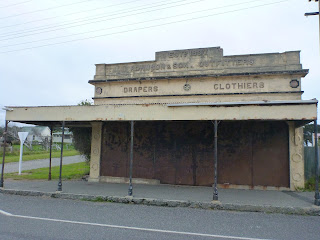
The next day, we took part in a little tramping ourselves, in the foothills of the mountains, before heading south. A brief chat to a fellow camper and an act of fate brought us to a place called Orepuki in the late afternoon. I'm sure this town once had character, charm and perhaps even people. Today, most of the houses are boarded up and all commercial buildings, bar one, have been derelict for years.

We found the one, resilient place still open for business: the Orepuki Tavern. We were lured in with the promise of a free campsite in their back garden, with a few mangy looking sheep and one, stump-legged pony. Ah freedom, there's nothing quite like it.

I was volunteered by Med to go into the tavern to enquire about the camping. This would be one of many times when Med used his new, ever-fuzzing facial hair as a reason why I should do something to "give a better impression".

So off I trot, pushing the smeared glass door of the tavern open. Seven pairs of eyes turned to watch my entrance. "Hi," I smiled meekly, met by silence. If there's one thing we've learned about the Kiwis, that while they're the most open, generous, good-humoured people you'll ever meet, there's no time wasted on pleasantries and how do you dos. "We saw the sign out the back and was wondering if we could park up our campervan, it's small and..." I trailed off as all seven pair of eyes continued to watch me. "Wait there," said the thick-set woman as she walked to the back of the bar.

Here, a man stood over two, large deep fat fryers - this was also the town's only restaurant. I was sad to see that we'd missed the 'Speed sheep sheering' contest the night before and we wouldn't be around for 'Sarah's Tarts and Vicars divorce party' "John, can these people park their van in the field?". John, eying me while he held a fozen bag of battered-something-or-other up, replied: "Yes, just tell'em they need to buy a $100 worth of beer though!" - his large gut shuddered as he chortled at his joke. The woman walks back over to me, all the while I'm aware of a old, toothless man staring at me as he propped up the bar, pleased with John's joke and nodding his balding head in agreement.

After signing my name, country and D.O.B in a book for no apparent reason but to amuse the locals, I made a run for the door and heard tinkers of laughter as I stepped outside.

As appealing as the deep-fried fancies on offer inside were, I cooked dinner and we decided we had better go in for a pint in return for our free pitch. To my surprise, the crowd inside had more than doubled by now and, despite it being 6.45pm on a Sunday night, everyone was in various states of drunkenness. We ordered two pints of DB, a local spin-off of VB that tasted just as bad, and walked across the threadbare carpet to find two stools around an old-fashioned barrel. As soon as we had sat and taken our first gulp, a ruddy-faced man in his 60s failed to walk in a straight line as he made his way over to our table.

In the conversation that ensured, we understood around 30% of what his inebriated words, we made for an uncomfortable 25 minutes. One part we did understand was when he pointed out his wife, the woman in her bike leathers, even more incoherent than her husband. We watched as she mistook the window for the door and her husband explained, "Shus pissed as uh fart". We drank up, thanked the drunk man for the 30% of information we could decipher and headed to the only reason anyone visits Orepuki: Gem Stone beach.

Sadly, we didn't knowingly find any of the precious gem stones that wash up on this shore all year round, but Orepuki was a shining treasure in it's own, sheep sheering, beer drinking way.

Wednesday, 29 February 2012

Half way home

It's been 6 months since we left home to go on our year-long adventure around the world; 6 months of the most amazing, humbling and unforgettable adventures; 6 months of experiencing the unique colours, landscapes, religion, food, climate, languages and people of this beautiful world that we live in.

I can't find any more words to truly describe our time so far, so I've picked a couple of photos from each country that I love, I hope you do too...

The 'new, beautiful' family - Pokhara, Nepal
Langtang trek, Nepal
Ha Long Bay, Vietnam
Bia Hoi corner, HCMC, Vietnam
Koh Kong trek, Cambodia
Angkor Wat, Cambodia
Langkawi, Malaysia
Sunset beach, Malaysia
Quobba blowhole, Western Australia
NYE, Sydney, Australia
Top of Franz Josef, New Zealand
Tongariro crossing, New Zealand

Saturday, 25 February 2012

From snowy mountains to icy lakes

We hopped over to the other side of the Alps, to catch a glimpse of New Zealand's highest peak: Mount Cook. Med's parents had a surprise in store for us - we would be flying over the summit in an helicopter!
As we approached, the faint, white peaks of Mount Cook (3,754m) and Mount Tasman (3,497m) popped into view in the distance. We skirted Lake Pukaki, a brilliantly blue lake at the foot of the mountain range and crept closer to the snow-capped wonders.

We watched as the propellers of our helicopter swung into motion and we were ushered towards the noise and chopping blades. The noise was deafening, just as I had imagined, so we quickly piled inside and grabbed our headphones to block out the din.

Soon, we were hovering above the ground, levitating in a smooth motion towards the mountain range. We had impressive views of the mountains on one side, and the flat plains below, leading to Pukaki lake.

We rose steadily into the embrace of the mountains, surrounded on all sides by thick, crevassed snow and sharp, rugged peaks. Below our feet, we could see Lake Tasman with mammoth chunks of ice that had once belonged to the Tasman glacier. The lake is 727m deep, so that's some icefall.

We continued to fly-by the glacial icefalls and snow crevasses, all the while enjoying simultaneous mountain and lake valley views. We landed at a snowy spot at the top of the Franz Josef glacier with the Fox Glacier on our left. Far down below we could see where we had stood the day before, peering up at this glacial beast.

After an impromptu snowball fight and a final gawk at the spectacular views, we took to the skies once more, and this time Audrey and I were in the front seats.

The ride back included even more impressive views of the frozen glaciers, bright blue lakes and the flat, mild plains below. We even did a 360 of the Fox Glacier.

I can’t imagine anything surpassing the thrill of zooming past the craggy glacial peaks, getting as close a look at the mammoth ice flow as any human can. We were on a high long after our feet touched the ground.

We then went for a cooling dip in the iridescent Lake Pukaki. The glacial feed to the lakes in this area gives them a distinctive, milky blue colour, created by glacial flour - the extremely finely ground rock particles from the glaciers.

We rounded off an incredible day in a cottage near Twizel, with nothing but farmland and mountains as far as the eye could see.


The next few days we stopped in the small town of Te Anau, a gateway to the mighty Milford Sound. With up to 9 metres of rain annually and around 200 days of rainfall a year, to have a sunny day in Milford sound is very rare and you are a very lucky tourist if you happen to be there on such a day. We were the lucky tourists that day as the skies were blue and the air was balmy.

But it didn't start that way. We woke to thick, grey cloud and the mountains that surrounded us were mostly invisible on our journey towards Milford. Wisps of fog swirled all around us and we had little hope of it clearing.

We drove through the Homer Tunnel, a 13km mountain road tunnel of exposed rock and minimal light. At the other side it was still mist, murk and lost mountains. Yet, the cloud cover thinned as we reached our destination and Milford Sound came into sharp focus.

Out of the fog came a parade of chiseled rock faces that plummeted into aquamarine water; waterfalls of every shape and size from long thin to thundering sheets; and steep cliffs where moss and evergreens cling to soil-less surfaces. As we boarded our boat, we could already sea the snow-capped peaks in the distance and the reflection in the water that has made Milford Sound famous around the world.

The sky was blue above us and, all of a sudden, that misty haze that had so bothered us 30 minutes before was a bonus, lingering in the background. adding mystery to the countless lumbering headlands that lay sleeping around the fjord. Because it is a fjord, not a sound - an early mistake that stuck. It's also named after Milford Haven, but the similarities with the Welsh town it's named after end there.

Milford Sound is beautiful. We sailed through towards the sea, spotting seal colonies playing on the rocks and waterfalls as tall as 50 storey buildings. The rocks hold precious gems and gold, but the natural wonder of the sound has proved more precious to New Zealand so it has been left, untouched. We could see signs of the treasures the rock holds, with patches of jade green and copper gold visible from the boat.

The waterfalls weren't in their full glory due to the unusual lack of rain in the past week, but we still got drenched as the boat hovered close to the edge. The clouds rolled in once more as we arrived back at the small harbour, the curtains closing on the breathtaking performance we had just enjoyed.

We headed for classic, Kiwi 'fush 'n' chups' to celebrate another good day.

The next day we headed south to Queenstown, where we stayed in a lovely hotel with views of the town's iconic lake, alpine forest and mountains. We tucked into our first Fergburger, an infamous, delicious burger served up in the adventure capital of the south island. It didn't disappoint!

Before we knew it, we were saying goodbye to Audrey and Julian. We couldn't thank them enough for our week full of treats and unforgettable adventures.

Thursday, 23 February 2012

The Medlands arrive in New Zealand

We had little time to dwell on Christchurch and it's empty centre, as we were picked up by Med's parents who had come out to meet us. It was family holiday, round two. And we were excited.

In a blur of plump sheep, gorgeous views and wispy clouds, the four of us drove to the township of Akaroa. Located on Banks Peninsular, south east of Christchurch, Akoroa sits on pretty harbour inside the eroded crater of a huge, extinct volcano.

As well as its hills and seacapes, Akoroa's charm is all borrowed from France, with French names, quaint shops and delicious food. So, the Medlands, coming from Guernsey, were quite at home!

After a couple of days of luxury, dinners out and wind-kissed walks along the coast, we headed onwards to explore the South Island, stopping off at the infamous Sheffield Pie shop for a warm and tasty treat.

We drove along the high mountain pass on the main divide of the Southern Alps to the picturesque, alpine village of Arthur's Pass, passing through broad plains, braided rivers, dramatic gorges and majestic mountains.

We settled into our cosy home-stay at Arthur's Pass, where the high, tussock-covered slopes are carpeted with wild herbs and alpine flowers and the Southern Alps form a dazzling backdrop of serrated ridges, roaring waterfalls and suspended snowfields.

Here, we met the park’s most infamous resident: the kea. This pesky alpine parrot has a very inquisitive nature and likes to fossick leftover picnic tit bits and strip rubber fittings off cars. Even the flowers outside the local restaurant had to be guarded from the mischief makers by chicken wire.

After a hearty, home-made breakfast in our home-stay, we headed to Franz Josef, stopping off pan for gold in a river, once the scene of a gold mining sight. We didn't find our fortune there, but we did come away with a few gold flecks and a small, smooth jade stone from the gold panning organised by the information centre. Well, gold beggars can't be choosers.

Franz Josef, our final stop of the day, is a town of 300 souls that takes care of the hundreds of thousands of tourists who descend upon the region to explore the nearby glaciers.

We pulled into our hotel, with the mist-laced mountains of the Southern Alps looming overhead. We had surely stepped into the movie-set for King Kong, an ethereal wonderland of lush ferns and heavy clouds. As we ate dinner that evening, the snowy peaks unveiled before us and we felt a twinge of excitement for the next day.

That evening, the boys took themselves off into the bush to spot the world's rarest kiwi in the wild (and happily it was mission accomplished, 20 mosquito bites later), while Audrey and I relaxed in the thermal spa - three, hot pools nestled in native rainforest and fed with pure, glacier water.

The next morning we walked across glacial rocks ('morrain', for you geographers out there) to the foot of the Franz Josef glacier. The Maori people know Franz Josef as Ka Roimata o Hine Hukatere (Tears of the Avalanche Girl). Legends tells of a girl losing her lover who fell from the peaks, and her flood of tears freezing into the glacier.

They must have been some tears, the glacier is huge and extends for 12km, fed by a 20-square-kilometre snowfield. We squinted up at the vast, frozen river leading from the tops of the mountains to the valley below, with its striking, natural ice sculptures and jagged peaks. The morning sun slowly crept across it's crests, throwing light on it's blue, frosty surface.