Showing posts with label Bolivia. Show all posts

Friday, 1 June 2012

Down in the jungle where nobody goes...

After a few days discovering the witches and prisoners of La Paz, we flew into Rurrenabaque (still Bolivia) in a glorified tin can of a plane owned by TAM, which is the Bolivian Military's commercial airline.

Please don't touch
Rurrenbaque took us back to the jungle towns of Asia: hair-curling humidity, mal-nourished dogs and stalls selling deet, ponchos and dubious bottles of suncream.

When people think Amazon, they think Brazil. I know we did. Yet the Amazon basin covers nine South American countries meaning you don’t have to take an expensive tour in Brazil to see it. Our backpacking budget breathed a sigh of relief.

Our luxury cabin
With the Aussies, Tess and Adrian, and the Kiwis, Simonne and Mike, we had booked a 3 day jungle/2 day pampas tour with Mashaquipe tours. The pampas are the low, flat wetlands, teeming with caymans, dolphins, birds, monkeys and more.

It was jungle first, and so we took a well-worn wooden boat to a cooperative jungle camp organised by indigenous people of the Tuichi River area.
Following in the footsteps of pumas

It was jungle heaven: spacious, scented wooden huts, lazy hammocks and butterflies providing decoration across the camp floor.

Our guide, Billy, was a walking encyclopaedia of the jungle. We followed tracks and looked and listened for animals, stifling giggles when Billy did the most loud and amazing imitations of their calls. Sometimes, we actually heard the animals replying to him. Billy, the original Tarzan.

Hundreds of beautiful butterflies
We chased through the trees to find brown capuchin monkeys, listened to the raucous calls of the howler monkeys, saw poisonous frogs and beastly spiders on night walks, touched the mangled and spiked branches of ancient, gnarly trees, tracked a puma just ten minutes from camp and followed the footsteps of anteaters.

The jungle is so thick and lush that it's hard to spot animals without spending weeks in it's heart.

Then came survival fishing. After finding maggots inside sugar cane plants to catch small fish...and using the small fish to find the big fish...we waited for a bite. But none came.

Med gets peckish
Vultures and condors swooped and glided overhead, stretching out to their full 3 metre wingspan and wiggling their long fingers in the breeze. Yet still none came. Eventually Billy, our guide, caught three huge salmon in his net. We would not go hungry tonight.


We then spent a night on the jungle floor (quite literally - with just a roll mat and net), watching electric blue and red macaws at sunset from a lookout, eating an amazing feast by candle light with our ears swarmed by the sounds of the jungle - more alive than ever at night. Mosquitoes - 34, Sally - 0.

Double, jungle rainbow
After a testing night's sleep on the hard floor, we arose for a delicious breakfast of pancakes, dulce de leche, fried cheese, fruit salad and empañadas. The food was sensational at every meal time, even in the middle of the jungle on a single-ringed stove.

Before our raft started to sink
After more macaw spotting, we built a raft to take us back to the main camp. The building itself went quite swimmingly and we set off down the river. Then disaster struck: Mike and Billy stood on the same log at exactly the same time and it snapped, cleanly, in two.

Turtle tanning
At that same moment, Med dropped the paddle. We were, quite literally, up the creek without a paddle. Somehow we made it across rapids back to camp, and then jumped in the water for a swim as all our clothes were wet already from the half-sunken raft.

The next morning, we went by boat and car to Santa Rosa: the gateway to the Pampas. It was an eventful journey (I know no other kind in South America) involving us trying to tow trucks out of the thick mud, and failing, trying to fix someone's car, and failing, and watching a sloth move in a tree, and failing (because sloths don't move, I've seen it with my very own eyes).

Capybara and bird - best of friends
As we arrived to our river-side hostel, even before we got onto the boat we spotted some fresh water pink dolphins swimming around just ten feet or so away from us.

A red-bellied piranha (supper)
A long, thin boat with rickety seats and water pooling in the bottom was to be our transport for two days and soon enough we are floating along the muddy brown river, the sun beating down relentlessly on our shoulders, the river occasionally splashing us with a welcome spray of water.

On various river trips during the day, we got up close to an amazing amount of wildlife: tortoises sunning themselves on logs, birds of all shapes colours and sizes (egrets, herons, blue kingfishers, eagles and birds of paradise) skimming along the water or atop the trees, capybaras (giant, semi-aquatic guinea pigs - I joke not) and trees full of tiny yellow squirrel monkeys, black howler monkeys and brown capuchin monkeys.
Yellow squirrel monkey catching mosquitoes with his hands

Before sunset, we balanced in our boat on a laguna and held our fishing lines with lumps of meat on the end, shrieking at every tug and rejoicing when we caught something. We were piranha fishing - I had a unique technique that involved getting Tess and Simonne soaked and I nearly fell in when I pulled a big one into the boat where I sat.

Cayman lurking
At night we went cayman spotting, their beady eyes burning red by torch light near the riverbank. We came across a few babies in a nest too and our guide insisted it was perfectly fine to get out the boat and wade towards a group of three big caymans. When one disappeared, the girls made a quick dash back to the safety of the boat. We then turned off our torches and watched the fireflies sparkling in the trees.

Swimming with pink dolphins
The final day was my favourite of the five day trip: we went swimming with pink dolphins in the river. Perfectly safe, we were told, as the dolphins push away the sharp-toothed, blood thirsty caymans.

Once I had convinced myself I wasn't going to get eaten, it was a really special experience: dolphins big and small swimming close by, quite happy with human company. And noone lost any limbs.

Friday, 25 May 2012

On the highway to hell!

Death Road (El Camino de la Muerte in Spanish) near La Paz, Bolivia is described as the most dangerous road in the world. Prior to 2007, an average of 28 vehicles a year would fall off the cliff edges of this road, with drops of over 600m and the road as narrow as 3.2m.

Gearing up
A replacement has now been built, which has left the old road open for tourists to cycle down as well as a few local cars.

All this gear made me more nervous!
With around 15 cyclists have died doing this route (the most recent in May 2011 - a British guy), you'd think you'd have to be stark raving mad to pay money to live on the edge, quite literally.

This thought only sunk in whilst I was flying downhill on a mountain bike, slamming on both brakes while negotiating hair-pin bends and oncoming traffic. Panic struck when I realised that this was the easy tarmac section and we hadn’t even reached the "death" road.

Ready to go!
We started the day trip at 4700 m above sea level overlooking a crystal clear lake mirroring the snow-capped mountains. We watched as a group of locals made offerings to a Pachamama (Mother Earth) statue to guide them on their journey. I wondered if we should have brought something...

Our Bolivian guides at Vertigo Biking handed us our comprehensive protective gear including elbow and knee-pads, a full-head helmet and heavy-duty trousers and luminous orange jacket. Once geared up, I could hardly move as we each grabbed a double suspension mountain bike.

The first 63 km of cycling downhill on the tarmac road made me feel like a kid again. The icy-fresh air splashed my face while I stole glimpses of the snow-capped mountains and valley ahead.

After a snack break, dealing with permit formalities and a short drive, we hit the actual world's most dangerous road. And talk about timing, that's when the clouds hit; we had ten metres visibility and it was very wet!

The mist comes in at the top
My stomach flipped as our guide, Oscar, gave a second run down of riding protocol, most notable of which was the rule whereby if you´re cycling downhill and meet a vehicle on it´s way up, then you pass cliff-side, not mountainside (this happened to me!).

To ease us in, Oscar got me to do the "llama dance" with him, making our hands in the shape of llama heads and busting some moves. It made me feel calm, for about two minutes.

My entire body shuddered as we tackled the rough terrain, weary of the proximity between my tyres and the cliff’s edge.
This doesn't do the danger justice!
As I cycled past moss-covered wooden crosses and shrines, I had told myself that I was there to complete this and not for an adrenaline rush.

So, along with a few others I remained firmly at the back of the pack with the brakes applied 99% of the time! It was rocky, slippery and my left wrist (from an old injury) and hands were in agony before we'd even reached halfway. I was determined to finish it, though.

We cycled through rivers and under waterfalls, stopping at various intervals to check everyone was still with us. The view occasionally opened up to reveal the lush green, sheer drops that had taken so many people's lives.

The vigorous cycle route ends in the small village of Yolosa where we shed our protective layers, bid farewell to our mountain bikes and toasted each other with a local beer.

Oscar filled us in on the beer-fuelled bus journey back to La Paz on the recent incidents where tourists have fallen to their death. It made me realise that sometimes the cliché ’ignorance is bliss’ is best.

So the next time I wear my free T-shirt that says: ‘I’ve got what it takes to ride down the world’s most dangerous road’ I will take a moment to think of those who didn't make it, and value the incredible and gruelling experience of cycling through Bolivia’s rough yet beautiful landscape.

Tuesday, 22 May 2012

Sweet as Sucre

We planned a travelling timeout in colonial Sucre. Take a break; have an unpack -recharge our backpacking batteries ready for the next chapter of adventures.

A hat party
After we left the sky-high salt flats behind us, we headed for the slightly lower Sucre (2750m) which was a physical relief. We could breathe easy again and the uphill roads became less of an obstacle.

The nation of Bolivia was founded in Sucre and the "Declaration of Independence" was signed here. Even though Sucre is not the Bolivian capital anymore, it is still considered the constitutional capital and the Supreme Court is located here.

I fell in love straight away: the sunny weather, cobbled streets, terracotta roofs and white colonial buildings - it is just like Spain.

The medic's of Sucre protest
But, of course, we were still very much in Bolivia: women in voluminous skirts and long plaits serve fresh orange juice from street carts; young working children selling sweets or asking for 1 Boliviano off tourists; and absolutely everything being sold in and around the chaotic mercado central.

After having holes drilled through our bedroom wall and Med receiving an electric shock from a light-switch, we moved to the family-run guesthouse "La Dolce Vita" and it was flawless, with it's charming sun terrace and a courtyard. It's the little things in life I appreciate, like the cute, labelled pots to stand up the bags of milk Bolivia produces. We ate from the central market, which seemed to have Bolivia’s entire supply of fresh fruit and veg, because we certainly hadn’t seen any of it anywhere else.

For the first few days, we dropped our sightseeing momentum and just walked. Sucre is perfect for wandering around and exploring, the only problem is the narrow, cobbled streets get very crowded at lunchtime when everyone heads home to eat the main meal of the day with their family. Even the teenagers; it's a revelation.

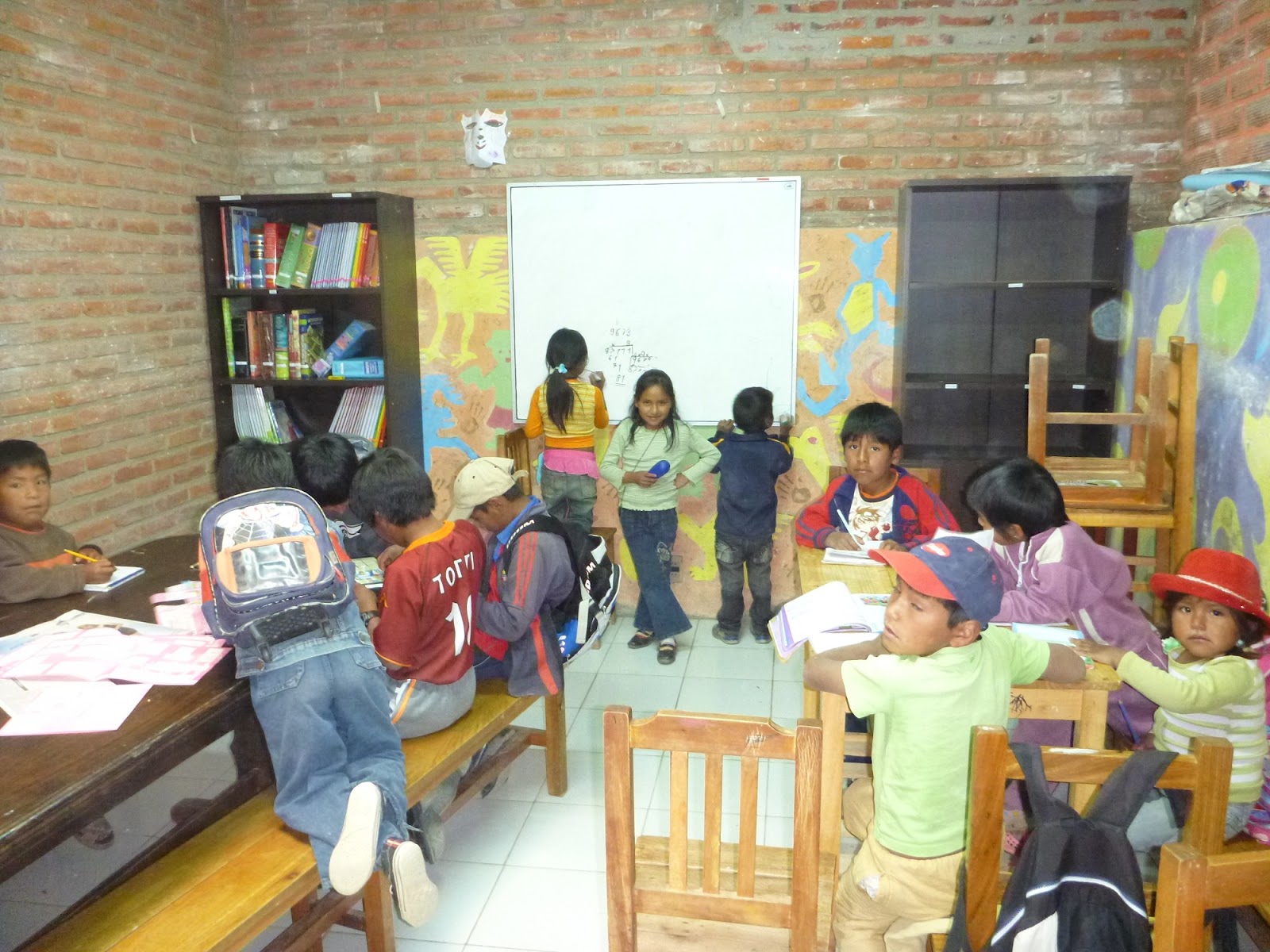
Med and I both enrolled into Sucre Spanish School. I wanted to brush up on what I had learnt and Med wanted to stop relying on me to get by. They also helped me to find afternoon volunteering at a community centre in rural Sucre. So I had a full working day for the first time in eight and a half months - it was exhausting!

Marisol and me
Charlotte (another volunteer) and I had to get a bus to the centre (made tricky by the constant transport and medic strikes while we were there). Buses in Sucre also defy all laws of physics in as much that they are built to take 30 people at the absolute maximum (including those lying on top of each other) but somehow manage to cram about 60 in and three bags of potatoes. It was fun, exchanging grins with creased-skinned, Quechuan ladies who were fascinated by our presence on the bus.

Volunteering itself was a challenge, both linguistically and organisationally. In the afternoons, the centre welcomes children from the surrounding, rural area to come in after school. We were left to it, almost running the centre as the women in charge locked themselves away in the office. For the first hour we had to help with their homework, the homework they wouldn't have time or space to do in their mostly-Quechuan homes.


My knowledge of long division and fractions is pretty rusty in English these days, so trying to do this in Spanish was as challenging as it was amusing. I usually helped out little Marisol, who didn't like doing her homework and needed one-on-one supervision, but handwriting and numbers were more manageable for me.

It was always a relief when the homework was done and the fun began! We played games outside on the basketball court overlooking the valley, and I tried teaching dancing to some of the older girls, who seemed more interested in copying sexy, music video dancing than anything else!

It was a challenge that I was sad to turn my back on as we left Sucre for La Paz. I miss their giggles, brown eyes, dusty skin and energy.

Monday, 21 May 2012

From sand to salt : Salar de Uyuni

Talking of cowboys in my last post, after hearing countless stories about the drunken cowboys who drive 4×4 tours through the desert to the Salar de Uyuni, the next day we were pleased to find that our driver for the next four days had a solid head on his shoulders. And a beaming, no-nonsense wife next to him to keep him in check and cook our food.

Lots of llamas
And so, after strapping our bags to the roof of our truck, Tess, Adrian, Med and I set off on our trip all the way from Tupiza to the salt flats with Segundeeno, our guide, and Porfidia, our cook and entertainment for the next few days.

On this first day, we were headed to the small village of San Antonio de Lipez (popn 250) via breathtaking landscape dotted with llamas. We had seen our fair share of cacti-pimpled desert over the last week but this really took the biscuit. Bright red, weather-beaten cliffs sat amiably among mounds of loose blue-grey shingle and tufts of parched, yellow grass.

Village children playing football
At every twist on the mountain road the plains became more and more beautiful throwing up even better, stretching vistas. The llamas were all different coloured and distinguished by the multicoloured pom poms and ribbons clipped to their pointed ears.

Muy frio in our homestay!
We arrived in the village where we were staying the night in someone's modest house. We watched children, layered in llama wool and gloves, play football in the forefront of a snowy mountain range that was catching the last of the day's sun. It was simple, authentic and lovely, despite the freezing temperatures at 4260metres.

We had limited electricity and an outside bathroom, and not even a fire to warm us up. So, after putting on all our clothes, we enjoyed our feast, listening to the songs of a shy local village boy who had come to earn a few Bolivianos. Money is scarce in these isolated, rural communities.

We woke up at 4am, still under the bright stars, moon-drenched mountains and in the bitter cold.

I couldn't feel my toes or fingers for the first hour or more as we made our way across the dusty, rubble track in the dark to San Antonio - an abandoned, ghost town that is thought to have been controlled by the Diablo (Devil).

Rub-a-dub-dub
As the sun burst over the mountains we entered the Eduardo Avaroa Parque Nacional, crossing frozen streams and bumping over rock-laden track - stopping for photographs and "el bano naturale"!

We drove through the gold mining settlement of Quetana Chico and onto the Polques aqua termales. It was freezing and we struggled in the wind, but we are hardened backpackers used to cold showers and a bit of dust so we stripped off and sprinted as fast as we could towards the pool.

Geysers and mud springs
Inside the hotspring it was absolutely divine just as long as we kept as much of ourselves as we could under the water. Still, when was the last time you took a hot bath at 4400m surrounded by mountains, desert and llamas?

After a brief stop at Laguna Verde and Laguna Blanco we headed through El Desierto de Dali - remiscent of the paintings of Salvador Dali and full of weird and wonderful petrified lava and onto the "Sol de Manana" - the geysers at 5000m.

It was colder than ever here and we felt a bit weak with the altitude, but it was great to stand among the plumes of sulphur.

Our accommodation that night was next to Lake Colarado, a huge red-coloured lake (because of the plankton and algae) home to hundreds of flamingos. Into bed after dinner with all our clothes on and extra blankets stolen from the other beds in the dorm.

Another early start, they were getting easier, to take us to the Desierto de Siloli to see a rock shaped like a tree and other petrified lava formations. We were now completely in desert, nearly 5,000m above sea level. Muy estrano.

We joined the laguna dots, visiting one after another to see more flamingos and watch them constantly snacking. And then on to a dust bowl of a settlement to see the tombs of the first inhabitants of the region, from pre-hispanic times. Nothing like a few explosed skeletons dressed in the rags they died in to give you the jitters.

One of many lagunas
That night we stayed on the cusp of the salt flats, in a hotel made completely of salts.

The walls, the furniture and even the beds were all made from solid blocks of sparkling salt. We crunched along the rock-salt floor to the salt-walled shower, then sat on my salt bed and plugged my camera into charge in the salt wall.

The next morning was what we had come for: Salar de Uyuni, the world's most famous salt flats. We drove across the water-logged part of the salt flats to watch sunrise in the middle of it - probably the best sunrise I have ever witnessed.

The salt hotel
The salt flats are indescribable, sucking all the colour out of the world and leaving just the vibrant blue of the sky and the dazzling white of the earth’s crust.

Everywhere we looked was white – just miles and miles of smooth, flat, sparkling white land joining the distant mountains that surrounded us.

Sunrise on the salt flats
As momentous as our first sighting of Salar de Uyuni was, every ounce of wonder and happiness had been hard earned in the cold and wind of the desert and mountains.

After a delicious breakfast of cake and cereals in the middle of nowhere, salt as far as the eye could see, we of course we made the obligatory stop so that we could take a hundred photographs that played with perspective. We had come prepared, bringing with us Godzilla himself and an almost-empty bottle of rum.