Friday, 23 September 2011

Poon Hill to Gandruk trek: 3 Brits, 2 Aussies and a crazy man

The vast majority of the Shangri-La countryside in Nepal is still inaccessible by road, hidden behind ridges and up steep valleys. These tracks are used by pilgrims, trekkers, traders and locals, and this paradise land, without wheels or engines, was where we were heading to next.

We decided to 'warm up' our legs (in preparation for a bigger trek to come) on a five day trek in the Annapurna region - looping from Naya Pul to Gorepani and then east to Gandruk. We were dreaming of seeing a panoramic sweep of Himalayan peaks - but it would prove to be almost as illusive as the rhino in Chitwan.

Med, Tom and I started the trek alone, without a guide or a porter. Despite an early setback of a
vast, still-tumbling landslide at the foot of the mountain range, the winding paths proved easy to follow and the locals were always friendly. Old men and women, with lined faces and gorgeous smiles, would waggle their fingers to show us the way and we soon felt a million miles away from the Nepal we had experienced so far.

The trek offers spectacular mountain scenery along
with charming villages inhabited by the Gurungs and Magars (two of the many ethnic groups of Nepal), dense rhododendron forests full of birds and deep, sub-tropical valleys, all set below the mighty Annapurna range.

On the way up, we passed small villages and settlements,
often getting a glimpse of people trying to eke out a living on small parcels of land. Men ploughed with oxen and, with shouts and guttural throat noises, encouraged the cumbersome beasts to turn on small stepped terraces the size of postage stamps; colourfully-clad women walked up and down with parcels to trade, often barefoot, pressing the soles of their feet against the rough track made from heavy slabs of rock that must have taken an unimaginable amount of time and energy to assemble up the steep faces of the landscape.

Yet, the most enduring image of the trek has to be that of porters, moving up the steep hillsides carrying enormous loads, heavier than their own body weight. With the thick strap of the conical wicker baskets tight against their foreheads, their backs bent under their burden, their feet clad often only in flip-flops, they moved slowly up the mountain, carrying bags for organised treks or supplies for isolated villages. Seeing this everyday, we didn't moan once about the comparatively small loads we carried.

We greeted everyone we met with "Namaste,” pressing our palms together at our heart for the customary, Nepali (and Indian) greeting. Twig-thin men with grizzled beards and red-rimmed watery eyes would look out from beneath their topis - the traditional headwear of Nepal that resembles a soft, crushed fez - and returned our greetings with broad, gap-toothed grins and
deep, lingering drawls of "Namaastaaeee."

We kept walking through the lush green, terraced valley, following the path of the river, climbing up steep steps until we had to rest to catch our breath and find a pump to replenish our bottles. Tea houses, perched precariously up the steep valley, provided a welcome break on the way - and of course a place to re-charge our trekking batteries with hearty helpings of Daal Bhaat (the Nepali staple meal of lentil soup, rice and curried vegetables - of which you are usually given two, or even three, enormous helpings in one sitting!) and hot chocolate.

Our first afternoon and evening was spent in the
quaint village of Ulleri, filled with friendly children who lined the streets waiting to 'high-five' us on arrival as if we'd just completed a marathon (well, almost). The tea lodges were almost flimsy, cobbled together with bits of plywood, but the showers were hot, the beds fairly comfortable and the food was tasty and laden with carbs.

After peeling off our boots and socks and washing away the day's layer of dirt and sweat, we sat outside with views of the surrounding mountains. A man carrying a large, chicken-filled coop on his back caught our eye. We wondered, "is there anything they can't carry up the mountain?"

Cards games, book reading and map studying are the staple, post-trek activities. And with the arrival of the black, night's sky, it's off to bed early by the light of one bare bulb (if you're lucky).

On the second day, after an early-morning start, we stumbled upon the crazy man of Ulleri, locked away in a wooden room on the main thoroughfare out of the village. Mountain whispers from the few trekkers we had encountered the day before told us he tried to shoot people in the village and has been imprisoned for five years, left without food. I looked into his dark, bewildered eyes and noticed his wild, dusty hair and half-believed the stories. It seemed impolite to ask the locals for the truth and we didn't wish to linger in his gaze any longer.

As we climbed further up the valley, we became more enclosed by thick jungle and steep, canyon walls. The second day was a fairly short climb up to reach the beautiful village of Gorepani, which stands at 2800 metres above sea level. Gorepani is the spring board from which to reach Poon Hill, an Himalaya view point that we were to summit early the next morning.

Gorepani brought us the pungent smell of drying mushrooms, a "bonza" pair of Aussies, Damo and Sarah, and our first western-style toilet of the trek - such luxury!

We awoke the next morning to drizzle and fog, but decided to carry out the ascent to Poon Hill regardless, which stands at 3210 metres. At the top, the sunrise promises views of two of the Himalayan giants, Dhaulagiri (8167 metres) and Annapurna I (8091 metres), along with a maze
of other white peaks.

But for us, there was no view, just a thick fog soup that dampened our faces and our spirits. So, I'll skirt around the pre-dawn climb, freezing temperatures and slippery steps we endured. I guess it would make us appreciate what was to follow all the more.

We bid farewell to our trusty companion, Tom, who had to
hotfoot it down the mountain to catch his flight home, and embarked upon a day's trek through the deepest river gorge in the world, wading through jungle with our Australian friends. The canopy of trees let through chinks of light but it was a unrelenting, damp day to our next stop:
Tadepani.

And here came our just deserts. After a murky day, the dense blanket of cloud started to dissolve, revealing celestial mountain crests that glowed in the light of the full moon. The peak of Machapuchare (6993 metres, known as the 'Fishtail' peak, which is forbidden to climb as it is regarded as holy - that night a local man pointed out the shape of the tiger god that resides within it) stuck out like a glowing white tooth in the sky, and later, Annapurna I (8091 metres, the tenth highest mountain in the world) revealed itself too - it seemed in touching distance from our lodge balcony. We had no idea they had been so close all this time, choosing this moment to rise out of the fog and gleam down on us.

The next day we made our way through dense, tangled jungle, filled with trees that had trunks covered with moss and plant matter. There were more leaches than before (Med and I someone survived, unbitten - the Aussies didn't fair quite so well), and we stumbled upon little maggots sprinkled on a huge section of the jungle floor. It was humid under the canopy, and we were relieved to arrive at beautiful Gandruk.

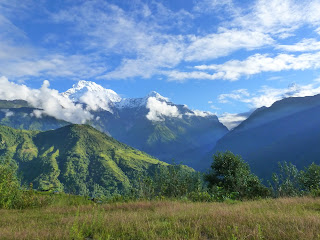
With a medieval vibe, Gandruk commands stunning, valley vistas over terraced rice paddies and tea plantations. We settled in for the afternoon, playing endless games of cards (which, truth be told, I usually lost). The next morning, the mountain range once again put on a stunning display for us. Huge snow-capped peaks - ethereal, supreme, heavenly - dominated the morning valley. Our smiles didn't do this view justice - it's a totally natural high that sends you soaring.

Spellbound, on our final day we descended back
down to Naya Pul, stopping for endless trails of mountain ponies, adorned in colourful costumes and heaving heavy loads up to the villages.

The trek was a physical challenge and we played witness to an ever-changing show of cloud and light, mist and mountain. The mountains were playing 'peak'-a-boo with us, but were even more spectacular for it.

Giddy with memories of the mountains, our hearts were now set on our next trek in the Langtang region, but our legs would need a few days of gentle recovery.

Tuesday, 20 September 2011

Seeking Shangri-La

Shangri-La, a fictional earthly paradise first described in the 1933 novel, Lost Horizon, by British author James Hilton. This mythical, Himalayan utopia - a permanently happy land, isolated from the outside world - is almost within reach in Nepal.

Draped along the greatest heights of the Himalaya, Nepal is where the ice-cold of the mountains meets the steamy heat of the Indian plains. It's a land of yaks and yetis, stupas and Sherpas and some of the best trekking on earth.

Thousands of backpackers and jet setters alike grab their hiking boots and make their pilgrimage to this rugged, land-locked country in search of this mystical kingdom.

Around 64% of the country is covered by mountains; one third of the total length of the Himalaya lies inside Nepal's borders and the country claims ten of the world's fourteen highest peaks.

Yet, Nepal is not just a mountain climbing, apple pie eating Shangri-La. It's also one of the poorest countries on earth. So, many visitors, drawn to Nepal by the promise of adventure, leave equally enchanted by the friendliness and openness of the Nepali people.

Friday, 16 September 2011

The 'New Beautiful' family

What truly made our time in Pokhara was stumbling across The New Beautiful Cafe, a modest, street-side restaurant that I miss dearly already. It is a must for anyone craving home comforts and the warmest family welcome in town.

The owner, Shambhu, had us at "hello", offering us discounts on the menu prices and grinning
broadly at us. And then the food they could cook, it was unbelievably good, dishes from all over the world, all made completely fresh to order and with such love and devotion. We were hooked.

Shambhu's gentle wife, Parbali, would welcome us by taking our hands and calling me "Sister". Her younger brother, Samip, spent hours beating the boys at Bagh-Chal (a brilliant game of goats and tigers on a grid). Then there were their two adorable children, Pranisha and Pranaish, who we played with. Pranaish, the little boy, kept coming back to me to play

with a set of small wheels that once belonged to a toy truck. So contented was he with this broken old thing; so giddy with excitement when I rolled them over to him, making "vroom vroom" noises.

On our last evening with them, we bought them all presents to thank them for their gorgeous hospitality. Wide-eyed, they thanked us endlessly for the gifts and insisted they treat us to breakfast before our long trip to Kathmandu.

At breakfast, they pushed mountain fridge magnets into our hands and gave us a little family photograph of themselves. Such beautiful and kind people, this is the Nepali way.

Pokhara: a naked man, a lightning boat and a snow-capped sunrise

After our time in Chitwan, which was scheduled to thrill, we were looking forward to slowing down the pace in Pokhara - one gateway to the Himalaya kingdom.

We immediately fell in love with the peaceful rippling of Phewa Lake (Nepal's second largest), the towering mountains that wrapped tightly around it and the horn-free streets of laid-back Lakeside.

"Perfect", we said, "just what we need." Anyone would think we had been on the road for months, not days, but we greedily indulged ourselves with some peace, quiet and home-cooked wonders.

And then came the naked man. After a hearty, rooftop meal with our new friend, Tom, we ambled back to our hotel, taking in the many shops and restaurants presenting their worldly goods, the giggling groups of children darting back and forth and the friendly dogs on the block meeting up, probably exchanging stories of finding tasty food titbits outside restaurants. Caught up in this state of mild distraction, I didn't notice the naked man until I'm stood just one metre away from him. The naked man of Pokhara (I'm sure he must be infamous by now) did not look at us, as we stood silently agog, he just carried on walking down the street, holding a piece of dirty cloth at his side (that could have been put to better use!). "Tarzan", a local guy threw at us and pointed, "he Tarzan."

We saw naked man three more times during our stay. Still naked, still carrying that same pie
ce of tatty cloth.

The next day, the three of us hired a rowing boat for an afternoon on the lake. The
sun was streaming down and the still water unveiled reflections of mountains as we sailed toward the Hindu Barahi temple, built on a small island in the lake. We spotted monkeys jumping through the thick jungle terrain on the far lakeside and let the screeching sounds of cicadas fill our ears as they sang their song to celebrate the heat of the day.

Lulled by the scene, it took us a while to notice the dark clouds rolling in, and we watched as waves began to crest on the lake, rocking our humble rowing boat as each one slapped against its wooden side. "No panic", we thought as we started to paddle back. And then came a great clap of thunder and lightning forked in the near distance - just a couple of miles away. So then the panic kicked in and, after a small setback for Tom while he put down his oar to reason with himself that we were the highest point on the lake, the boys rowed us to shore at speed, battling against the wind and waves that had crept up on us. Dry land had never felt so good!

Unruffled, the following day we were back on the water, to hawl ourselves up to the Peace Pagoda - a beautiful Buddhist stupa designed to provide a focus for people of all races and creeds, and to help unite them in their search for world peace.

While Nepal is overwhelmingly 85% Hindu, the areas bordering Tibet and specific parts of Kathmandu and Pokhara offer colourful glimpses into the rich Tibetan Buddhist culture. Many Tibetans fled their native land during the war in 1959, just ahead of the Chinese army, which destroyed thousands of monasteries and killed hundreds of thousands of monks as they advanced. Tibetan refugees have made Nepal their home, selling hand-strung beads and prayer wheels, introducing delicious momos into hundreds of restaurants and piping out the serene Buddhist mantra Om Mani Padme Hum from music stores in tourist areas. Despite their past turmoil, Tibetan's have hearts of gold, and the brilliant gold of the peace stupa glistened down on us as we took in the views of the lake, Pokhara and the mountains that enshrine it.

During our lakeside chill out, we also managed a pre-dawn taxi ride to the top of Sarangkot, a high green hill at the northern end of Phewa Lake that separates Pokhara from the Annapurna Himalaya range. We did not get off to a good start: rain was hurtling down on Pokhara, we were locked in our hotel and the taxi driver was 25 minutes late. But we were determined to see sunrise, and so we ascended in our rattling taxi, woken up by the aroma of a burning clutch. The
taxi could only take us so far, so we picked our way up the rocky path by the dim light, gasping for breath in our urgency to reach the summit for sunrise.

At the
top, there were still some clouds, but we could see the snowy peaks crisply and we watched as shades of orange, pink and purple filled the sky and reflected off the white-capped mountains. Beneath us, the river valley glistened a rich, dewy green, and a few low-hanging clouds clung on to the hill-tops. Just beautiful!

The perfect few days to prepare us for our first trek, Nepal style.

Thursday, 8 September 2011

Chasing rhinos

As quickly as we had been flung into the colourful consciousness of the city, we were bumping and bouncing our way out, from pothole to rubble, on the five hour tourist bus to Chitwan National Park. At this stage of our trip, we very much felt like tourists, not travellers, but we were hopeful that once we had done the 'guidebook greats', we could don the baggy trousers and head scarves and find our travelling mojo (updates on this transformation to follow).

Famous as one of the best places to stalk wildlife in Asia, and one of the last places to allow tourists to go on foot (at your own peril), Chitwan translates as 'heart of the jungle' and we had high hopes of spying on one-horned rhinos.

We were blessed with an animal-guru of a guide, friendly, round-faced Tilak, and a great group of people who were staying in our lodge of relaxed luxury just outside the park. We shared laughs, beers, banquets, mosquito bites and sunsets during our 3 days of safari seclusion - and we sweated in unison in the balmy heat of the Terai region of Nepal.

There are many ways you can enter the national park, each coming with a reasonable price tag and standard T&Cs: 'No animals guaranteed, ok!'. So you pay your fee in blind faith and hope for the best.

As it's the end of the monsoon season in Nepal, the grass in the park is up to 8 feet tall so the best, for us, was spotting the one-horned rhino. We could be spitting distance from a leopard or royal Bengal tiger and be totally oblivious. But for the portly rhino, there's no hiding that big bottom and we'd heard recent reports of spottings and chasings - we would take either!

And so, we started our adventure in the 932 sqkm of sal forest, water marshes and rippling elephant grassland in a narrow, wooden canoe. Greeted by a few basking crocs, kingfishers and wild deer, we sailed down the silty river with the taste of anticipation (and bug spray) on our lips. Mistaking a few buffalos for rhinos, and rustling trees for monkeys, we then took to the jungle on foot - a new, thrilling taste of fear as Tilak instructed us to run for our lives if we came across a charging rhino. No such luck though - a few more deer, some fat furry caterpillars and an unwelcome leech.

Following a quick diversion to the elephant breeding centre (not recommended for animal lovers), that evening we were jeeped to a local, Tharu village to watch a group of very agile local boys and men perform the traditional Tharu stick dance, spiced up with fire, a man dressed up as a very convincing woman and a giant, dancing peacock. At the end, the girls from our group, including myself, got up on the dusty, wooden stage to join in. It was fast and sweaty as our throbbing feet slapped on the hard floor, but the energy and excitement was infectious and we laughed and danced until it hurt! After a few high fives with the performers, we dragged sweat-drenched bodies home - buzzing with contentment. But still, we dreamed of rhinos.

4.30am and Tilak is pounding on our door - it was jeep safari time! We flew down the quiet roads to get to the park, watching the pink sunrise over the mountains in the distance. Keeping quiet along the track through the park, we saw lots of spotted deer and stags, shuffling wild boar and nimble monkeys - but the rhino hopes remained, like an absent guest at this wild party. Still, the sight of the snowy peaks of the Annapurna skyline as we drove out of the jungle was more than consolation - we went from dense forest to iced mountain views in seconds.

That afternoon it was elephant safari time, something I wasn't completely sure about - how happy could an elephant be with 300 kgs of human on its back? But I went with the jungle swing of things, and didn't want to miss out on the precious rhino spot. We sauntered through the jungle and marshland atop this incredibly powerful, and sadly, incredibly tame animal, and spotted lean samba deer, stags and a quick-footed barking deer. There was also the not so rare breed of noisy Chinese tourists who surely frightened off all the other wildlife with their bellowing calls of "Which country?!"to neighbouring elephant groups.

So, that was our chance over, no rhino. We had only seen the prints of a mother and baby. It was becoming as mythical a beast as the little-seen, Himalayan snow leopard.

At 5.30am on our last morning in Chitwan, I toyed with the idea of having a lie-in while Med and some of the others went out on Tilak's bird walk. But, never a person to miss out, I threw on some clothes and headed out still full of sleep - despite gulping down a coffee with three teaspoons of sugar. We squelched and slipped along the muddy river bank, noone really over-enthused but the sightings of herons and other avian sightings. And then came a call that jolted us all out of our sleep-starved state: "RHINO!" "RHINO!" COME!" - and we all scurry after Tilak to see if it's really true.

There, just 20 metres away on the other side of the river, was a enormous male rhino, cooling off in the water as he munched his way through kilos of breakfast - fresh, long grass. We took in the amazing view, grinning at each other, and then back at the rhino. At last! Tilak showed us, over and over again, our pathway to run should the rhino start to charge. But Mr.Rhino seemed happy enough in the water, watching us from time to time before continuing to chomp away with that powerful jaw of his. We even got the delight of his big bottom, all nobbly and notched like compacted pebbles on a beach.

So, we chased down our rhino, and thankfully he didn't chase us. Dhanyabad, Chitwan!

Wednesday, 7 September 2011

Pepsi and puja

Caught up in the enchanting whirlwind of Kathmandu, it's easy to forget the fabric of the country we're in. A 6am taxi ride to the bus station offered just the quiet exposure we needed to step back and see it, without keeping one eye peeled for motorbikes and street hawkers.

The first Europeans and Americans didn't enter Nepal until the 1950s, but now there are thousands of shops selling western food, clothes and shampoo. Religion is very much at the forefront of almost every Nepali person's life, but on the way home from giving puja to the gods, many can be found flogging singing bowls and necklaces to pale-faced tourists. Traditional motifs (including the swastika, still used in Buddhism and Hinduism as a symbol of good luck and refreshingly free from the corruption of those Nazis) are sprinkled with international football emblems and clothing brands. A mountain shack with a hole-in-the-ground toilet has a bottle of Harpic in the corner. Nepali families in their old, crumbling homes crowd around the latest T.V to watch American wrestling.

That morning, I watched a shoeless woman with her puja bowl amble past a large Pepsi advertisement, and right next to it sat an ageing man on his haunches, playing with a mobile phone. The capital city has none of the glossy, high-rise buildings and air-conditioned metropolis found in India's biggest cities, but there's certainly an aspiration for it as Nepal plants more roots in the international community.

For now, we're lucky enough to see it with much of its antiquity and historic charm - and can chuckle at the local 'Walmart' food stall and eccentric 'Hard Rock cafe'.

Thursday, 1 September 2011

Temples, tiger balm and tongba in Kathmandu

First stop on our trail: Nepal. Or more specifically, Kathmandu, which really isn't Nepal at all - rather its flamboyant and frenzied cousin knocking travellers, and wannabe trekkers, sideways.

After a whirlwind taxi journey that shook us out of our weary plane coma, we settled into our hotel with its rooftop garden and mountain views. As we are in the last month of the monsoon season in Nepal, the sky started to ink and heavy rain let rip on the city as we negotiated the 64 zips and clips on our brand new backpacks. The rain unveils a fresh, cooler city and we stepped outside.

Kathmandu is a feast for all our senses, pumping with traffic, people, and the occasional rabid dog. In the din of blaring horns (which, it's worth noting, don't compare in decibels or frequency to Indian horns), chiming cycle-rickshaws, revved-up engines, women, and even children, carrying impossibly heavy loads on their backs, tiger balm sellers and other retailers hawking their goods, we walked past shops selling just about everything, each adding their own flecks of colour to the vibrant paint pallet of Kathmandu.

Sharing beer and Tibetan momos (dumplings) on a rooftop in Thamel, we toasted our 12 month adventure as we looked out to the Swayambhunath temple and mountains beyond. Subhakamana!

The next day we headed for Durbar Square, the pulsing heart of the old town where the Nepali kings once ruled. Anchored with Hindu and Buddhist monasteries, standing side by side, it is a World Heritage Site that is treated as a busy market place, casual hang out and traffic thoroughfare - we took about five minutes to digest the scene.

Trying to shake off our would-be guides and trinket sellers, it soon dawned on us that something unusual was happening. Everywhere we looked there were hundreds, if not thousands, of women and young girls in luscious, red saris; men in traditional, checkered Nepali cloth hats; Sadhu holy men in orange and red robes with faces painted like African warriors - all flowing past us in a kaleidoscope of colour. We later learned it was Teej - Nepal's fasting festival for Hindu women.

Making our way through the heaving crowd of ruby red, with small pockets of dancing and drumming, we witnessed beautiful Nepali women, adorned with beads and sequins, queuing through the streets to give puja - praying for marital bliss, the well being of their husbands and
children and purification of their own body and soul.

We would occasionally stand on the edge of the crowd, overwhelmed, and let the whirl of colours and movement rush by, astonished to see rickshaws, handcarts, bicycles and even motorcycles forcing themselves through the scarlet throngs without touching a soul. We followed the queue out of the square and looked back in wonder at what we had just witnessed.

Welcome to Nepal!

The festival got us into the rhythm of the city and we drifted through the winding streets, encountering temples at every crossroad and chowk. We sheltered from monsoon rains atop the Swayambhunath temple and watched monkeys huddling together to keep dry; we headed to the wealthy district of Patan, once a fiercely independent state but now a quiet suburb of Kathmandu; we shared Tibetan food and tongba (a millet-based drink that is like Sake to the Japanese); we settled into Nepal and looked forward to the month that lies ahead of us.