Saturday, 15 October 2011

All the Huế to Hội An

We travelled south on the train to visit the cultural heart of Vietnam, Huế. Our expectations for the overnight journey were low and flashbacks from my India train travel made me a little anxious.

We opted for the hard sleeper, and had no idea what, or who, lay in wait in our 6-berth sleeper cabin. But, we were pleasantly surprised by the neatness of the carriage and the politeness of our 'roomies' for the night, and tucked ourselves in on our clean bunks, nodding off to the monotonous sound of the train rolling over the tracks.

We awoke in 'South Vietnam', as the country's divide is still apparent in the people. They were instantly friendlier (and would get increasingly friendly as we made our way to Saigon) and there was a less aggressive feel to the traffic, the commerce and the day-to-day interactions we took part in. We breathed a sigh of relief and settled into Huế.

Previously Huế was the capital of Vietnam and where the Nguyen dynasty chose to build their imperial palace on instructions from their feng shui experts at the time. Huế thrives on culture, is full of history and awash with tragic memories. With this tantalising concoction mixed with the general, Vietnamese desire for chaos, it's an interesting place to pass through and a welcome break on the arduous journey from Hanoi to Hội An.

Over the next two days we explored the citadel and took a lazy boat up the river to visit the monster tombs of the emperors - a chance to gaze at a world of riches, opulence and massive egos!

We had designated ourselves a 'rest day' to help us beat travelling fatigue, and it just so happened that the Rugby World Cup was on, twice. But then the sky burst. Rain gushed down, water pushed its way through the quiet streets of the city and, in just minutes, we were surrounded by flood water. There was nothing left to do but drink beer with new friends (one of which went to the same infant school as me in Cumbria - small world), watch rugby and spectate as people waded, cycled and motorbiked through the new, muddy river that blasted through the street outside.

Thankfully, in Vietnam, we are all millionaires (£29.90 = 1million Dong), so our many hours in the bar came to just £8. As the hours past, the flood water rose and we had to wade through the
knee-deep river to get back to our hotel, passing by a wriggling snake (that made me walk considerably faster).

We went from flash floods to a bus journey with a solvent-sniffing driver, all within 12 hours in Vietnam. C'est la vie in South East Asia!

But the beauty/chaos balance was restored upon arriving in Hội An, with the sun shining down on the crumbling, Spanish-style backstreets. We were treated to a fairytale light show for full moon, known as the 'Hội An Legendary Night'. Flickering candles, cupped in delicate paper cases, lined the streets by the river, incense perfume wafted through the people-filled streets and lanterns hung from every bridge and tree branch.

We watched as people sent the floating candles into the gentle flow of the river to be carried away under the bewitching light of the full moon.

To reach the 30km stretch of beach nearby, we cycled past paddy fields and palm-fringed waterways, by thatched homes and families sat doing their daily chores of washing, fixing, building and cooking. The people in the villages of Vietnam are truly self reliant—growing, killing, and cooking their own meals is a daily way of life. And yes, I must tell you, that one of the staples of their diet, particularly during celebrations, is dog.

Like me, I'm sure you're reading this with a scrunched up face as you imagine your neighbours' poodle being served up, à la carte. Many rural communities in Vietnam have dogs lying around outside, not pets but reared like their cows and pigs. We also heard stories of people's pets going missing (and yes, some dogs and cats are domestic pets, they even have collars), as dog can fetch a lot of money in one of the special, dog meat restaurants.

While this filled me with horror at first, I soon softened as I realised this was just a way of life and, in many cases, survival and was no different to the Vietnamese than the pigs they roasted and the cows they turned into phở bò. What's more, Vietnam is the first Asian country I have visited where the streets weren't roamed and ruled by mal-nourished, disease-ridden dogs.
Still, there was no way we'd knowingly eat dog!

Cycling to the beaches was a breezy insight into rural life. The 'local beach', An Bang, was our favourite, with warm sea and white sands disappearing into the hot haze of the midday sun.

It was hard to leave.

Wednesday, 12 October 2011

The power of 'Ten' in Ha Long Bay

Late one evening in Hanoi, we were told that, if we wanted to make it to Ha Long Bay, we had to leave at 8am the next morning. There was a storm brewing; the typhoon that had wreaked havoc in the Philippines was whirling its way across the South China Sea and would hit the east coast of Vietnam in three days.

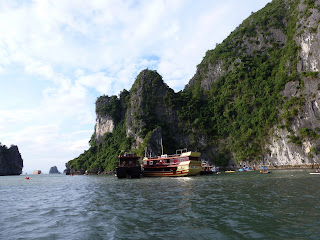
With a UNESCO World Heritage seal of approval, Ha Long Bay sits on the northern ridge of a limestone chain that sweeps up from the Gulf of Thailand and the Angthong National Marine Park. It’s not the cliffs themselves that make Ha Long Bay unique, but rather their sheer number. This huge bay is dotted with nearly 2,000 mostly uninhabited, jagged limestone islands, or karsts.

Meaning "dragon descending" and created over millions of years, local legend says that, when the Vietnamese were fighting Chinese invaders, the gods sent a family of dragons to help defend the land. This family of dragons began spitting out jewels and jade. These jewels turned into the islands and islets dotting the bay, linking together to form a great wall against the invaders. The people kept their land safe and formed what later became the country of Vietnam.

As much as I like this mythical story, it was in fact tectonic forces, not sparring dragons, that slowly thrust the limestone above the water-line. During this process, waves lapping against the stone carved out a number of huge, striking caves and grottos.

Early the next morning, the bus picked us up in Hanoi and zoomed us along, sadly with masses of other tourists, to the coast. In walks Ten into our lives - our terrible, yet terribly brilliant, tour guide, wearing his 4-stripe, 'Adidass' jacket.

The window scene morphed into a dramatic landscape of limestone pillar mountains, jutting vertically up from the water below. The karsts cluster into a mystical array of gray stone, verdant lushness, and boats - or junks - with colonial sails and rudders.

We got dropped at the dock along with the hordes of others. Tour guides scrambled in every direction leading their pack of sheep through the crowds. It was clear our guide was a live-wire from the very start, a hopeless ball of energy, constantly on two mobile phones, who confused us with his directions every step of the way.

After almost losing half our group, we boarded the Chinese-style junk, with its large dining room and upper deck with lounge chairs and potted plants, and started slowly cruising our way around the spiralling crags.

It was nice and quiet on the water —well, except for the dozens of other tourist junks that sailed around us. Oh, and one other thing that just seems impossible to escape in Vietnam. The hawkers. Even out in the calm, quiet waters, tiny women in tiny boats approached, encircled, and surrounded us on a few occasions.

“Excuse me. Please buy something from me.
Oreos? Ritz cracker? I have snack for you.”

These women were the most persistent salespeople I’d ever encountered, rowing with narrow oars well into the night.

Our boat had a great, international contingency and we tucked into a spread of seafood, vegetable and tofu that would become all too familiar over the next 48 hours as we had carbon copies of the buffet at every meal time.

After lunch we headed to the “Surprise cave” (Sung Sot cave) and once inside you can see why. There are three main caverns and each one gets larger than the next, dripping with weird and wonderful limestone formations. Stalactites speared downwards to meet stalagmites all around us.

Next came our abrupt introduction to the floating houses tied together in villages, many of which comprise of just flimsy, wooden structures bobbing up an down plastic-covered polystyrene.

Our boat driver smashed into one of the houses, snapping in half one of the supporting planks of wood. No problem, it would appear. The owners were getting money from us as we all took out their kayaks on the water.

Later, we sat on the top deck of the boat on loungers. The sunshine became softer and softer as it wrapped its rays around each pillar of limestone, bouncing off the moving water. Our boat dropped anchor for the night amidst the sea and stars. Silhouetted against the night sky were the forms of dozens of looming limestone cliffs—it was surreal, and a little chilly!

Ten tried to plan numerous "illegal parties" that night for "the big strong men" and the groups of girls. Despite his best efforts, and hundreds of suggestions that such a party should happen, there were no illegal parties, or at least none that Ten received an invite to.

The next morning we sailed to Cat Ba island, one of the largest islands in Ha Long Bay and home to a dense National Park. And there Ten really came into his own.

"Get on bus," he instructed us in his broken English and pointed. So a few of us start piling on this bus and find a seat.

Ten then looks around him, confused as to where we had gone. "What are you doing on the bus?!" he shouts. This kind of clown comedy ensued throughout the day, including a bemusing boat incident where Med and I nearly lost half our belongings. It was official, Ten was the worst tour guide in Halong Bay, perhaps even Vietnam. But our affections grew.

After a muddy trek to a viewpoint and a trip to Monkey Island, we sat down for dinner in our hotel on the island. In walks Ten, with a huge lump on his forehead and blood coming from his mouth. "What have you done there, Ten?" we ask. He makes a hand-slapping gesture and explains, in between slurping his lips, that he walked into the glass door downstairs. "Do you know what make it better?" he said to the Irish
girls, "I know something." He then gestures to his lip and makes a kissing noise with his swollen lip. You have to admire his persistence.

The next day we floated back to the harbor point as the wind started to come in, back into the scurry of everyone else and back into the racing bus. Ten, in a last bizarre move, gave everyone on the bus a heartfelt apology that he couldn't give us a better trip, before putting a few of the quieter members of the group on the spot by asking how they felt the trip went. All of us at the back of the bus cringed

We said goodbye to the wounded Ten as we arrived back in Hanoi. This time I was prepared for the full-on assault of the city and it seemed just a little tamer than when we left.

Saturday, 8 October 2011

Bia hơi and phở bò in Hanoi

With heartfelt memories of Nepal fresh in our thoughts, we weren't quite prepared for the humdinger that was Hanoi.

It’s a political capital city with a robust, hard-faced attitude that more resembles China than South East Asia. I can see why this city wouldn’t appeal to everyone - and it certainly didn't to Med.

In Hanoi, crossing the road became an extreme sport, with a ruthless, kinetic flow of traffic racing through the tree-lined city. Masses of motorbikes swarm through the tangled streets, choking the heart of the city and stealing our peace and quiet at every junction.

We, and other people we met, also felt that tourists weren't made to feel that welcome in the city - we even got shouted at to get out of a restaurant filled with locals before our bums had hit the seats.

Bemused, pining for Nepal, we wondered why we had come
to Vietnam.

We reminded ourselves we were here for more rough and ready travel, more chaotic, Asian experiences, to try new food and witness a new, raw and overwhelmingly unique culture. I tried to keep an open mind, despite the set-backs and the road-crossing drills.

Hawkers in conical hats ply their wares, many speaking French as well as Vietnamese; locals sip iced Vietnamese tea on the street or linger over coffee in Parisian-style cafés, watching life pass them by; ramshackle market stalls, selling anything from caged birds to coffins, line the grand, leafy boulevards.

If you strip back the gaudy commerce and block out the pulsating noise and traffic, Hanoi is quite beautiful - a city with a blend of Parisian grace and Asian pace.

We thanked the French for their wide, attractive pavements with quaint blue and white street signs, for the crusty baguettes we tucked into over breakfast and for the continental architecture dotted amongst the modern, Vietnamese structures. These moments of Paris make Hanoi special, as the smell of café au lait permeates street corners and lakes and parks dot the city - providing a romantic backdrop to the non-stop roar of the city.

But there are still incongruous moments of East meets West in Hanoi. Remnants of the wars are ever present, behind the bricks of museums and in the stony faces of some of the Vietnamese.

There was still a war of words in the Army Museum, with the enemy (be they French or American) painted as evil by the propaganda-laiden displays. We grimaced at the rusty bits of metal that had taken the lives of thousands of men and stood, suspended by horror, looking at the images of extreme deformities in the Agent Orange exhibition. A day on the historical trail left us slightly bewildered but helped us understand the country we were in a little more.

We joined the locals for meal times at the pavement food stations, perching precariously on tiny plastic chairs we've not sat upon since primary school - Med's knees were up to his ribcage.

We tucked into phở bò (noodle soup with beef and bean sprouts) and not so phở as I attempted to ask for the vegetarian option, as the sight of the raw meat left out to bake in the day's heat sent my stomach churning. But this was lost in translation as most of the Vietnamese don't speak English and couldn't understand our attempts at their tonal language, so I sucked it up, and swallowed the lumps of chicken fat that mysteriously appeared in my hot bowl of phở. Still, it's only 20,000dong (about 60p) for a big bowl - we weren't complaining.

And then we'd move to some even smaller plastic chairs that spilled out into the road to enjoy bia hơi, a locally-brewed, fresh beer that is served for 13p a glass on almost every street in Hanoi. It is brewed daily and delivered to street vendors in plastic bottles and jugs. Sitting with new friends in the street, watching the lights of the traffic stream past us, we decided Vietnam was going to be a great adventure after all.

Wednesday, 28 September 2011

A day of temples: Pashupatinath and Bodhnath

Arriving back in the city after eight days of trekking is derailing. Thin, crisp Himalayan air is viciously replaced with black billows of pollution, spurting from buses, tempos (three-wheeled taxis) and motorbikes; brilliant green and blue backdrops have dissolved into a melting pot of dour greys, browns and synthetic shop signs; silence, but for a rushing river, has given way to engine drones, incessant horns and the hammering of new hotel construction.

After a couple of days for adjustment, we walked through the eccentric streets of Kathmandu out to the Pashupatinath Temple, one of the most sacred Hindu shrines in the world, on the banks of the holy Bagmati River.

The temple is surrounded by a bustling market of Hindu stalls, selling luminous marigolds, prasad (edible gifts to be offered to the deities), perfumed incense, rudraksha beads, conch shells, pictures of Hindu deities, tika powder in rainbow colours (to be applied to the foreheads of worshippers), glass lingams (representations of Shiva) and other essential, religious paraphernalia.

Stepping inside the temple area, I was immediately transported back to Varanasi, India, aside the Ganga. As in India's holiest city, there were would-be guides launching into stories; sadhus (holy men) loitering on the stone steps, festooned in religious decoration to make tourists with cameras go weak at the knees; and scatterings of puja offerings being swept into the river.

All around us were richly-ornamented pagoda houses, sacred linga, or phallic symbols, of Lord Shiva, as well as gold-plated roofs and silver-coated doors. Like Varanasi, religious pilgrims and sadhus travel all the way from the remote areas of Nepal to visit this sacred sight and choose to be cremated on the banks of the Bagmati.

As soon as we stepped foot on the ghats, we were aware of a collective, tangible silence radiating from the crowds. We stopped walking. Down by the river's edged, two bodies, wrapped in orange and crimson cloth, were just visible in the throng of people. These would later be joined by a third - they were the three Nepalis who had perished in the plane crash just two days earlier - returning to the city after a early-morning, tourist flight around the Himalaya.

We watched quietly from afar as the mother of the pilot wailed and fainted into the funeral crowed. Further along the river, funeral pyres were already burning from earlier ceremonies. The thick smoke created a sombre haze over the whole, terribly sad, scene. We walked away, not wanting to stand and gawp at the grief of these three families any longer.

As we walked past photo-posing sadhus and groups of Hindus muttering mantras, Pashupati started to flood as the heavens opened. We figured that the three pilots were making their final mark - rivers started rushing down the stone steps and twisting in between stone shrines. We sheltered inside one and watched the skies wreak havoc all around us. We wondered what had become of the funeral parties as the Bagmati river began to swell with fresh rain water.

When the rain subsided slightly, we waded through the water to continue on to Bodhnath, one of the grandest Buddhist stupas in Nepal. Passing through the peaceful suburbs of Kathmandu, we watched children playing cricket and street-side games. It was strange to see such gleeful happiness after witnessing a torrent of grief beside the burning ghats.

Once at Bodhnath, we joined the throngs of Buddhists and monks in the clockwise march around its perimeter, dipping in and out of the soft notes of Om mani padme hum from nearby bead shops.

Within a couple of hours and just one or two miles apart, we had been witness to two such meaningful ceremonies, proving that religion is the pulse that keeps Nepal's heart beating.

Tuesday, 27 September 2011

Langtang trek: landslides, an earthquake and yaks

With our beastly journey to Syabrubesi behind us, Med, Luc and I set out on the trek through the Langtang valley with a spring in our step and the colours, views and scents of the valley made for an energising climb in the sunshine.

The forests were full of trees that seemed to be dripping with moss and ferns, the river was raging with glacial-melt waters, the birds and other animals chatted away oblivious to our
intrusion, and even the air seemed to take on a new, pure quality.

The national park is sacred, so no animals can be killed within it, preserving it as a rich, natural paradise. Trekking through the forest-lined valley on the first day, we saw long-tailed, Gray Langur monkeys and the native species of, to quote, "a goat-like deer". We walked past flowers, bamboo and even thick plants of natural marijuana!

Unfortunately, with all that nature surrounding us, I did have a run in with a leech (on my back) within the first couple of hours. But, despite their sluggish, fanged demeanour, they are harmless and leave just a small, red mark in their wake. However, if you'd tried to tell me that at the moment I discovered its fat little body on my back I probably would have told you otherwise!

Unlike the leech, the monsoon season had left its mark on Langtang. We clambered up and down slippery pebbles, rocks and boulders, scrambling over toppled-over trees, jumping over destroyed parts of the trail and carefully shuffling over unstable logs and rocks to cross waterfalls. It filled us with a sense of adventure, but it was apparent how vulnerable the mountains, and their inhabitants, are at this time of year.

We arrived, happy and sweat-drenched, at Lama Hotel (2340m) - a strangely named settlement that would be our resting place for the night. After an afternoon greeting a few fellow trekkers in the sunshine, including Andreas and Marit who we'd met the day before, we huddled inside the spartan, wooden dining room of our lodge - 'Friendly View'. The sun dropped behind the mountains and the room was lit with just two, faint bulbs. Conversation about that day's trekking buzzed and we all relaxed in the hot glow of the log fire.

Suddenly, the lodge and the ground beneath it started shaking. Gripped with fear, I held on tightly to the bench I sat on. Another group's porters rushed into the room and a few people started scrambling, terrified, to the door. Landslide, I thought, my heart pumping in my chest. But soon the shaking, lasting just 30 seconds, came to a stop and we all stood in suspended disbelief. Earthquake, I then thought, and I was right. I went outside, feeling a little claustrophobic now in the small lodge, and asked the hotel owner what had happened.

News crackled in on the mountain radio, first that the quake had been in Tibet, and later that it had in fact been in Sikkim, India, which borders Nepal in the east. Shaken, quite literally, we went to bed wondering what else the Langtang valley would have in store for us.

Over a breakfast of cement-like porridge, we heard the sad news that a few people had been killed in Kathmandu, where the buildings are held together with tangles of electricity cables and broken rocks on roofs. Later, we would learn that even more had died in Sikkim and many more still missing there, in the very same mountain range we were exploring.

Clouds had started to roll in and there was a patter of rain as we walked through thick forest on the second day. The river crossings became a test of agility and in my mind that day was the picture of the American girl from the poster who had gone missing 18 months before on the same stretch of the trek.

Although we had climbed up to over 3000 metres and had emerged from the forest, the mountains were still soaring high above us, disappearing into the mist that now blanketed the valley. We arrived in Langtang (3300m) and found the old village to be an enchanting collection of stone and wood-carved houses with more stone walls and pathways winding between them.

Seeking shelter and warmth at the 'Shangri-La' lodge, I spent the afternoon looking after the family's four month old baby, who was layered in over-sized clothes and seemed to enjoy my English nursery rhymes.

The small lodges up the mountain are wooden
and basic and, as the temperatures drop in the evening, you can find yourself sat around the fire with the family who own the house and even in the kitchen, watching them preparing the evening meals. The mountain folk of Langtang are made up of three main ethnic groups: Tamang, Hyolmo and Bhotia - our experience was that they were all in some way related to each other, with many brothers and sisters in the different settlements along the trek.

The men of the mountain wear anything from herringbone vests and faded shirts to moth-eaten North Face fleeces and faux-leather jackets. Those who dutifuly serve as trekking guides are easily identified by their crunched-up toes, made so by years of gripping rough mountain trails wearing nothing more than thin, rubber flip-flops.

Contrasting with the muted browns of the men’s garments, the women of Langtang are wrapped in brilliant dresses that paired colours and patterns that would be incongruous in the western world, but somehow here seemed to match perfectly. They also wear the traditional brass earrings of the valley people - heavy, the earrings are supported with loops of pink or red wool. Their hair, that has never been cut, is usually tied in a single, long, shiny braid down their back.

Like the local people, we started to adjust to going to bed early and rising not long after dawn. But that night I had an altitude-interrupted sleep and awoke with a the start of a cold. We trekked slowly upwards, through the mist. I started to get a bad headache, which can be a symptom of altitude sickness. After an hour sat in a wooden hut nursing a cup of tea, Andreas and Marit, both medics, advised Med and I to go back down to Langtang to err on the side of caution. So, just half an hour from our next stop, we descended for another night's acclimatisation at Langtang village - hoping we would meet the others the following day.

With my head feeling a bit clearer the next day, we set off again up the same path. Thankfully,
the mist had lifted somewhat and we could see the view of the valley for the first time in two days. Each little settlement we passed was preceded by a line of stone mani walls, inscribed with Buddhist mantras to guard the towns and offer safe travels to those that pass. We ensured we passed them to the left as is tradition and enjoy spotting large, hairy yaks dotted all around.

Higher up, past the tree line, lies the village of Kanjin Gompa (3800m), named after the white,
sloping walled gompa (small, Buddhist monastery) that lies at the junction of the Lirung valley with the Langtang Valley. Approaching the settlement, we were surrounded by massive rocks protruding out of the now faint breaths of mist. We picked our way around the lodges of the villages, with kitchens blowing out fire smoke, finding where our three trekking friends were staying.

It was so very cold in the village and, wrapping myself up in borrowed blankets for the afternoon, I suffered more flea bites than I dared count. Still, the Tibetan bread and yak cheese (from Kanjin Gompa's cheese factory) made up for it - as did the sublime sunset view of the white mountains that towered over us on all sides.

The next morning it was still clear and we assembled at 5am to start our summit up to Kyimoshung (4640m). Still suffering with a cold, I was about 80 plods behind the group, my lungs and legs feeling heavy in the thin air. I struggled up sand (a reminder of just how new the Himalaya are) and eventually, exhausted, reached the top.

It was a luminous morning up high in the mountains, with sharp, iced peaks, outlined in blue every way we looked, including Langtang Lirung (7227m). We stood right next to a glacier that looked as if a river had just frozen - suspended and rugged. The brightness was almost blinding and we enjoyed the heat of the sun on our backs as we took in the panorama.
After three days of mist, we had earned this view.

The Langtang valley gave us pine forest, shifting clouds, swift mountain streams, ribbons of waterfalls, rugged landslides, glaciated mountains giants, grassy meadows strewn with flowers and yak cheese to share with new friends. We made our descent down feeling thoroughly content, steeply up and steeply down the labyrinthine valley.


Monday, 26 September 2011

"The road is the goal"

"The road is the goal" - a beautiful travelling thought shared by our new Norwegian friend, Andreas. However, for this blog entry, I shall use a bit of artistic license. For this tale, "surviving the road is the goal" paints a more vivid picture of what is to come.

At 7.30am on Saturday 17 September, Med, Luc (our new, French ami) and I squeezed ourselves into child-sized seats on a bus hurling north from Kathmandu to the tiny settlement of Syabrubesi, the end of the road and the start of our Langtang valley trek. The valley lies just south of the Tibetan border and boasts surrounding peaks of up to 7227 metres - and would be our adventure playground of the next eight days.

There is no such thing as a straight road in Nepal, and flat roads are hard to come by. We climbed up and down, and down and up, the green hills beyond the Kathmandu valley, weaving and shuddering, this way and that, taking the blind corners at heroic speends and producing strangled horn noises every few seconds (in case the person at the back was in danger of getting
40 winks).

As the bus gathers steam, we think ourselves lucky enough to have a seat (albeit cramped, damp and designed for bum-numbing discomfort). The aisle is full of people standing, their
bodies swaying constantly with tilt of the bus, and the roof is full of people and cargo. I could see more pairs of feet above my head than I could count before we'd hit another pothole and I would be catapulted three inches out of my seat. Concentrating on hugging the seat in front of me was my only option for five long hours.

A shrieking circus of people, music and movement is unravelling in front of me; we're starting and stopping, people are sprinting after the bus, jumping on to the handles on the outside, climbing up and down from the roof while it's moving and hauling on cumbersome tyres or ancient canvas bags filled with onions.

It's one thump on the metal exterior to stop the bus and two thumps for go - sometimes we'd join in when the driver and ticket collector appeared to be time-wasting or trying to get more customers onto this full-to-the-brim steel trap.

Early on in the ride, a man lost his balance and pushed his dirty, canvas bag against my arm. I sniffed at the now damp patch on my arm, and gagged. It would soon transpire that there was a chicken in the bag, which had by now been swung up into the narrow luggage rack opposite me. That stunned chicken, with its unbearable stench, would haunt me for the rest of the journey. It's frightened, glassy eye kept peering down at me as it opened and closed its beak in silent protest.

By 10.30am, it's time for Daal Bhaat. As we hopped of the bus on our shaky legs, I watched a Nepali man spray vomit down the side of the bus. Sick count to date: three, and counting - I had unfortunately already witnessed someone throwing up on the seat opposite me. I was in danger of joining the count, so I opted out of Daal Bhaat and mentally prepared myself for the next
journey hell-raiser that was surely around the corner.

It's 1pm now - we've been moving since 7:30am
but travelled less than 70 miles because the road (track) is a series of poorly maintained hairpin bends hugging steep mountain faces. And we make endless stops to cram more people on the top of the bus - I wince each time another person joins the circus. But now we judder to a halt and the bus is leaning forward, rear end in the air. There is shouting and chaos - it seems the road, in the monsoon rains, is no longer passable. We pile out: the 60 plus locals, the bags of onions, the two tyres and, of course, the chicken.

With no instruction or idea, we walk in the same direction as everyone else. The mountain is shrouded in mist but we can feel, and occasionally see, the immediate danger of the sheer drop at the side of the deteriorating track.

Wading through streams and stumbling over large, loose rocks, we are eventually beckoned onto the back of a heavy duty truck. Us, and the 60 locals from the bus. I had at least five people leaning on me and the chicken was still watching me from inside one of the rubber tyres I knelt on. Med eventually had to squat as the small edge of the truck he had claimed early on was taken over by men and children who leaped onto the truck as we jostled along the rubble track. We held onto each other.

We knew we were still quite far from our destination - but stopped asking questions as we were by now afraid of the answers.

The truck journey was a painful 30 minute ride through the mist and the locals who grabbed onto the side of the truck seemed oblivious to the laws of balance - hanging off the cliff edge side so the whole truck had an unnatural lean downwards.

Soon, the breaks screeched and we were piled off once again. A few steps more and there are some more buses in our path. We are ushered on to an already full bus. There's only one place left to go - the roof! I join the scramble up the flimsy ladder to the roof of the bus and am grateful to find a place on the mountain side of the bus next to Luc, but Med has to make do with an unsteady throne of wet tyres.

I soon get that same, stomach-tightening whiff. I say "chicken?" to the man sat next to me and he picks up the bag lodged under his legs. "Chicken," he grins. Somehow, the poor, wretched thing is still alive.

And so begins the worst part of this journey. The bus takes on very recent, active landslides caused by the swell of the monsoon at speed and my grip on the sharp edge of the roof tightens. The heavens open and a sheet of dusty tarp is pulled across the roof-dwellers, which acts as more of a uncontrollable sail than a shelter. With our centre of gravity now sitting really quite high, when we hit exceptionally rough patches of rocks, the whole vehicle begins to sway dramatically. We all scream - and we can hear echoes of screams from down below.

Yet, I am strangely comforted that, from atop the bus, I can envisage my survival jump when the bus slips off the track and down the deathly drop. I count myself as one of the lucky ones that, in the last moments, my fate would be in my own hands.

We chat to the locals to avoid thinking about the rain and the danger. I learn the days of the week in Nepali, and, when more swaying ensues, start chanting them louder and louder, much to the amusement of my audience of locals.

When I think my fingers can't grip on any longer, we reach an army check point for the Langtang National Park and we have to get down from the roof - a temporary arrangement that the army pointlessly enforce for a 20 metre stretch of road next to their base. With many of the locals now at their destination, we join the inside of the bus and meet Marit and Andreas, from Norway, who couldn't believe we had been on the roof all this time.

After being charged again for the journey to Syabrubesi (arguing gets you nowhere on Nepali buses), we then went over the worst part of road so far - the huge, back tyres of the bus nearly giving way to the biggest landslide yet. Once again, I closed my eyes, crossed my fingers and gripped onto a little silk purse filled with good luck charms from friends and family, and the St. Christopher my Grandad carried with him in India, which I also took there myself last year.

And it worked. We were now on a good bit of road again, the chicken had departed at the town
of Dunche and we were soon chatting and laughing, still pumping with adrenalin.

Naturally, the bus couldn't take us all the way to Syabrubesi, that would be too easy. So, we got off and walked the hour to the village as the sun went down - arriving in darkness, but arriving nonetheless.

So, it took us 11 hours, 60 locals, 23 stops, 11 landslides, 5 trekkers, 3 bruises, 3 vehicles and 1 very smelly chicken.

"Surviving the road is the goal."

Friday, 23 September 2011

Poon Hill to Gandruk trek: 3 Brits, 2 Aussies and a crazy man

The vast majority of the Shangri-La countryside in Nepal is still inaccessible by road, hidden behind ridges and up steep valleys. These tracks are used by pilgrims, trekkers, traders and locals, and this paradise land, without wheels or engines, was where we were heading to next.

We decided to 'warm up' our legs (in preparation for a bigger trek to come) on a five day trek in the Annapurna region - looping from Naya Pul to Gorepani and then east to Gandruk. We were dreaming of seeing a panoramic sweep of Himalayan peaks - but it would prove to be almost as illusive as the rhino in Chitwan.

Med, Tom and I started the trek alone, without a guide or a porter. Despite an early setback of a
vast, still-tumbling landslide at the foot of the mountain range, the winding paths proved easy to follow and the locals were always friendly. Old men and women, with lined faces and gorgeous smiles, would waggle their fingers to show us the way and we soon felt a million miles away from the Nepal we had experienced so far.

The trek offers spectacular mountain scenery along
with charming villages inhabited by the Gurungs and Magars (two of the many ethnic groups of Nepal), dense rhododendron forests full of birds and deep, sub-tropical valleys, all set below the mighty Annapurna range.

On the way up, we passed small villages and settlements,
often getting a glimpse of people trying to eke out a living on small parcels of land. Men ploughed with oxen and, with shouts and guttural throat noises, encouraged the cumbersome beasts to turn on small stepped terraces the size of postage stamps; colourfully-clad women walked up and down with parcels to trade, often barefoot, pressing the soles of their feet against the rough track made from heavy slabs of rock that must have taken an unimaginable amount of time and energy to assemble up the steep faces of the landscape.

Yet, the most enduring image of the trek has to be that of porters, moving up the steep hillsides carrying enormous loads, heavier than their own body weight. With the thick strap of the conical wicker baskets tight against their foreheads, their backs bent under their burden, their feet clad often only in flip-flops, they moved slowly up the mountain, carrying bags for organised treks or supplies for isolated villages. Seeing this everyday, we didn't moan once about the comparatively small loads we carried.

We greeted everyone we met with "Namaste,” pressing our palms together at our heart for the customary, Nepali (and Indian) greeting. Twig-thin men with grizzled beards and red-rimmed watery eyes would look out from beneath their topis - the traditional headwear of Nepal that resembles a soft, crushed fez - and returned our greetings with broad, gap-toothed grins and
deep, lingering drawls of "Namaastaaeee."

We kept walking through the lush green, terraced valley, following the path of the river, climbing up steep steps until we had to rest to catch our breath and find a pump to replenish our bottles. Tea houses, perched precariously up the steep valley, provided a welcome break on the way - and of course a place to re-charge our trekking batteries with hearty helpings of Daal Bhaat (the Nepali staple meal of lentil soup, rice and curried vegetables - of which you are usually given two, or even three, enormous helpings in one sitting!) and hot chocolate.

Our first afternoon and evening was spent in the
quaint village of Ulleri, filled with friendly children who lined the streets waiting to 'high-five' us on arrival as if we'd just completed a marathon (well, almost). The tea lodges were almost flimsy, cobbled together with bits of plywood, but the showers were hot, the beds fairly comfortable and the food was tasty and laden with carbs.

After peeling off our boots and socks and washing away the day's layer of dirt and sweat, we sat outside with views of the surrounding mountains. A man carrying a large, chicken-filled coop on his back caught our eye. We wondered, "is there anything they can't carry up the mountain?"

Cards games, book reading and map studying are the staple, post-trek activities. And with the arrival of the black, night's sky, it's off to bed early by the light of one bare bulb (if you're lucky).

On the second day, after an early-morning start, we stumbled upon the crazy man of Ulleri, locked away in a wooden room on the main thoroughfare out of the village. Mountain whispers from the few trekkers we had encountered the day before told us he tried to shoot people in the village and has been imprisoned for five years, left without food. I looked into his dark, bewildered eyes and noticed his wild, dusty hair and half-believed the stories. It seemed impolite to ask the locals for the truth and we didn't wish to linger in his gaze any longer.

As we climbed further up the valley, we became more enclosed by thick jungle and steep, canyon walls. The second day was a fairly short climb up to reach the beautiful village of Gorepani, which stands at 2800 metres above sea level. Gorepani is the spring board from which to reach Poon Hill, an Himalaya view point that we were to summit early the next morning.

Gorepani brought us the pungent smell of drying mushrooms, a "bonza" pair of Aussies, Damo and Sarah, and our first western-style toilet of the trek - such luxury!

We awoke the next morning to drizzle and fog, but decided to carry out the ascent to Poon Hill regardless, which stands at 3210 metres. At the top, the sunrise promises views of two of the Himalayan giants, Dhaulagiri (8167 metres) and Annapurna I (8091 metres), along with a maze
of other white peaks.

But for us, there was no view, just a thick fog soup that dampened our faces and our spirits. So, I'll skirt around the pre-dawn climb, freezing temperatures and slippery steps we endured. I guess it would make us appreciate what was to follow all the more.

We bid farewell to our trusty companion, Tom, who had to
hotfoot it down the mountain to catch his flight home, and embarked upon a day's trek through the deepest river gorge in the world, wading through jungle with our Australian friends. The canopy of trees let through chinks of light but it was a unrelenting, damp day to our next stop:
Tadepani.

And here came our just deserts. After a murky day, the dense blanket of cloud started to dissolve, revealing celestial mountain crests that glowed in the light of the full moon. The peak of Machapuchare (6993 metres, known as the 'Fishtail' peak, which is forbidden to climb as it is regarded as holy - that night a local man pointed out the shape of the tiger god that resides within it) stuck out like a glowing white tooth in the sky, and later, Annapurna I (8091 metres, the tenth highest mountain in the world) revealed itself too - it seemed in touching distance from our lodge balcony. We had no idea they had been so close all this time, choosing this moment to rise out of the fog and gleam down on us.

The next day we made our way through dense, tangled jungle, filled with trees that had trunks covered with moss and plant matter. There were more leaches than before (Med and I someone survived, unbitten - the Aussies didn't fair quite so well), and we stumbled upon little maggots sprinkled on a huge section of the jungle floor. It was humid under the canopy, and we were relieved to arrive at beautiful Gandruk.

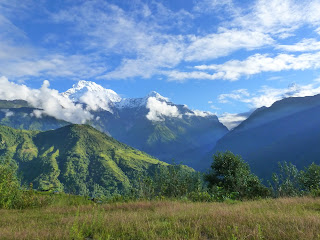
With a medieval vibe, Gandruk commands stunning, valley vistas over terraced rice paddies and tea plantations. We settled in for the afternoon, playing endless games of cards (which, truth be told, I usually lost). The next morning, the mountain range once again put on a stunning display for us. Huge snow-capped peaks - ethereal, supreme, heavenly - dominated the morning valley. Our smiles didn't do this view justice - it's a totally natural high that sends you soaring.

Spellbound, on our final day we descended back
down to Naya Pul, stopping for endless trails of mountain ponies, adorned in colourful costumes and heaving heavy loads up to the villages.

The trek was a physical challenge and we played witness to an ever-changing show of cloud and light, mist and mountain. The mountains were playing 'peak'-a-boo with us, but were even more spectacular for it.

Giddy with memories of the mountains, our hearts were now set on our next trek in the Langtang region, but our legs would need a few days of gentle recovery.