Tuesday, 10 April 2012

Quiero dos terremotos, por favor

During my time in Santiago, I endured a few shakes.

Hot off the heels of enjoying the local cocktail, terremoto (meaning earthquake, since you are left with the ground (and your legs) feeling very shaky after drinking it - that's the Chilean sense of humour for you!), I lived through a real life terremoto, or as I was later corrected, a temblor.

The difference between a terremoto (earthquake) and a temblor is that a terremoto shakes the earth up and down and a temblor side to side (or so I´m told by the locals).

The first time I woke up in the middle of the night, not sure what on earth was happening. My bed was shaking and it took me a while for my eyes and brain to focus and realise the whole room was shaking. Naturally, I just lay there in fear and made no attempts to move to a safe place.

Thankfully, it soon stopped and the next morning I was sure I had dreamt it, until Megan came into my room and said she had felt the same. Apparently they don't have earthquakes in Brazil: Claudia was up dancing with excitement over breakfast shouting "terremoto, terremoto!"

Angelica correctly predicted the quake as a 5 (well, it was 5.2, I told her she needed to make her predictions more accurate in future). But then came the big one.

I was with Med and Chris for this one, in the makeshift shed-come-lounge in the back of their hostel. This one I was acutely aware of from the very beginning, as the old, heavy TV, light fittings, fridges, stools and everything else in sight was shifting to and fro. Not only was it stronger, but it lasted longer too. But again, we all just sat there, eyes wide, muscles clenched. We'd make totally useless citizens.

This one was a 7.2 at source (to put this into perspective, the earthquake that destroyed Haiti was a 7.0) and a 6.8 in Santiago. The novelty had warn off now, especially after we were told not to leave the hostel for at least an hour in case buildings were damaged and electricity cables cut.
Luckily, that was the last big one we felt, although thousands rock Chile every year.

Med also suffered a different kind of shake while in Vina del Mar with Chris: he had his big backpack stolen from the hire car, leaving it for no more than an hour outside their hostel. Thankfully, there was nothing valuable taken, but it did leave Med clothes-less for a while with the relentless task of finding items big enough to fit him in a country full of small people.

No journey is perfect. Travellers go abroad knowing that, sometimes, flights will be delayed, baggage misplaced, hotel rooms disappointing and meals underwhelming. We know that the occasional bungle and hardship is all part of the experience, along with the freedom and moments of sheer joy.

Med is back in the game, with a new backpack, a few more clothes (of various quality) and the knowledge that the people who stole his bag have t-shirts and underpants with holes in.

Sunday, 8 April 2012

Escuela, escucho and Escudo

My escuela (school) was in the vibrant, bohemiam part of the city, Barrio Bellavista, near the foot of Cerro San Cristóbal - a hill with a 22m-high white statue of the Blessed Virgin Mary that looms over the highrises and rises out of the smog.

In 2011, Chile was named the ninth metropolis in the world with the fastest growth, and new, gleaming multi-storeys are shooting up, slicing up the skyline, as I write.


But Bellavista stays true to the old Santiago and it's crumbling heart: single and two-storey buildings with flat roofs, painted orange with deep blue doors or hot pink with green windows; riverbeds coloured by artistic murals and dogs lazing in the heat of the day; rusting tables and unchanging menus litter uneven walkways; and crumpled papers linger in the gutters, all that remains of the recent, student protests.

Meanwhile, standing as a reminder that this was no ordinary city in no ordinary continent, the backdrop to all of this is one of hazy, snow-capped mountains seen above a skyline of pick 'n' mix skyscrapers.

Bellavista was once the home of Chile’s Nobel Prize winning poet - Pablo Neruda - and there is now a museum, and spontaneous street art, devoted to his memory
down a peaceful cul-de-sac, lined with colourful houses.

Lessons were more fun than I had ever imagined, with our brilliant teachers Baba and Daniela breaking up taxing grammar lessons with language jokes and Chileno argot (slang). And then continuing our lessons for free over Escudo cervezas, pisco sours and the humdrum of fellow drinkers in the evenings.

Learning Chilean Spanish (and trying to translate English into Spanish in your head) helps you gain a new perspective on your own culture and language.

It reminds you just how many English words and phrases make no sense whatsoever and do not directly translate into another language. From words like "cheeky" and "posh", to phrases such as "sod's law" and "not my cup of tea". My mind was working faster than it has had to in many months and I even started to muddle the order of English words when chatting to friends.

There are also plenty of opportunities for error when learning Spanish, including mixing up words that should not be mixed up. For example, it's perfectly normal to use caliente to talk about hot foot, but it is definitely not acceptable to use caliente when you are personally hot. Especially over breakfast.

I also kept referring to Med as mi polola (my girlfriend), when I should have been saying mi pololo (my boyfriend). I'm walking through a Spanish-speaking minefield.

What's more, Chileans are notorious for speaking fast and actually quite badly. They hardly every pronounce the “s”; they skip “d” in nouns and adjectives (like estado and complicado), making the endings sound like “ao” instead of “ado"; and they pepper their speech with colorful phrases and plenty of swear words. Anyone under the age of 35 adds huevon or huevona to the end of almost every sentence. Huevon is the Chilean equivalent of dude, but literally derives from the slang word for testicles!

The Mapuche were the indigenous people living in Chile before the Spanish arrived. As the two cultures mixed, the Spanish adopted many Mapuchan words: cahuín (gossip or party), guata (belly), and malón (potluck). In class, we were taught the South American words; out of class we heard the Chilean.

I was fortunate to meet many young, Chileno people in my few weeks in Santiago and we had no trouble understanding each other, even if I still didn't have the right words. They listen to the same music, watch the same films, and spend their time on the same internet that we do. Of course, even if Chile as a whole is considered the third world, Santiago is most certainly first world. It is comprised of business people, those going to university, and people everywhere on iPhones and Macbooks (except me, I didn't even have a phone).


Yet, with all this familiarity, there was plenty of the weird and wonderful: hot dancing halls, dog houses built in the park and our daily game of 'food lottery' where we gambled with confusing menus and hoped we'd picked something relatively edible.

Many long lunches and even longer evenings in Bellavista peppered our Spanish lessons, and we followed the Chileno students to the cheapest lunch places and coolest bars. Chileans appear to have an amazing capacity for alcohol but no 'off switch'. Bellavista’s as chaotic as Soho, with live folk venues fighting for space alongside neon-lit clubs, hot dog joints, and salsa hangouts.

Then there was the karaoke after a few vinos de frutillas; I can now claim to have received a standing ovation from a room full of Chileno people - most over the age of 60.


As part of our course with Escuela Bellavista, we were taken on a (very long) tour of the Cementario de Grand Central - one of the largest and oldest graveyards in South America. 85 hectares of land in the city were set aside for the cemetery (almost 80 football fields), which features many earthquake-damaged ornate mausoleums and crypts, millions of dedications by the living and other displays surrounded by palm trees.

In this well-loved, colourfully adorned and artistically wonderful cemetery, it struck me once again how other countries deal with death with much more flamboyancy and openness than we do.
Many of Chile's past presidents and heroes are buried here, except of course Augusto Pinochet (Chile's dictator who killed and tortured thousands). Fresh flowers line endless walls stacked with small, square tombs and the rows of elaborate mausoleums influenced by Aztec and Egyptian architecture.

The tombs that fascinated me the most were flooded with flowers, Christmas decorations, various other gifts and thousands of scribblings in permanent markers.


These were the people who had been taken too soon, by car accidents or murders for example. It is thought that there souls remain here and the living should give gifts to them, in return for a favour. Some tombs are for money prosperity and job success, others had notes asking for luck in love and marriage.

As the fast Spanish words of our tour guide, Lidia, washed over me, I considered leaving my own gift and message. If these lost souls can make people rich, surely they can give me a tiny, helping hand with my Spanish?

Friday, 6 April 2012

At home in Chile

After a weekend of feasts and fiestas, moving in day had arrived.

During my two weeks of studying at Escuela Bellavista, I had arranged to move into a homestay with a lady named Angelica. I had never even clapped eyes on her, but I had her name, an address, and a terribly vague print out from Google Maps. Oh, and I also knew she spoke no English. Deep end, preparing to jump...splash!


I walked past another beautiful Catholic church in Providencia, down a leafy, sun-chinked street and stood outside what I hoped was the right apartment block. The traffic from the main street was forgotten as I said "hola" to the man selling flowers in black buckets on the side of the road, opposite.

Angelica wasn't home, but thankfully Megan - from Australia and also a student a Escuela Bellavista - was there to welcome me to the apartment and show me the ropes. The apartment was so homely, inspired by shelves full of meaningful trinkets, mismatched furniture and fabrics and a well-loved kitchen stacked with gem-coloured, glass bottles and old, rusting biscuit tins holding newly-purchased food.


Then there was my room, adorned with dusty rosary beads, a broken television set, brown and orange-striped sheets and a wooden bookcase full of forgotten treasures from past guests and old friends. As I put away my backpack under one of the beds and closed a drawer full of my clothes, I realised this was the closest thing to home I had experienced in seven months.

There were plenty of charming quirks to remind me I was so very far from home though: last minute invitations to evening meals at 11pm; numerous failed attempts to light the boiler with a match; coming home at 4am to find the Angelica and her nephew moving furniture;

misunderstandings followed by exaggerated hand gestures similar to those used by children's television presenters; and much laughter, sometimes with me, usually at me.

Breakfast was always an entertaining start to my day. Just like my grandparents do, Angelica set up the breakfast table the evening before, with two table clothes (one being the 'nice' one for the day, the other on top to catch crumbs and spills), and various old tins and jars. Every day we had pan (bread), with mantequilla (butter) and mermelada (jam). On some days there was also pate and jamón, and on one day we even had tuna, a prickly pear cactus fruit full of small pips.


But everyday, without fail, there was powdered milk for tea and coffee. I never got the hang of this, always swallowing bland lumps of milk powder as I sipped my tea. Still, it was a gesture of kindness as Angelica sat with us (Megan, Claudia (from Brazil) and I) and suffered our varying levels of bad Spanish.

That moment of peace and universal etiquette was quickly destroyed as we all then flung ourselves into various pockets of the apartment to get to school/work and then yell "hasta leugo!" or "buenas dias!" as the front door slammed.

Megan and I would then walk through the park to Escuela Bellavista, Claudia always on Brazilian time and trailing 15 minutes behind. At just 9.30am, couples, young and old, would be locked in passionate embraces on every street corner and park bench. Santiago is one of the most sexually charged cities I have ever seen. But also one of the friendliest.

Angelica is a very warm and welcoming woman who works hard to keep her modest apartment near the city centre and provide for her family.

Her son, Carlos (with his own 1 year old, gorgeous Nicolas), would come and go and spoke good English so understood my initial, broken attempts at conversation. I felt at home here but also like I was living in an almost silent world in the apartment, except for chats with lovely Megan who understood what it felt like to be living on the "outside".

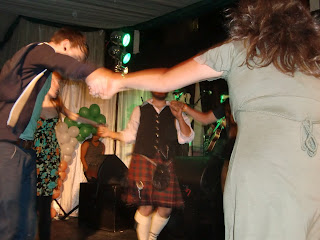
I arrived with almost no Spanish at all, which made my first outing to tango lessons with Angelica, Claudia and Megan an intimidating yet, in many ways, highly motivating experience. I understood very little and it was only my ability to quickly pick up dance steps that saved me.


The dance hall was bursting with men and women speaking in a thick, Chileno trill, all dressed elegantly in what I imagine to be their Sunday best. Flutters of conversations drifted by me, settling on me in much the same as wet snow settles on warm pavements. Whoever says you can just 'be' in a country and learn the language is telling fibs, or has never heard the mumblings of Chilenos at a tango lesson.

I had many people teaching me to tango that night - proving it doesn't just take two to tango, more like seven. Most of them barely reached my chin (many Chilenos are quite short, except those with German heritage) and so the next day I had back pain from where I had awkwardly tried to make myself shorter and, therefore, a better dance partner.

On another evening, I also accompanied Angelica to a traditional, Chileno dance hall for tango, salsa (which I thankfully had danced before) and a whole collection of other dances I was equally clueless about. Various people got me up for a spin around the dance floor - I was grateful that the band was too loud to hear what anyone was saying as I was sure I wouldn't understand them if I could.

Still, I enjoyed my first tango experiences and felt even more motivated to grasp the language; I wanted to turn those evanescent, snow-like drifts of conversation into sturdy, grinning snowmen.

Friday, 30 March 2012

La buena vida en Santiago

Thursday 15 March was the longest day of our lives so far. We lived it twice by the magic of time travel and a LAN plane from Auckland to Santiago de Chile - meeting Med's friend Chris at the arrivals gate.

Our first couple of days was a blur of dusty sunshine, 1 liter bottles of beer, language problems and stubborn body clocks.

We lusted after Cerro Santa Lucia, a city park crowned by a soaring system of staircases, fountains and towers with smog-filtered views of the urban jungle and the Andes beyond; we played food lottery (as we didn't understand restaurant menus) on small tables perched on bustling pavements; we walked, watery-eyed, though the hot streets of the city, stumbling upon cathedrals and narrow lanes leading nowhere.

Soon, Med and Chris headed to the coast for a week of surf and cervezas (beers) so, before I knew it, I was on my own, in a city I didn't know, unable to string more than two words together in Spanish. I was alone in the urban jungle and would be eating papas fritas for days on end if I didn't do something about it.

Over the next two days, I cemented my first South American friendships over asados (Chileno BBQs), pisco (traditional grape brandy), a U2 tribute band (for St.Patricks Day) and salsa clubs. I grappled with my first few words of Spanish and I managed to book myself onto a two week course in Latino Spanish. No more papas fritas for me!

But first, I had to learn to walk to the rhythm of the city. It is an endless maze of towering apartment blocks, delicate church spires and colourful residential areas. Most surprising of all are the ever-present Andes which, in the dense smog of a working day were all but invisible, their snowcapped peaks strangely detached like wisps of cloud against a dim blue sky.

Research tells me it's thermal inversion (a meteorological phenomenon whereby a stable layer of warm air holds down colder air close to the ground) that causes high levels of smog and air pollution to be trapped within the valley. My eyes and throat tell me to get out of the city to the fresh air of the mountains, but something is keeping me here, beckoning me to stay.

Perhaps it's the stunning architecture of some of the city’s buildings – the Museo de Bellas Artes, the Ex-Congreso Nacional, the heart-stopping Palacio de la Moneda and the surprising Bolsa de Comercio (far too beautiful to be a stock exchange) – little slices of Barcelona, Paris or Rome peeking out over the bells of tiny churches and ugly office blocks.

Then there's Plaza de Armas, the main square that seems to change it's characters, props and scenery to put on a new "performance" on an almost daily basis. On a bandstand at one end there are dozens of tables crammed full of old men stooped over chess games, a picture of concentration amid a flurry of activity.

Across the square, shoeshine boys (and men) taut for business; a comedian is surrounded by a hysterical crowd; tarot card readers are poised serenely over desks covered in red cloth; and artists fuss over exhibitions of varying quality.

There were some bizarre scenes too: moth-eaten toy ponies being ridden by children posing for photographers; a group of students dressed up on their way to an anti-government protest; hundreds of pigeons perching wing-to-wing on the roof of a sweet stall; and an information point on wheels that zips about the square far too fast to be of any help. Amid the chaos, church bells chimed and middle-aged men snored on benches. Yet somehow, everywhere I walk, people look at me as if I'm the strange one.

I was finally living my dream of being in South America. I had new friends. I was once again the obvious stranger in any crowd. I was finally adventuring again. For 2 and a half weeks, I would be living here in Santiago among life-size toy horses and a thousand curious eyes.

Wednesday, 14 March 2012

Hot springs and hot beaches

You can smell Rotorua before you get there: it has a permanent, stale whiff due to the plumes of sulphur rising from the earth's crust - it's very thin in this part of New Zealand.

So Rotorua stinks, but it's also a hotbed (I had to pun it) of thermal activity with hundreds of bubbling mud pools, frothing hot springs, and spurting geysers. Amazingly this doesn't seem to have deterred tourists from visiting; Rotorua is one of the most touristy and commercialised places we have visited in New Zealand.

Sadly, the entrance prices were stinking too, and so we only went to see the free areas of thermal activity: the splurging and splatting hot mud baths and steaming springs. Med and I aren't keen on paying for the natural things - I don't think Mother Nature hoped for ticket booths, overpriced cafes and a plethora of merchandise to litter her greatest work.

But the free bits were great to see too. Beneath the ground is a system of streams, which are heated by magma left over from earlier eruptions. Water reaches 300°C in places – creating the bad smell – hydrogen sulphide. A day was enough though - I'm not sure I could cope with the stench any longer than that.

We then went from hot water springs to a hot water beach on the Coromandel Peninsula. Usually, when you come across people with shovels on a beach, they are very young people. You know, little kids building sand castles, or just digging a great big hole because their dad has told them they can get to Australia (perhaps they say England here?).

So the scene at Hot Water Beach, then, was a little odd.

There were plenty of people digging with shovels in the sand, but none of them were children. At this beach in question, however, this was not out of the ordinary. Grown men (and women) bring their shovels at low tide and dig down deep into the sand. Because the beach lies atop a natural hot spring, the water that seeps up through the sand to fill the dug holes is hot - and I mean hot! It’s like digging your very own hot tub.

Med set about digging our little space (I was on the phone to family at home, so I "accidentally" avoided all the hard work) right by the cool, lapping seawater. We then set about wallowing in the really hot water in the early morning sunshine, watching other bathers in various stages of doing the same. This was genuinely the first bath I have had since leaving home in August, and it was bliss!

We then drove up the coast to the beaches around Cathedral Cove, famous for a huge hole cut into the cliff that you can walk through, making a Cathedral shape. It was just another stunning day in New Zealand - the sky cloudless, the water dazzling emerald, the air fresher than fresh. Oh and the wildlife, stingrays and hundreds of fish.

I had got my highs on the skydive, and it was now Med's turns to get the adrenalin pumping. We headed to Raglan on the west coast - beautiful because of rolling hills, filled with hundreds of sheep, that give way to the turquoise water of the sea and the occasional cliff dropping down to rocky beaches. The beaches, that are nearly empty, save for the few brave surfers that ride Raglan's famous waves.

Med hired a surf board, and took to the water where everyone called each other "bro", "man" or "duuuude". It was a reminder of my failed attempts at surf lessons in Sri Lanka - I must rectify this! Maybe in South America where the lessons will be cheap.

We then made a pitstop at 90 mile beach, which very long but actually 90kms (another classic, misleading Kiwi name). Then it was onwards and upwards to Cape Reigna, in the far north.

This cape is where two huge bodies of water, the Tasman Sea and the Pacific Ocean, converge. It is a wild yet peaceful place, but has moments of feeling otherworldly and eerie. This place is held sacred to the Maori people, who believe it is the place where the souls of the dead leave New Zealand to return to their ancestral, spiritual home - Hawaiki.

We walked in the wind and mist to the end where a lighthouse stands, seeing the rocky point jutting out to sea - Te Reinga - the place where the spirits enter the underworld. Clinging to the rock there is the ancient kahika tree, named Te Aroha. The spirits descend to the water on steps formed by the tree’s roots.They then continue on their journey to Hawaiki.

What makes it even more dramatic is the oceans colliding before your eyes. They differ in colour slightly and the waves crash and boom into each other, shooting powerful spray upwards. We sat and watched. We were drawn back to this auspicious place the next morning to catch the first light on the cape. As the sun cleared the morning mist, a ribbon of rainbow appeared over the lighthouse, eventually turning into a complete bow with the pot of gold - the lighthouse - at the end. This really is a very special place, we could feel it.

The weather had really turned in our last few days, casting a grey light over this beautiful stretch of coastline. We decided not to push our luck with a trip around the Bay of Islands and instead enjoyed the delights of our campsite by a river - which featured both a passing wild pig hunt by local Maoris and then some kind of nudest convention. Our jaws dropped on both occasions.

And so we had arrived in our final destination, Auckland. We bid farewell to our cosy camper and the sun came back out for the final few days as we explored the big city.

Tuesday, 13 March 2012

"The sky is falling!"

As a child, I was read the story of 'Henny Penny' when a little chick is worried that "the sky is falling!" when an acorn drops out of the sky and hits her on the head. I couldn't help but think about this story, and what Henny Penny would make of what I was about to do: fall out of the sky like the acorn!

So back to Henny Penny. On my first day in Taupo I made a skydive booking with Taupo Tandem Skydive and, thus, sealed my fate. I would be jumping out of a small plane at 15,000ft with an instructor strapped to my back, with a parachute strapped to her back and just fresh air to see us through. Much like the acorn, it wouldn't be the sky that would be falling, it would be me.

After the Tongariro Alpine Crossing, we arrived in Taupo, the skydive capital of the world. Just before I get into story, here's a little fact we read about Taupo that made me go "wow!

Taupo, which is really quite small, is the same size as Singapore. Singapore, which we visited before we arrived in Australia, has the same total population as the whole of New Zealand. To put this into perspective, that's like the entire population of New Zealand, living in Taupo. Asia: the mind still boggles.

I hadn't told anyone, but Med, my sister, Beth, and my cousin Rachel - all of whom were sworn to secrecy. The aim was to avoid my mum having many sleepless nights worrying about a parachute, strapped to an instructor, strapped to her first-born child.

The morning of my skydive we woke up in a campsite 30kms outside of town. The day had arrived and while I was nervous, I wasn't paralysed with fear, more giddy with excitement.

When in 'the land of the long white cloud', you can expect to see many long white clouds. Today was one of those days, but this wasn't about perfect blue skies for me, this was about hurtling through the air at a speed of 200mph.

I was minibussed with a few other jumpers to the airport. Yes, to the actual Taupo airport, I don't know why I was surprised by this, but I was. They had one space left on a plane that was minutes away from taking off so I was bundled into the back, giving a very quick safety briefing while about 7 pairs of hands quickly suited and harnessed me up. One of those was my dive master, Chrissy, the only female instructor they have.

"Is it all done up properly?" I asked. Everything had happened so quickly and the group I arrived with had barely sat down on the sofas for their introduction. "Yes, don't worry, it's all safe," Chrissy assured me. And it was off to the plane we go.

We bundled in at the back, with me basically sat on Chrissy's lap and my cameraman (who would be filming my freefall and taking pictures) sat on my lap. I then learnt that I was the only one of the group going up to 15,000ft and the rest would be jumping at 12,000ft. I tried to think of a good reason I had chosen the highest one when everyone else went for the lower option.

The flight up to 15,000ft is probably the longest part of the the entire dive experience. We were in a rickety plane, which rattled it's way up over Lake Taupo.

While taking in the views, I was chatting to Chrissy about her job and life in general, as if we weren't about to jump out of a plane at all but were sat enjoying a cuppa. The only giveaway was having to shout over the noise of the plane. And the man sat on my lap.

As we hit around 9,000ft, I had a breathe through an oxygen mask, again, the only one doing this as I was going up so high. The air at that altitude is really thin and super cold. I could feel my toes getting cold in my very breathable trainers.

As we hit 11,000ft, Chrissy helped me put on my hat and gloves as I looked out to see Mount Ngauruhoe above the clouds.

At 12,000 feet, the instructor at the front pulled up the door and the altitude’s cold air came whistling in. The others in the plane started jumping out and disappearing before we had chance to hear their screams. I was looking after the girl to my side who was overcome with nerves, forgetting any of my own fear for a few minutes.

Once everyone else had jumped, the rolling door was closed again and we went up and up to reach 15,000ft. That is very high, in case you were wondering. Way, way above the clouds and mountains.

Chrissy strapped the goggles to my face. I knew as they dug into my face that I would have attractive red marks for the rest of the day.
The door opened and my time had come.

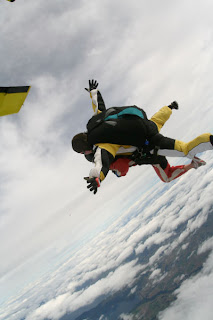
Chrissy and I, now moving as one, shuffled to the back of the plane. I swung my legs over the plane’s edge, my camera guy slid by and hung on to the outside rail of the plane (I remembered being worried for him, "quite dangerous," I thought), a mounted camera took a picture, Chrissy tipped my head back over her shoulder and we fell. And fell. (There really was no “dive” or “jump” out of the plane. It felt more like that team building game where you simply close your eyes, lean back – or in this case forward – and hope that the person behind you knows what they’re doing.)

I felt my heart lurch as I plummeted over the edge of the plane, but I did not scream. Perhaps I couldn't due to the wind that hits you hard for that instant facelift!

For about 10 seconds I had no idea where I was or which way was up. I thought the wind/air would stop us moving so quickly, but it did just feel like we were speeding to earth. It was like the lurch felt on a big rollercoaster, but never ending.

Chrissy levelled us up and tapped me on the shoulder to put my arms out. Now I could see clearly the clouds and lake below, and the never ending sky above.

Falling at terminal velocity is one of the best feelings in the world! My face was pummeled by the wind (some great photos of that!) but that couldn't do anything to move the huge grin off my face! I waved my hands around in sheer joy and felt the resistance of the air against me.

As I had 60 seconds of freefall, I actually had time to look around and enjoy the scenery. The lake peeping through the clouds truly looked amazing from way up there! Even the mountains came into view in the distance as we rotated around.

Just as I was waving at the camera, everything seemed to disappear and go blank. Time stood still. We had arrived into the clouds and were now cushioned by a parachute.

I felt like I'd lost all my senses in one go. I couldn't see anything but white, I felt quite deaf from a combination of cloud fog and painful ears from the altitude and it took me a while to recover from the shock and shout out in elation! "I did it!! Sorry mum!!"

We then gently parachuted our way over the edge of the lake, whooshing around in 360 turns and dazed at what had just happened to my body and mind. After a few minutes of gliding, we came in for a very soft landing on the grass and I joined the other divers waiting for me in a victory dance.

Skydiving is one of the best, most exhilarating, most unique experiences I have ever had. if you ever get the chance to fall out of a plane (with a parachute on), don’t even hesitate. You won’t regret it.

*I will embed the video of my jump as soon as I have it uploaded onto a computer. In the meantime, here it is on YouTube!

Monday, 12 March 2012

Walking on volcanoes: celebrating 6 months on the road

The day we hit the half way mark of our trip was a special one.

6.30am is an early start and 2 degrees is blooming cold to suffer for something we weren't even sure we could do that day due to a rotten weather forecast. But up we got to do the 20km tough hike touted as the best day walk in New Zealand - The Tongariro Alpine Crossing - also known to the locals as 'The Crossing of Death'.

The crossing passes over the volcanic terrain of the multi-cratered, active volcano, Mt Tongariro, and also passes the eastern base of Mt Ngauruhoe. We heard it was a bit like landing on the moon, and I felt very under prepared!


In my rucksack I packed all the layers I own, including an extra pair of socks that today would double up as mittens if needs must. We were to climb up to 1,900m above sea level and it was already cold at 600m. What's more, there had been fresh snowfall the day before and we would be less than 400m from it.

Yes, yes it could.As we wiped the sleep from our eyes and drove to where we were to catch the minibus to the start, we eventually realised that the sky was clear and the sun was shining down on the spectacular landscape. Could this be our lucky day?

6 months to the day since we had left home, we were to hike over an active volcano - strangely, this day fell on a leap year, otherwise we wouldn't be able to celebrate our half way mark at all as we left on the 29th August.

It was so clear our bus driver, Steve, said it was just one of ten days like it all season as he eagerly pointed out the snow-capped peak of Mount Taranaki some 200kms away.

We could also see the snow up on the three volcanoes in the park: Tongariro, Ruapehu and Ngauruhoe. I felt quite giddy, the kind of giddy when travel moments like this take our breath away.

Our luck almost ran out as we got stuck behind a group of school boys who were dragging their heels under the enormous backpacks they had to wear. But, right from the start, there was a real sense of camaraderie between the trampers, as we made various amusing attempts to run past the already-flailing school boys to get ahead. And get ahead we did, now walking with a Canadian couple, Ems and John.

The most active of the volcanoes, Mount Ngauruhoe (which, geographically is actually considered to be a large vent of Mount Tongariro - incase there's any geographers reading this!), last erupted in 1975, and as we walked on volcanic soil and rock, we could see past lava flows layered ahead of us, with the lava monster, Ngauruhoe, looming behind.

It was nothing short of spectacular, and the best was yet to come.

We climbed the Devils' staircase, hundreds of steps cut into the side of the rubble and lava. They really were the work of the devil, but the view from the top was encouragement enough.

In front of us was Mount Ngauruhoe (Mount Doom from Lord of the Rings - some trivia for you, as the top of the volcano is heralded as sacred by the Maori people, the movie makers didn't film the top and superimposed another volcano top), to one side was Mount Tongariro and in the distance we could still make out Mount Taranaki.

We had reached the South Crater, an impressive plain to cross underneath the gaze of of Mount Ngauruhoe/Doom before the final, hard ascent up the Red Crater, which is the highest section of the trek. The ground underfoot is a bit like fine charcoal and you can see why this part of the trek is considered quite dangerous in high wind. It's bit of a slog and very steep in places - no handy staircase here.

The volcanoes and the inherent geothermal activity which comes along with it have created a spectacular landscape of steaming fissures and brightly coloured lakes.

The crater itself looks very demonic with huge vents that belched sulphuric gas. In fact, as we reached the top and looked around at the endless volcanic landscape, steam was rising from the ground, creating a suffocating, rotten egg smell when the wind changed direction and blew it in our faces. Even the ground was warm to sit on as we rested our legs atop the Red Crater, left dumbfounded by the view.

Apart from having warm bottoms, it was cold up here as the icy winds licked at our faces so I was glad I had decided to wrap a scarf around my head to protect my ears from the cold. A volcano is NOT a catwalk.

We had been warned that this beautiful weather would change in the afternoon, and decided the 2 hour side trip to see the opening vent of Mount Tongariro was probably pushing our luck. And we were being lured by the jade and emerald lakes down the steep slope, which could only look the piercing under blue skies.

Ems and I falling down. The slightly treacherous descent down the other side is softened by the spongy volcanic ash and soil, which is good as just as I was laughing at our new friend, Ems, falling on her bum and sliding down, I then wobbled, lost my balance and followed her down. If only we had caught it on camera, we'd be £250 better off courtesy of You've Been Framed for sure!

The fiery black and red beneath our feet was perfectly offset with the intense blue of the Emerald Lakes and the deeper blue of the Blue Lake in the distance. Every now-and-then you can see bubbles coming to the surface of the Emerald Lakes and there was an even stronger whiff of bad eggs.

We watched one man put his whole hand in, which Med said was probably a bad idea due to the sulphur content, but he then went to put his own little finger in. How often in your life do you get to sample the water in the midst of a volcano?

We got close to one of the vents and saw the bubbles of boiling water that we spewing steam into the chilled air.

After walking across a barren, moon-like expanse, we stopped to eat our packed lunch (cheese and pickle sandwiches again, what else?) aside the Blue Lake, moving on again before muscle rigamortis struck. We were only half way after 3.5 hours of walking.

On from the Blue Lake the view into the valley slowly swings into view with a spectacular vista down into farmlands and off in the distance is Lake Taupo. The mist that had threatened to ruin the day was slowly rolling in, mingling with the steam from the hot springs.

We walked the long, winding walk, through forest and down to the car park at the end of the crossing - somehow walking downhill can be more hard work than going up. Thankfully, we were happily chatting to new friends, adding Canada on our list of places we have to see on a future adventure.

With sore feet, knotted hair and wet socks, after a trip by minibus back to the village, we went for a celebratory beer. Our luck continued, we had already booked a car park spot outside a hostel in Lake Taupo, which meant one thing: a shower! What's more, Med had promised to take me out for a slap up meal for our 6 month traveling anniversary - and we had certainly earned it.