
I set off with the French girls on a local ferry that we thought would take us to Kollam further south down the coast.
Only stopping for a traditional Keralan lunch in a remote village, it was another relaxed backwaters experience and I sat on the edge of the boat and absorbed the breeze and beautiful sights.
We chatted to a French guy, Paul, who offered us sweet fresh pomegranate - a great way to make friends! He had been travelling for years and years it seemed, and he had that slightly weathered look of someone who had embraced the world and all its extreme climates.
Paul was getting off at the next stop: the Ashram. In my ignorance, I didn't really understand what an Ashram was, apart from it housed a Hindu temple. After a long discussion in French with Paul and the girls, of which my understanding came and went, and then a brief chat in English for my benefit, we decided that we too would stay at the Ashram for the night and not go to Kollam after all.
As we stepped into the Ashram walls, we were confronted by people everywhere dressed modestly in white. It was quite disorientating as these people, a staggering amount European, all walked and talked with a great sense of purpose and seemed enthralled in their life at the Ashram. We felt like complete outsiders - especially with our backpacks and brash multi-coloured attire.
After a few minutes where I can only assume we stood and gawked at this small walled world of white, we worked out where we had to go to sign in. Faced with a barrage of questions from the man behind the desk and then a thorough form, we were eventually given a room. Before leaving, we chatted to a French girl (the Ashram seemed particularly popular with the French), who spent six months of her year at the Ashram, and six months back at home. It became apparent this was not uncommon, and some people had lived there for years. I then realised that all around me there were people working - making magazines, sweeping floors and other jobs I didn't fully understand. Jobs aside, it was a far cry from the 'real world', I felt.
Our room, or rather dorms, were in one of the (out of place) skyscraping blocks of flats inside the Ashram. We were on the 11th floor and, while the views of the backwaters and the sea were spectacular, our rooms were bleak in comparison. I will spare the details but let's just say I had my worst night's sleep in a long while that night. We shared our floor with Indian girls who could be no more than 12 or 13. They were at the Ashram to study for 2 years - how they must miss home!
We spent the first hour outside in the main square in front of the pastel pink temple. It was fascinating to watch these people go by, and ponder what had brought them here. We were promised a tour as newcomers but, when no guide arrived, we let ourselves get caught up in the throng of people who were all heading in the same direction: the beach.
The sea of people in white knelt down on the sand and then sat cross-legged around a platformed woman, also in white. I soon gathered that this was Amma, who I had heard mentioned and seen on posters around the Ashram. Amma is a famous Hindu guru (there are thousands of gurus in India) who inhabits the Ashram when she is not on tour around the world. We perched uncomfortably on the rocks that the sea crashed into, and occasionally caught the spray as the sun started to go down.
A voice on a microphone then led everyone in the twice-daily meditation. I was shocked to see how many European girls my age knew all the words to the chants and seemed to embrace this ritual. After what seemed to us like hours, it was timed for the dashram. Newcomers, leavers and people who were 'feeling sad' were invited to join the lengthy, winding queue to receive dashram - at this stage I had no idea what I was queuing up for but I went along with it - when in Rome!
It turned out that Amma was giving out hugs to everyone. As we got near the front of the queue, our bags and water bottles were taken from us and we were asked which language we spoke by her supervisors.
It was my turn next and I didn't really know what to expect. My head was pushed onto her shoulder and she held it there - quite intensely - for a while. It seemed like I was there awkwardly for a long time until she eventually whispered "my love, my love, my love" into my ear and released her firm grip before placing a small brown parcel containing incense (which I later found out was made of burnt cow poo) and a small sweet. I wasn't, and am still not, sure what to make of it. As far as hugs go, it was pretty good but I don't think I felt anything beyond that! I have since chatted to another French man, who said his first hug opened up his heart and he felt intense energy - I guess if you're hoping it to have an effect on you that anticipation might be strong enough to do that for you.
After a great deal more hugging (I am told Amma has given dashram for 2 days straight before with just sips of water in between), everyone was flocking back to the centre of the Ashram, where we witnessed a large ceremony in celebration of Amma's return from overseas. The Ashram has about 2000 people in on average and the full extent of this was obvious here.
I awoke the next morning at 4.30am, feeling almost feverish in our fan-less room, to hear people attending morning prayers. Any guests staying more than a couple of days were invited to carry out chores during the day, in between meal times, prayer and meditation.
I went to the Ashram feeling I should think 'outside the box' and have an open mind to this way of life and living. What I came away with was a sense that these people were living inside a box, between the four walls of the Ashram, discouraged from interacting with the nearby village amongst many other rules. I wondered what jobs and perhaps families they had given up to live at the Ashram and what the very small children being brought up here were missing out on.
Amma and the Ashram was great food for thought, but we did let out a little cheer as we stepped outside the gates.
Only stopping for a traditional Keralan lunch in a remote village, it was another relaxed backwaters experience and I sat on the edge of the boat and absorbed the breeze and beautiful sights.
We chatted to a French guy, Paul, who offered us sweet fresh pomegranate - a great way to make friends! He had been travelling for years and years it seemed, and he had that slightly weathered look of someone who had embraced the world and all its extreme climates.
Paul was getting off at the next stop: the Ashram. In my ignorance, I didn't really understand what an Ashram was, apart from it housed a Hindu temple. After a long discussion in French with Paul and the girls, of which my understanding came and went, and then a brief chat in English for my benefit, we decided that we too would stay at the Ashram for the night and not go to Kollam after all.
As we stepped into the Ashram walls, we were confronted by people everywhere dressed modestly in white. It was quite disorientating as these people, a staggering amount European, all walked and talked with a great sense of purpose and seemed enthralled in their life at the Ashram. We felt like complete outsiders - especially with our backpacks and brash multi-coloured attire.
After a few minutes where I can only assume we stood and gawked at this small walled world of white, we worked out where we had to go to sign in. Faced with a barrage of questions from the man behind the desk and then a thorough form, we were eventually given a room. Before leaving, we chatted to a French girl (the Ashram seemed particularly popular with the French), who spent six months of her year at the Ashram, and six months back at home. It became apparent this was not uncommon, and some people had lived there for years. I then realised that all around me there were people working - making magazines, sweeping floors and other jobs I didn't fully understand. Jobs aside, it was a far cry from the 'real world', I felt.
Our room, or rather dorms, were in one of the (out of place) skyscraping blocks of flats inside the Ashram. We were on the 11th floor and, while the views of the backwaters and the sea were spectacular, our rooms were bleak in comparison. I will spare the details but let's just say I had my worst night's sleep in a long while that night. We shared our floor with Indian girls who could be no more than 12 or 13. They were at the Ashram to study for 2 years - how they must miss home!
We spent the first hour outside in the main square in front of the pastel pink temple. It was fascinating to watch these people go by, and ponder what had brought them here. We were promised a tour as newcomers but, when no guide arrived, we let ourselves get caught up in the throng of people who were all heading in the same direction: the beach.
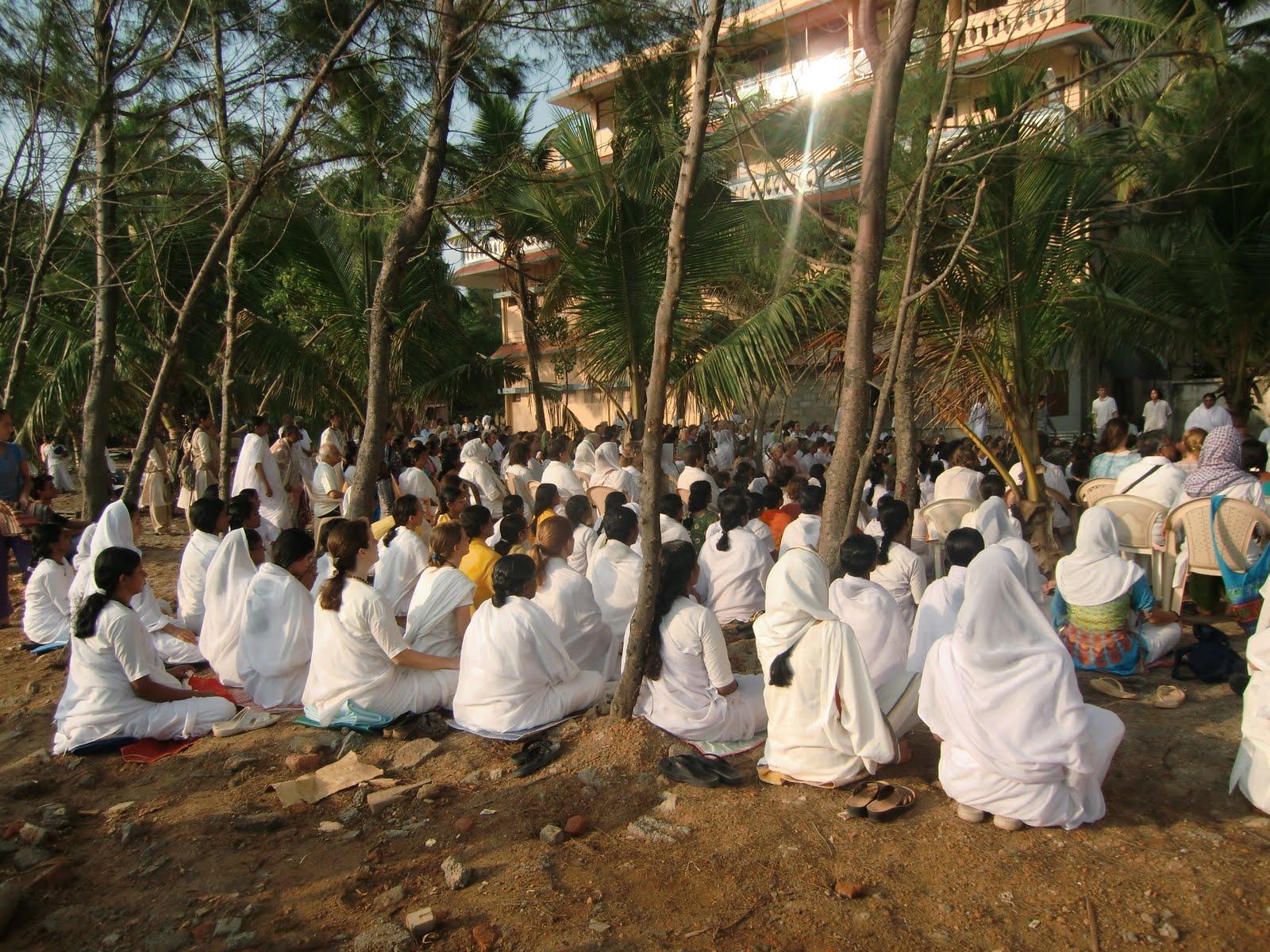
The sea of people in white knelt down on the sand and then sat cross-legged around a platformed woman, also in white. I soon gathered that this was Amma, who I had heard mentioned and seen on posters around the Ashram. Amma is a famous Hindu guru (there are thousands of gurus in India) who inhabits the Ashram when she is not on tour around the world. We perched uncomfortably on the rocks that the sea crashed into, and occasionally caught the spray as the sun started to go down.
A voice on a microphone then led everyone in the twice-daily meditation. I was shocked to see how many European girls my age knew all the words to the chants and seemed to embrace this ritual. After what seemed to us like hours, it was timed for the dashram. Newcomers, leavers and people who were 'feeling sad' were invited to join the lengthy, winding queue to receive dashram - at this stage I had no idea what I was queuing up for but I went along with it - when in Rome!
It turned out that Amma was giving out hugs to everyone. As we got near the front of the queue, our bags and water bottles were taken from us and we were asked which language we spoke by her supervisors.
It was my turn next and I didn't really know what to expect. My head was pushed onto her shoulder and she held it there - quite intensely - for a while. It seemed like I was there awkwardly for a long time until she eventually whispered "my love, my love, my love" into my ear and released her firm grip before placing a small brown parcel containing incense (which I later found out was made of burnt cow poo) and a small sweet. I wasn't, and am still not, sure what to make of it. As far as hugs go, it was pretty good but I don't think I felt anything beyond that! I have since chatted to another French man, who said his first hug opened up his heart and he felt intense energy - I guess if you're hoping it to have an effect on you that anticipation might be strong enough to do that for you.
After a great deal more hugging (I am told Amma has given dashram for 2 days straight before with just sips of water in between), everyone was flocking back to the centre of the Ashram, where we witnessed a large ceremony in celebration of Amma's return from overseas. The Ashram has about 2000 people in on average and the full extent of this was obvious here.
I awoke the next morning at 4.30am, feeling almost feverish in our fan-less room, to hear people attending morning prayers. Any guests staying more than a couple of days were invited to carry out chores during the day, in between meal times, prayer and meditation.
I went to the Ashram feeling I should think 'outside the box' and have an open mind to this way of life and living. What I came away with was a sense that these people were living inside a box, between the four walls of the Ashram, discouraged from interacting with the nearby village amongst many other rules. I wondered what jobs and perhaps families they had given up to live at the Ashram and what the very small children being brought up here were missing out on.
Amma and the Ashram was great food for thought, but we did let out a little cheer as we stepped outside the gates.


.jpg)