Friday, 17 August 2012

One man and his drug

Medellín is synonymous with the name Pablo Escobar, one of the most notorious criminals that ever walked the earth. Supplying cocaine all over the world, he became a billionaire several times over and left a permanent scar on Colombia’s colourful tapestry.

Escobar offices in the centre of the city
At the height of its power, his Medellín drug cartel was smuggling 15 tons of cocaine a day, worth more than half a billion dollars, into the United States.

As a result, Escobar is regarded as the richest and  most successful criminal in history. In 1989, Forbes Magazine listed him as the seventh wealthiest man in the world with an estimated fortune of $9 billion dollars. The truth is, he probably had a lot more.

As you wander through the leafy streets of Medellín, brushed with the breeze of its eternal spring, it’s hard to imagine that this city was once the stronghold of this notorious criminal and his followers.

Still owned by the Government
But Pablo Escobar and his Medellín cartel once ran these streets using a mix of intimidation, bribery and violence, resulting in the murder of hundreds of innocent civilians and many police and government officials.

Though he was eventually killed by Colombian police in 1993, his legacy is still felt by the people, forever etched into their city’s cultural memory.

One of the things we wanted to do in Medellín was to gain an understanding of where he operated, his influence on the city, how people view his legacy and the truth behind his pseudo-celebrity reputation.

However, having spoken to a Colombian friend who said her mother would disown her if she went on a tour about “that man”, we were in conflict. We also heard that one of the two companies running the Escobar tour is probably giving money to Pablo’s brother to do a ‘meet and greet’ with tourists.

I didn’t want to fund anything that continued to glorify and exasperate the problem of “that man” and what he did to this beautiful country.

Where's Pablo? Never hiding away from recognition
After asking around, we decided to go with the Paisa Road organisation, which donates a percentage of its profits to fund social projects in some of the areas where Pablo’s bitter legacy still has a stranglehold. So, we headed out to see the sites where the evil-genius operated with impunity for so many years.

What stunned me the most about the entire tour was that he didn’t operate in the far perimeters of town or in the jungle, he ran everything right in the beating heart of Medellín. He wanted everyone to know the face of Pablo Escobar.

We stood outside various buildings, his home and the offices where he ran all his legal and illegal business operations, all distinctly white and boastfully opulent. And yet, left abandoned and to rot, you would never know that these greying structures once housed one of the world’s most powerful criminal enterprises.

We discovered that these buildings are still all owned by the government and police, who don't want to sell them as this would mean giving a percentage of the profits to the community. Cocaine may have had its day in Colombia, but corruption is still rife.
Pablo & son by the White House - they were looking for him

Inside these walls, Pablo worked to build his “Robin Hood” reputation, by building football fields, churches and housing for the poor. The man who started his criminal dealings by robbing gravestones to polish and re-sell, transformed himself into a knight in shining armour for many of the poorest neighbourhoods in Medellín.

Undoubtedly an elaborate exercise in PR and manipulation, Escobar procured support for his Medellín cartel, befriended the police and military and even found his way into the government in 1983.

Pablo will pay more to keep you quiet
It is easy to be blinded by his showmanship and ability to make friends in high places, but Escobar was responsible for horrible atrocities, corruption and intimidation, he was a known paedophile with mistresses as young as 14, and had an effective, inescapable policy in dealing with law enforcement and the government, referred to as "plata o plomo," (money or bullets).

Escobar was allegedly responsible for the murder of Colombian presidential candidate Luis Carlos Galán, one of three assassinated candidates who were all competing in the same election, as well as the bombing of Avianca Flight 203 and the DAS building in Bogotá in 1989.

His legacy of money, drugs and bullets is undoubtedly one that many Colombians still live with every day. In fact, on the tour we were driven through Barrio Triste (which literally translate to “Sad neighbourhood”), where empty shells of human beings sit on street corners, victims of the enormously addictive “Bazuco” drug – cocaine before even the first “cut” has been made.

Pablo brought this ugly, debilitating drug into the hands of vulnerable Colombians, and it is still only 50cent a gram.
Apt street art outside the house where Pablo was killed

Pablo’s successful transporting of drugs to North America, his involvement in politics and his high life with exotic, Brazilian dancers and hippos (which were left to escape – Colombia now has the second largest population of hippos in the world) in his ostentatious home couldn’t last forever, and eventually the Colombian government buckled under pressure from the US after the assassination of Luis Carlos Galán. Still, Pablo was allowed to build his own “prison”, known as La Catedral, complete with huge T.V. and bar.

But the cocaine trafficker’s luck was running out and a group known as Los Pepes (translates as the People Persecuted by Pablo Escobar) started working with the Colombian government and military to get rid of Pablo, and his dirty drugs, once and for all.

The roof where he was shot
The final battle of Pablo Escobar’s life was on the roof of a humble home, his hiding spot, in the residential area of Los Olivos. It was here that he was trying to blend in as a normal citizen to avoid the blood-thirsty uprising coming in from the Colombian government, Los Pepes, US special forces and rival cartels.

Escobar suffered gunshots to the leg, torso, and the fatal one in his ear. It has never been proven who actually fired the final shot into his head, or determined whether this shot was made during the gunfight or as part of possible execution, and there is wide speculation about the subject. Some of the family members believe that Escobar could have committed suicide.

A well-tended grave
We rounded up the tour in the cemetery where Escobar and some of his family members are buried. The poetic irony of his own gravestone being stolen a couple of years ago wasn’t lost on us, after he stole so many from innocent people in his youth.

It was a shock to see flowers and children’s drawings laid on his tomb, and a man sat in quiet reflection – proof that some sections of Colombian society still hold a torch for Pablo.

However, I think Pablo Escobar’s torch is slowly being extinguished and his legacy won’t be my lasting memory of Medellín. It’s the dedication and optimism of the Paisa (indigenous) people that characterises the city.

Industrious and forward-thinking, Medellín owes a great deal of credit to the its population who have overcome adversity and sought to make their city somewhere to be proud of.

Thursday, 16 August 2012

Olympic Medellín

The Olympic Games were a distraction, a massive one. In fact, Seb Coe should probably be on the phone to the city of Medellín to personally apologise for the lack of attention backpackers, particularly British ones, gave to the city during the first few days of the event.

Olympic fever - Murray wins gold!
We watched the opening ceremony in Salento, before arriving in the rather aptly named Medellín ((pronounced Med-i-geene, I'm playing with words here!). To say I was bursting with pride that afternoon in a small bar packed with Colombians would be an understatement. I was jumping with pride, laughing with pride and goosebumping with pride!

I’ve not been on British soil in eleven months and it was like receiving a big hug from everyone at home. Danny Boyle and La Reina (the Queen) – I salute you! And who knew Mr. Bean enjoyed such international fame? The Colombians certainly loved that part of the ceremony the most.

A message to the people above in the cable car
Our time in Medellín (which was, until quite recently, the drug and murder capital of the world) was splashed with Olympic sport and hurried sight-seeing that the time difference between us and London allowed.

Medellín is, in many ways, two different cities in one - and a place that faces far more nuanced challenges than its tarnished reputation implies.

Soaring high above the favela 
On the one hand, it is a city of beautiful, young socialites. The women here are simply stunning, and a night out in the Zona Rosa is enough to make even the staunchest objector consider the benefits of towering, white stilettos and plastic surgery.

Beyond la vida locaMedellín offers a new and speedy metro system, drinkable water (hurrah!), police officers on every street corner and designer shopping malls too (the scene of only the occasional gang shoot out these days).

But then there’s the rest. Medellín is famous around the world for its involvement in the drug trade, for the violence that this illegal export inspired, and for guerrillas who have kidnapped more than just a few foreigners.

Generally speaking, those days are over. The Medellín of today is a much safer and more welcoming place than it was in Pablo Escobar’s heyday. That said, the city remains haunted by its past and seems uncertain of its new identity after the violence that has only recently come to an end.

Favelas squeezed together
And then there are the issues all too common in the developing world: unemployment, lack of access to healthcare and education, and high poverty levels. In fact, 47% of Colombia’s population falls below the poverty line.

This fracas, between old and new, poverty and glamour, hit me when we travelled on the gleaming silver cable car up across the favelas (cobbled together communities) to the national park.

There is barely space to hang out the weekly wash and the buildings are falling apart in their tiny, muddled rows, patched together with whatever is at hand. Every roof has huge bricks holding it down; some have car doors and old paint pots too.

One minute we were walking through the favela area, watching men selling bags of fruit out of a rusted wheel barrows and the next we were arriving at the Parque Arvi where families were dressed in their Sunday best - with sky-scraper heels (this is Colombia!) and designer labels to boot.

Of course, what unites these people is their heartfelt "Bienvenidos a Colombia" (welcome to Colombia) and delight that tourists are venturing to their country after so many years of turmoil.

After exploring the conflict of Medellín, it was back to some Olympic Medallin’!

Sunday, 5 August 2012

La Zona Cafetera: the coffee love triangle

After the excitement of the city, we headed for the cool hills of La Zona Cafetera – the home of muy rico (very tasty) Colombian coffee.

Paintbox streets of Salento
As we drove into the green abyss, we immediately noticed the hills enveloping farms producing coffee, cattle and silkworms. We walked to our home for the next few days, the Plantation House in Salento, glimpsing down the quiet roads to see the local, elderly men who spend their entire day chatting and drinking coffee.

We stayed in the midst of coffee plantations and tropical gardens, on the edge of this idyllic small town with its gorgeous, fading buildings, warm climate, backdrop of lush green hills, grinning local people, horses and carts roaming the streets and little gingerbread houses painted in all the colours of the rainbow.

Walking through the village of Salento was a treat for the senses. Sound of arepas (Colombian corn cakes) frying on outdoor ovens, people greeting one another in hearty shouts and the aromas of grilled trucha (trout) and roasted Colombian coffee beans wafting from every doorway.

The plaza here, like every South American town, is the hub for all this activity – a place to meet, relax, people watch and drink coffee. I could have walked around the plaza and its side streets for hours – admiring the colonial buildings coloured white with splashes of blue, green, yellow or red, perfectly contrasting with the green hills all around.

Vintage jeeps to take you around
The trees offer shade to the worn-out benches where people of all ages hang out: children playing with spinning tops, teenagers watching the gringos go by - examining their foreign clothes – and the beautifully wizened faces of those who are older than some of the coffee plantations here.

We took an old, vintage jeep to Cocora Parque Nacional and, with a friend, trekked to the bottom of this Andean valley surrounded by small coffee farms and horse and cattle ranches, moving up the canyon following the rushing stream. Cocora Valley is the unusual home of the tallest palms in the world, Quindio wax palms.

One of eight types of hummingbirds
We were both in awe of this and the hundreds of hummingbirds we encountered (there are eight different species in the park) along the route – oh and the local dog who followed us for the entire hike up two mountains. A very special place.

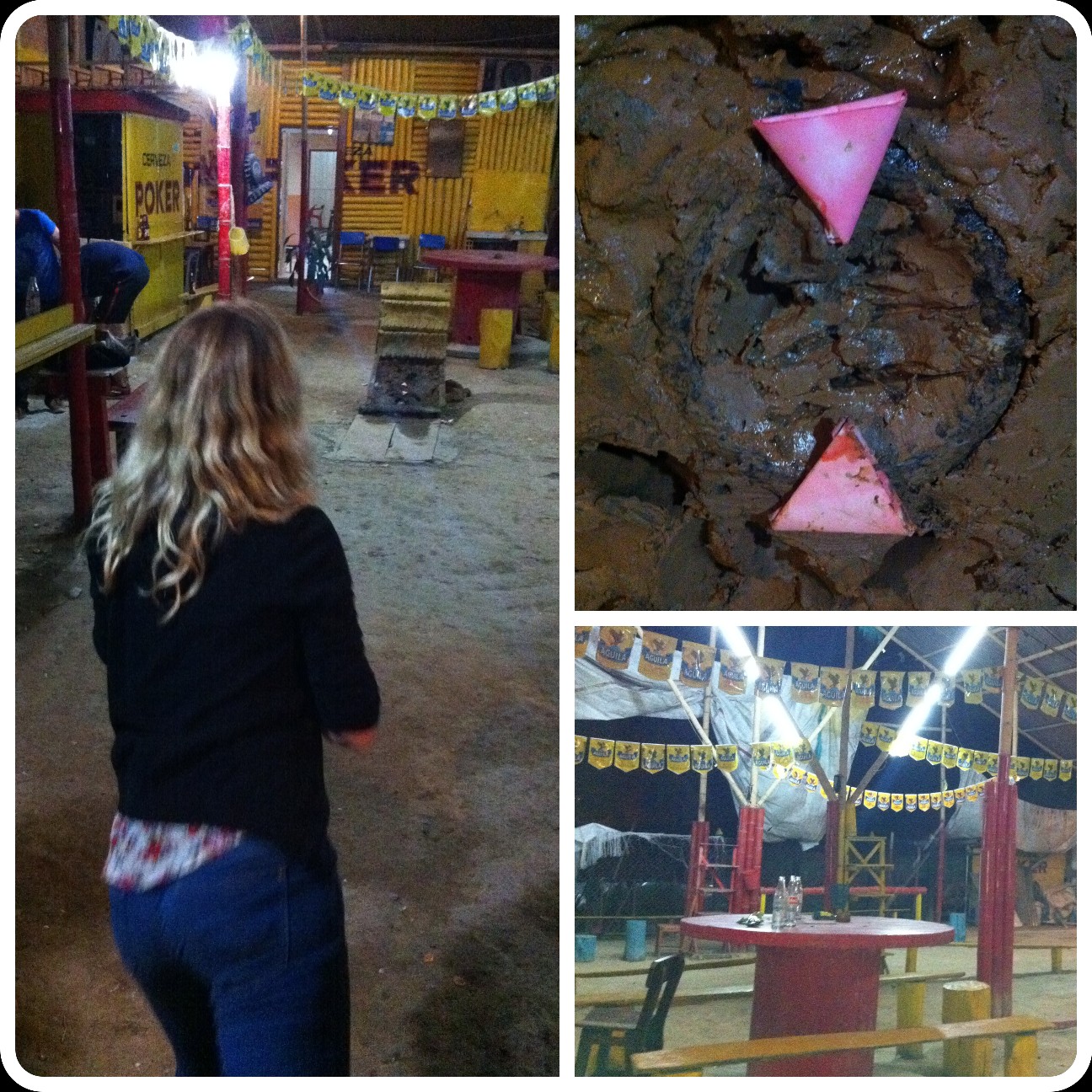
Now is the time to introduce Tejo, game of the Colombian gods. There are very few sports in the world wherein drinking is positively encouraged as you play. Darts is one.

Colombia, too, have their very own sport that is synonymous with getting intoxicated. In fact, often, it’s a sport that’s free to play providing you keep ordering more beer as you play.

Cocora valley with wax palms
Tejo involves getting a group of rowdy, drunk people together with lots of gunpowder and letting them throw metal discs (about 2kg) at a series of targets in a clay square. Within these targets is “mecha”, or gunpowder.

With a good shot, you’ll strike the mecha and most likely drop your beer in shock as the explosion rings throughout the building, cascading off your ribcage on its way.

Tejo should be an Olympic sport
Despite the initial shock of the explosion (I actually stuffed tissue in my ears at the start!), the satisfaction of causing the bang is addictive and, luckily, is the whole point of the game. The more bangs, the better your score, the more likely you are to win. Olympic Games 2016? Brasil, take note!

The following day, with a fun group of Aussies and Anjelica, a beautiful Colombian/American girl, we’d befriended over tejo, we took an even more “vintage” jeep through the misty mountains to see more wax palm forests, drink very milky coffee surrounded by hummingbirds at a remote farm and hear the tales of these hills that were once FARC territory in the 80s and 90s.

Ex-FARC territory amidst wax palm forests
Though FARC , the Revolutionary Armed Forces of Colombia (not to be mixed up with paramilitares – Colombia’s got them too), still poses some degree of threat to the Colombian population, the revolutionary force no longer has the clout it possessed a few decades ago.

The deaths of its rank and file members, its dwindling military power, and mounting rejection from Colombians leave little option for FARC but to reach a peaceful yet uneasy end to the conflict.

Wax palms
That said, as we arrived into Popayan, we heard news of a FARC blowing up a bridge 200kms away and isolating a small mining town from the rest of the country. FARC aren’t quite as silent as the Colombian tourist board would like you to believe.

We visited an old, rural school in the mountains that was turned into the FARC headquarters to survey the land. FARC claim to represent the poor people of rural Colombia, hence this location.

A list of names, killers (we were told by our discerning guide), was still visible amidst the graffiti and fire-charred paint.

Iridescent long-tailed hummingbird
We then heard about how corrupt army officials, not wanting to fight FARC, would dress homeless people up in FARC uniform on this very spot just to shoot them and hand them over to their chiefs. The words of our guide echoed off the haunted walls.

The children up in the mountains now have to leave their homes at 4am to catch the school bus at 6am for school in Salento. The burnt-out school stands untouched as a lasting reminder of what happened here. May it never happen again.

A school turned into a FARC base
In true backwards fashion, we toured the coffee plantation attached to our hostel on our last day in Salento, walking through the entire process from cultivating to roasting of the beans.

Fascinating stuff, too detailed for this blog. Our tour of Finca Don Eduardo culminated in the group sitting down for some delicious, freshly brewed coffee. I don’t even drink the stuff at home, but when in Colombia…

Coffee plantation
I think this muddy mixture of coffee plantations and mountains stalked by FARC tells me something about Colombia.

While the country still struggles with the inability to completely shed itself of its troubled past, the Colombia we have gotten to know in the last couple of weeks is differentiated by some of the happiest, laid-back coffee drinkers in the world and a diverse, bountiful landscape that keeps on providing for its people.

So, in Salento, I learnt about coffee and terrorism. It’s a colourful world...
Sunset over the hills of Salento

Wednesday, 1 August 2012

Colombia begins: the heart and soul of Salsa

We decided to change our flights out of Costa Rica due to time and expense, and so as we made our way across the border into Colombia, we knew this would be the last country of our trip. But first, we had a two day trip across the border to contend with.

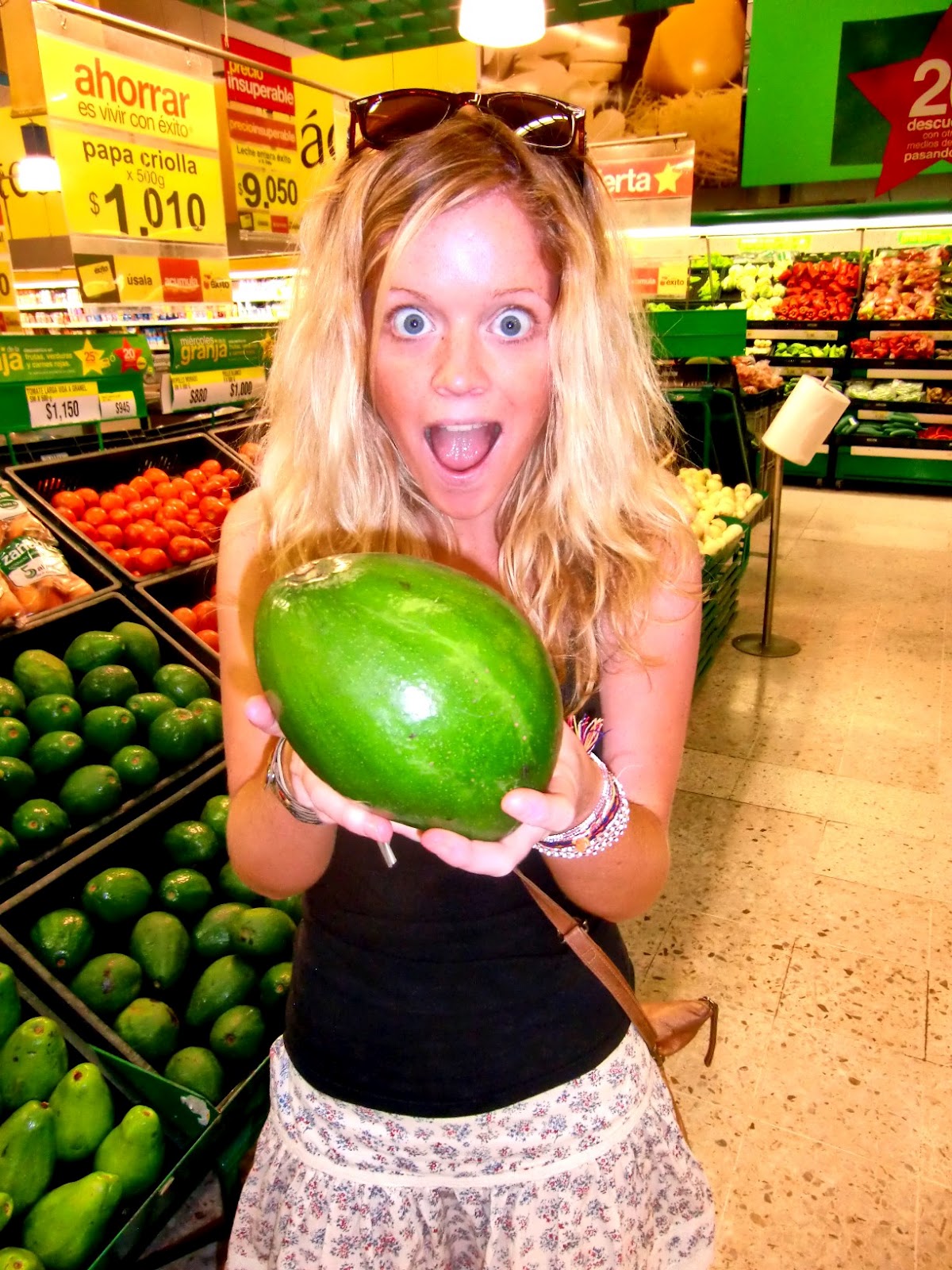
Is this the biggest avocado in the world?!
Border crossings have offered lots of imaginative twists to our South American travels: multiple protests, road blockades, disdain from Argentinian officials and even a (albeit minor) bus crash.

So naturally, crossing through what is fondly known as “bandit territory” had us interested and slightly nervous as to what would happen on our final crossing. We’d heard whisperings and tales of hijackings and robberies (even by the Colombian police!).

Thankfully, the only twist to this two-day journey was the insane amount of armed police and military that we saw on our way, armed with huge weapons.

Even in the most seemingly remote places, there would be a few fully decked out soldiers on the side of the road, complete with large automatic weapons slung over their shoulders, or sometimes by their sides, with their fingers actually resting on the trigger. We made sure to give them our best “gringo” (foreigner) smile and be polite!

Pretty Popayán
We’d seen this all over South America, but this was the first we’d been frisked by one. Onto the bus came a soldier carrying a shotgun while he took ours and all the locals’ identification. Perfectly normal.

Then we all got asked to get off the bus, separate into men and women and I watched as Med got a full frisking and bag search by a man with a gun. Thankfully, I just had a bag search and few questions about our journey.

We made it, without being hijacked, robbed or arrested – high five for us!

We arrived into the pretty colonial town of Popayán, known as the “white city”, since all the buildings are painted alike. Popayán is surrounded by some really beautiful countryside; many a mountain, volcano and national park, but the town is quiet and we just relaxed after a two day journey.

We did manage to sample some of the local nightlife though, in the form of a dark, maroon bar serving up cheap drinks, music from collectible, Colombian LPs and heaps of entertainment from the sozzled, rosy-cheeked locals who perched on wobbly stools and musty chairs.

I loved it. This was the Colombia I had imagined: infectious Latino music, wafts of meat cooking on the street outside and tables oozing with empty beers and spirits.

There was only one thing missing: sizzling Salsa!

Cali is known as the salsa capital of the country, if not the world. (Salsa the dance form, not the dip!)
Cali is serenely surrounded by miles of sugar cane plantations, and sweeping landscapes, but its heart and soul is in complete contrast. It pulsates a unique and sassy energy, the energy of fiesta and homegrown Salsa.

Cali is also known for “medical tourism”, i.e., a lot of people come here to get plastic surgery. Certainly a lot of the locals have had boob jobs and I suspect bottom implants too. We’ve even heard that it’s a traditional present for a wealthy 16 year old to have a boob job in Colombia; Med and I now play a mean game of real or fake!

The city also has a dramatic history – much served up by the drug kingpins of the late eighties and early nineties. Today, change is happening and Cali has become a safer and happier place for everyone.

Med was less than thrilled to be there though, where two left feet just don’t cut it. But I was desperate to go to a real Colombian Salsa club and try and keep up with the locals who started dancing, as one guy put it, “en el vientre” (in the womb).

So a few of us took a class in our hostel, with Carlos (so far everyone seems to be called Carlos in Colombia!). As we learnt fast Salsa and special Cali salsa to the Latino music in the studio with a wall of mirrors, I felt like I should have brought my high heels and be-jewelled skirt! I came out of the class drenched in sweat, feeling like I really should have been born Colombian. This was too much fun.

We headed out with a big group of travellers and locals to Las Brisas, a notorious Salsa hotspot full of be best dancers in Cali. Wow!

The brightly and skimpy clad costumes on the dancers dazzled as they fiercely moved their bodies in time to the beat, legs stepped perfectly in sync with each other and moving so fast I felt dizzy. I was finally here, and totally out of my depth!
Las Brisas Salsa club

Thankfully, within our group we had a few Salsa teachers who refused to let us sit down for more than two minutes at a time. Rum and Aguardiente (Colombia’s national spirit, similar to Ouzo) were passed around and I danced until I couldn’t feel my feet!

At one point I even found myself at the front of some kind of line dance version of Salsa with a huge audience - you just get into the outrageously electric atmosphere and no one seems to care that you’ve only had one lesson.

Five days into Colombia and we were overwhelmed and enchanted by its people and soul. Despite the very recent, tumultuous history, Colombians are an unbelievably friendly bunch. We have been stopped by complete strangers just to say “Bienvenidos” (welcome) more in this country then in all other countries combined. The staring at our white skin and fair locks continues with renewed vigour here, but at least they are most likely to do it with a smile or a “Buenos” (the short form of "Buenos dias" - good day.

I’ve fallen in love with this country, and am so excited about our last month of being "viajeros" (travellers).

Sunday, 29 July 2012

Ballenas, Baños and Burritos

We had sea mammals on the mind as our next stop was the mainland coast of Ecuador. Humpback whales make their way to equatorial waters during the summer to mate and give birth in warmer waters, offering a rare chance to see one of nature’s greatest mammals in her natural environment.

No zoom required! Just metres away from humpbacks...
It is estimated that about 7,000 whales (ballenas) come from the Antarctic to the tropics each year. Over the years, expert whale watchers have identified about 2,000 different whales in Ecuadorian waters, based on their unique tail markings, which essentially amount to a fingerprint.

During the courting rituals whale watching is breathtaking. The males often put on macho displays of dominance, in which they inflate their chests and throats, physically confront possible competitors, and jump above the surface of the water.

Females have also been known to show their tail above the water as a sign that they wish not to mate at a particular time, giving researchers a chance to capture their fingerprint.

After a night in party-town Montanita, we took a boat out from Puerto Lopez – a charmingly local and sand-tossed town further up the coast. We raced across the water for ten minutes and then finally slowed to a lull. And waited.

But after just few seconds…wham! A shower of salt water a few metres off and the tail-slapping and breaching began, at times, just three metres from where we sat.

It was unreal to think that an animal so enormous and strong could be swimming around right beneath our small boat, using their watermelon-sized eyes to flick a look at us before plunging back into the depths of the salty sea.

It was also amazing to think that these magnificent creatures, that so dwarf us mere humans, could be endangered. This quote sums it up nicely:

The whale is endangered, while the ant continues to do just fine” (Bill Vaughn)
We could feel the spray from her tail

Our next stop was Baños, for all things tacky and taffy  - the sugary, sticky sweet treat the town makes on wooden posts in shop doorways.

I appreciated the comedic genius of getting a tummy bug (probably because I eat everything and anything in South America) in a town that literally translates to “toilets” – all I saw was the toilets for the first two days. We were also staying at Hostel Erupcion, I’ll say no more!

Illness aside, the town was charming in its tourist-driven tackiness, we were surrounded by waterfalls cascading down lush, green mountainsides and the air was fresh and invigorating.

We even managed a five hour hike through the hills on the last day (loo roll at the ready!): wandering through farmers’ back gardens, completely lost, to be cheerfully put back on the right track.

Men making taffy all day, every day along the streets
Due to my dodgy tummy, I didn’t try one of the local specialities, cuy (spit-roasted guinea pigs), but they were everywhere, sizzling on the streets.

From the verdant green of Baños to the colonial chaos of Quito. Quito is the only capital city in the world located directly beneath an active volcano, Pichincha, which erupted as recently as 2006, sprinkling ash over the city and causing major disruption.

Old town Quito, one of the largest, best-preserved historic districts in the world, was selected by UNESCO as one of the first two World Heritage Sites in 1978.

One of the farms we found ourselves at in Baños
Sadly, Quito has a reputation as a dangerous, crime-ridden city amongst travellers. The safe haven of our hostel was buzzing with stories. I told how a friend of mine had her camera robbed at knifepoint.

Someone else (an ex-military guy, no less) was attacked and mugged down at the end of the street, 100 meters from the hostel. Another person three days before was stabbed in the arm when he refused to hand over his valuables.

And then we added our own, near-mugging to the mixing pot of nail-biting tales.

We were walking down a busy street in broad daylight when two guys and a girl blocked our path and started yelling at us. “Un dólar, un dólar!” the girl kept screaming while the others closed in on us. Our hearts thumping in our chests, we managed to jump into an open doorway that, by some miracle, had a security guard sat behind a desk.

The thieves moved on, while the security guard continued to avoid acknowledging our presence at all. We were lucky, but left quite unsettled.

Crispy cuy, NOT for guinea pig lovers!
Thankfully, our hostel and its people were great so we went round in a group from then on, making regular outings to the burrito house around the corner as a welcome change from almuerzos of chicken, rice and beans. Although, it was pointed out, a burrito just provides that combo in a different format!

Quito’s colourful canvas is also hinged by its positioning in the middle of the world, or the “La Mitad del Mundo”.

In 1736, French scientists set out to determine the exact point on the globe that was located midway between the north and south poles.

This was no easy feat, since so much of “middle earth” is ocean, swamps, and jungle. Their search for dry land led them to Ecuador, a short distance from present day Quito, where they established La Mitad del Mundo also known as the Equator.

Two hundred years later, in 1936, a monument was erected on the spot and a line painted on the ground to mark the Equator, a site which is today one of the top tourist destinations in the country.
Beautiful El Centro, Quito

Each year, thousands of tourists straddle this line, believing they have one foot in the Northern Hemisphere and the other in the Southern Hemisphere.

Many have no idea that actual Equator runs through the middle of a pre-Inca ruin located approximately 300 metres to the north of the monument, a fact confirmed with the development of satellite Global Positioning Systems (GPS).

We went to the statue, but then walked the 300 metres out the back entrance, around the corner and along a dirt track to stand on the actual equator.

There, we were given a guided tour explaining how the ancient Andean people, including the Quito tribe, worshipped the sun here and had great knowledge of the celestial bodies.

Cheesy Equator jump was a must!
The Quito tribe, completely naked to this day, built ceremonial and ritual sites right along the Equator, knowing they were in the middle of the earth (the word “Quito” actually means “middle earth”).

The tribe is also famous for it's shrunken heads. When a chief dies or an enemy killed, they are beheaded and the skull removed. The lips and eyes are sewn shut and the head is then boiled in an herbal solution that begins the shrinking process and fixes the hair so that it will not fall out.

Then, to keep the shape, it is filled with hot stones and then hung over a smoky fire until the skin turns black. Heads are then worn was necklaces and on top of spears. We saw a head that was more than 100 years old - lovely stuff.

Also fascinating, if not a little amusing, were the experiments we got to do with water and balancing eggs. Water really does go down the plughole anti-clockwise in the northern hemisphere and clockwise in the south; eggs can be balanced on a nail head due to less coriolis effect; and apparently our bodies have less gravity directly on the Equator, diminishing our weight and, therefore, strength.

The much-disputed claim...
Despite the tourist gimmicks, there is something very exciting about being at the exact centre of the world.

In Ecuador, we were also standing on one of the highest points on the Equator – the highest place from the centre of the earth to the Equator actually being on top of Volcan Cotapaxi just south of Quito.

Wednesday, 25 July 2012

Galapagos Islands: swimming with sharks

After our cruise, we were back in Puerto Ayora, where an entire street turns into a restaurant from 6pm and the meaty smoke of its delicious asados (BBQs) lures in locals and tourists alike.

Tortuga Bay, Isla Santa Cruz
Most people who live here are Ecuadorians whose families have lived here since colonisation, but there are a few Europeans who started migrating to the islands in the 1920s. Everyone is friendly, though, and there is a great spirit to the streets and shores of Galapagos.

For the next couple of day we made the most of Tortuga Bay, a long and crisp white beach in walking distance.

On the track to the beach, small lava lizards ran along in front of us, and a symphony of Galapagos birds, including Darwin finches, yellow Galapagos flycatchers, and the Galapagos Mockingbirds, sang to us as we walked. If it doesn’t have “Galapagos” in the title, it has “Darwin” or “lava”!
Tortoises munching in the Darwin breeding centre

The sound of crashing waves greeted us as the trees and strange, tree-shaped cactuses gave way to Tortuga Bay, its white sands and iridescent waters.

The sun was so strong here: not only were we at the beach, we were at a beach along the Equatorial line where the sun shines strongest. Thankfully, my mum’s obsession with suncream has rubbed off on me (quite literally!).

We also visited the Darwin Research Centre to learn about its tortoise breeding program. The animals of Galapagos have evolved without fear of humans, but that isn’t to say they have never been threatened by man. In 1535, Fray Tomas de Berlanga, a missionary whom the King of Spain had named Bishop of Panama, was sailing home to inform the king about lands recently conquered from the Incas when he was forced to land on the Galapagos Islands.
Galapagos Land Iguana - bright yellow during mating season

Man, the greatest predator the Galapagos have ever known, had arrived.

From the time of the buccaneers until colonisation, tortoises were hunted mercilessly (a study of whalers’ logbooks suggests that a minimum of 100,000 tortoises were taken by North American whalers alone), but even colonisation did not end the slaughter. Ecuador proclaimed their ownership of the islands in February of 1832 and settlements immediately sprung up.

"I'll have two tuna steaks, por favor!"
Resources of the Galapagos were exploited with renewed fervour: fur seals were killed for their skins; a particular variety of lichen was collected for the manufacture of dyes; sea cucumbers, prized as an aphrodisiac in the orient, were decimated.

Tortoises did not escape this latest round of profiteering. The demand for turtle meat was replaced by a market for their oil, which was used in street lamps and to light homes in Guayaquil (mainland Ecuador) until the 1930s.

The tortoise, the icon of the Galapagos (in fact the name Galapagos is derived from old Spanish word for saddle, which the tortoise shells resembles), was nearly made completely extinct by man.

Sunset with a sea lion on San Cristobal
Their original numbers, estimated to have been in the 250,000 range, were reduced to a mere 3,000 as a result of this uncontrolled hunting.

Awareness and extraordinary funding brought the Galapagos tortoise breeding program. Eggs are collected and placed in temperature-controlled incubators that determine the sex of the offspring.

Higher temperatures produce females, while cooler temperatures produce males. When their shell curve reaches 20 centimetres, the young tortoises are tagged for future identification and repatriated to their island of origin.

Old goggle-eyes underwater
However, not all efforts have been as successful. Lonesome George, the last remaining tortoise from Pinta Island, sat in an enclosure with two Española females, which are the closest to his species, genetically speaking.

Unfortunately, Lonesome George showed no propensity to mate and his species  was made extinct on 24th June 2012.

There were 8 in the bed and the little one said...
The other tortoises we saw in the centre seem unperturbed by extinction and past cruelties; they continued to munch contentedly on the thick, juicy grass and, occasionally, stuck their necks out to get a good look at us.

So what of man’s interference on the islands now? More than 200,000 people visit the islands each year, and five of the islands are inhabited by about 30,000 people. While tourist traffic is kept to a minimum (the $110 you have to pay before you step foot on the islands helps), it's still amazing to see purity of the islands so well maintained.

Me swimming with a green sea turtle
Thankfully, nearly all the islands (97% of the area) are protected by the Ecuadorian government and rules of the islands are emphatically communicated. Do not touch or disturb any plant, rock or animal. Don't feed the animals. Remain on the path. Do not startle or chase any animal. Do not be closer than 2 metres to an animal. Do not litter.

Being conscientious travellers, we of course abided by these rules, however some of the animals here have their own rules, and sticking to these parameters is sometimes very difficult indeed.

The Kicker Rock welcome crew!
Especially in San Cristobal, which we caught a speed boat to for our last few days. Here, there are sea lion slobs lounging on park benches, sea lion police men guarding police cars and sea lions blocking steps to beaches. And they definitely do not keep to the 2 meter rule – how rude!

For our last few days we snorkelled and watched sunset off the most beautiful, sea lion draped beaches. From the white sand beaches, we experienced some of the best snorkelling in the world.

Sea lions came up onto the beach to coax you into the water; the calm water made visibility almost as clear as looking through the glass of an aquarium; turtles continued to yell “Duuuude” at each other as they swam with us.

One of hundreds of sharks at Kicker Rock
On our last day, we sailed the short distance to Kicker Rock, which is a huge rock jutting out of the ocean, slowly splitting into two. Named “Kicker” because pirates thought it resembled the shape of their pirate boots.

We snorkelled toward the channel opening between the splitting rocks, instantly greeted by masses of turtles in the deep water. Then came the huge hammerhead sharks just a few metres below us – and we hadn’t even made it into the channel.

What came next was the best snorkelling I think I will do in my whole life. More than one hundred Galapagos sharks swam between us, one even swimming  less than a metre towards Med’s leg before changing his mind. Then more hammerheads came just metres away, as if they were fighting for our attention.

The fleet of Eagle Rays arrive
We were surrounded by hundreds of sharks, but I had that perfectly calm feeling I get when I’m snorkelling, despite the danger. Something about only being able to hear the static crackles of underwater life takes away my fear. Then came a flotilla of giant, spotted eagle rays – faces the same size and almost the same shape as bottle-nosed dolphins and so graceful and peaceful.

There is something about seeing more than a hundred rays and sharks around me that made my heart beat harder and slower. Everything around me just melted.

What an experience - thank you Galapagos!
By the time you arrive in Galapagos, you have stepped back in time to a place where the earth is almost untouched by humans. You have entered a dream in which you swim with penguins, sea turtles and sharks. You have gone to another planet, where the terrain is arid and you tiptoe past alien-like iguanas basking on the rocks.

And at the end of the day, when the sun settles in the middle of the glowing water, you just know you are somewhere amazing, and I didn't want that moment to end.