
A tingle crawled from the bottom of my spine. Up to that point it hadn’t seemed real. But I was suddenly struck with the full force of reality at 4am: I was going to Machu Picchu, visiting the "Lost City" of the Incas.
We were up, as we learnt from our Aussie friends, 'at a sparrow's fart!' I climbed out of bed and watched the cloud forest emerge from inky blackness, but I was still hopeful for sunny skies. Apparently every day at Machu Picchu starts like this.
We were first in the queue for the first bus up - you can walk but we wanted to save our stiff legs and sore feet for a full day of exploring. A 20-minute bus ride carried us up the zig-zagging dirt road to the entrance, beyond which lead a stone staircase, bound for the top of Machu Picchu.
We were nervous - the tour company has made an error with both Med's and my tickets - they both said we were 112 years old and had a typo in our passport numbers. Raoul was with us though, and we shuffled in quietly like a pair of 112 year olds.
As we walked into Machu Picchu at the front of the already-forming crowd, the famous mountaintop citadel came into view; it was still dark but I could now see the clear sky above it. The most breathtaking sight - "like Disneyland, for adults" I squeaked. The resident llamas looked down at us: "here we go again," the were probably thinking.
 Machu Picchu is known, actually incorrectly, as the "Lost City". It was rediscovered in 1911 by American historian Hiram Bingham. Bingham had been searching for the city of Vilcabamba, the so-called "Lost City of the Inca" where the last of the independent Inca rulers waged a years-long battle against Spanish, when a Quechua family with whom he was staying told him about a nearby mountaintop ruin.
Bingham paid the son, 11-year old Pablito Alvarez, about a dollar to lead him to the ruin we now know as Machu Picchu. Mistaking it for the Vilcabamba, Bingham dubbed it the Lost City of the Inca and the name stuck.
Eventually the government of Peru recognised the importance of Machu Picchu and took steps to protect it. Years earlier, unaware that the ruins existed, the government had deeded the entire mountaintop to three local families.
What makes it so special, one of the seven wonders of the world, is that it survived intact, unlike most other Inca sites that were eventually plundered or destroyed by the Spaniards.
Legend says that upon learning about the advancing Spaniards, the Incas erased all signs of trails leading to Machu Picchu and abandoned it rather than allowing their most sacred of sites to fall into the hands of marauders.
 I am most grateful that they did. Sadly it did fall into the hands of Yale University, where Bingham took 74 boxes of treasures on the promise of returning them within a few months. Yale has them hidden away to this day much to the disgust of Peru - it was a brave man who we saw wearing his Yale jacket in the ruins.
Machu Picchu's other speciality is the mystery that enshrouds it. The Incas had no system of writing and left no written records, and archaeologists have been left to piece together bits of evidence as to why Machu Picchu was built, what purpose it served, and why it was so quickly vacated. There are so many questions left unanswered, and I like it that way.
After the initial rush of seeing Machu Picchu wore off, and we’d watched the sun spray it's rays over the top of the mountains, it was time for a tour. Lead by Raoul, our guide from the Salkantay Trek, we walked around the complex for about 2 hours, learning about the sacred temples, the unfinished sites and what life might have been like in the kingdom.
Raoul pointed out the difference in the masonry: painstakingly polished stones were used for religious structures, while rough-hewn stones signalled structures used by commoners. Though theories abound, most now believe that Machu Picchu was a religious centre, occupied primarily by priests, members of the Royal family, and the commoners who served them.
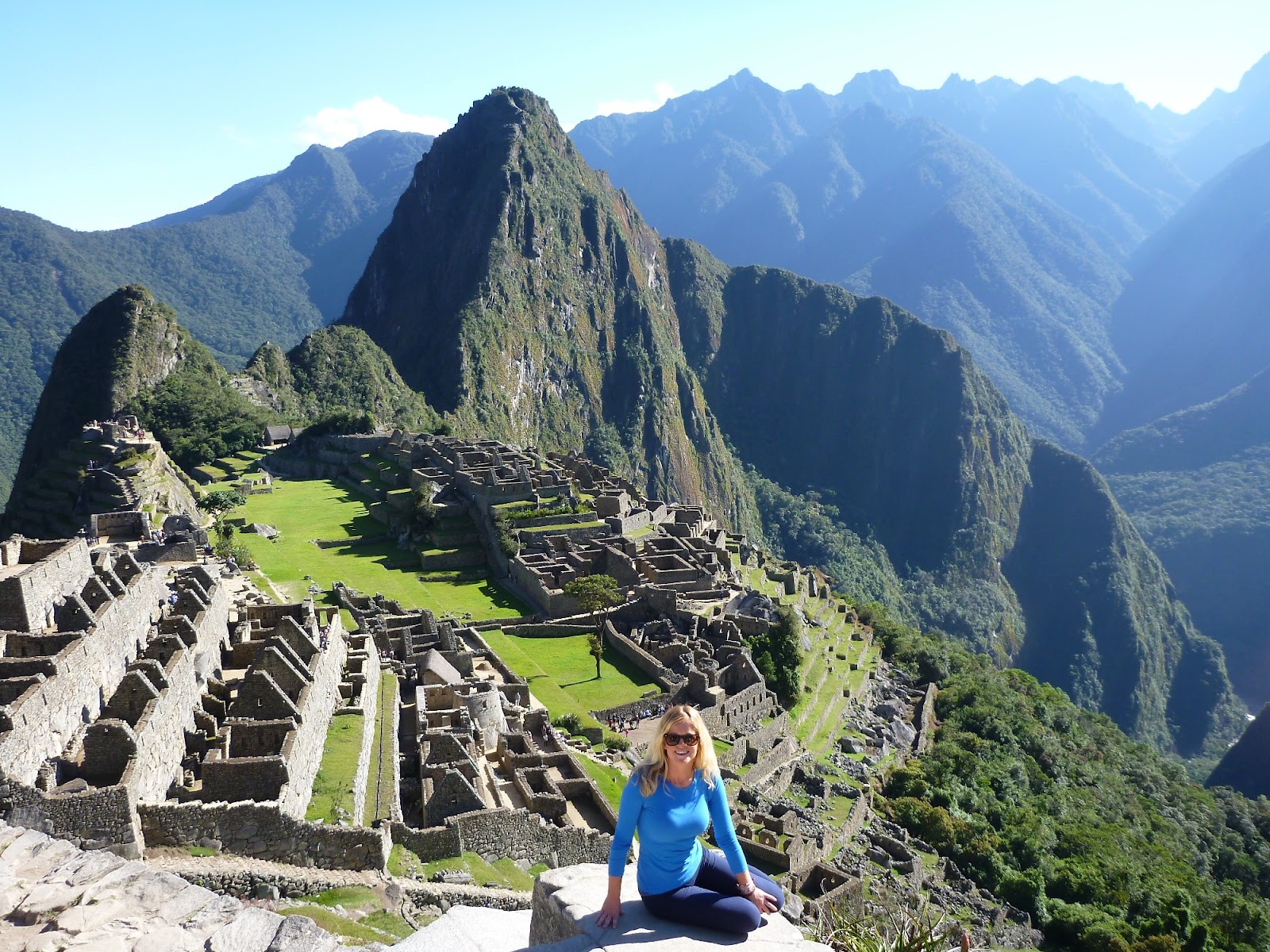
 At 10:30am, after refuelling on some snacks outside the main gate (you aren't supposed to eat inside), we climbed to the Guard House, the original entrance to Machu Picchu, for the postcard-perfect view of one of the seven wonders of the world.
Then it was onwards and upwards to the Inca bridge, a very narrow, beautifully intact pathway that clings to a sheer cliff. Incredible to think it's survived earthquakes, storms and landslides over 600 years. Even more amazing was discovering that the Incas appeared to make their structures earthquake-proof.
We could linger too much on this thought, as it was time to climb Wayna Picchu for a birdseye view of Machu Picchu.
When I first lay eyes on Wayna Picchu, I had no idea how I’d get up it with my tired legs and throbbing toes. I’d heard there were ropes on the steep sections (actually they are steel cables), but from below, it looked impossibly steep.
But believe it or not, there is a trail that winds up the mountain face, and it only took me about 20 minutes to get up it. And what a view!
It is thought that priests and virgins made this climb every morning at dawn to welcome the new day. Once was enough for me, though.
We then bid farewell to our fellow Salkantay trekkers, and completed the pretty tough loop to the Gran Caverna (Big Cave) with our Aussie friends, James and Fleur, who just happened to be at Machu Picchu at the same day.
Before our final climb of the day, we sat cross-legged on one of the broad agricultural terraces and watched the day’s 2,500 (or more) visitors abandon the site. By 3 p.m, we had Machu Picchu almost to ourself as the grassy central plaza glistened an amber-green and the ruins turned a burnished gold in the retreating sun.
We climbed up slowly up to the Sun Gate, where one of the original Inca trails approaches the kingdom. The low sun was blinding, but the view was another of the amazing vistas that leave people speechless here.
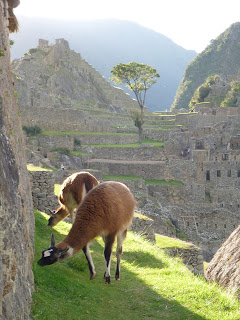 On our way back down, the llamas were back, surveying their land, making sure no tourists outstayed their welcome. We stayed right until we were asked to leave (and I was actually chased by one of the llamas!).
It is thought 60% of Machu Picchu still lies tangled in the roots of the jungle around us, so who knows what it will look like 50 years from now.
I hope that they keep it that way though: buried in layers of mystery and mostly reclaimed by Pachamama (Mother Earth).
 |
| Our first view of Machu Picchu |
 |
| A room with a view: the priest's house |
We were nervous - the tour company has made an error with both Med's and my tickets - they both said we were 112 years old and had a typo in our passport numbers. Raoul was with us though, and we shuffled in quietly like a pair of 112 year olds.
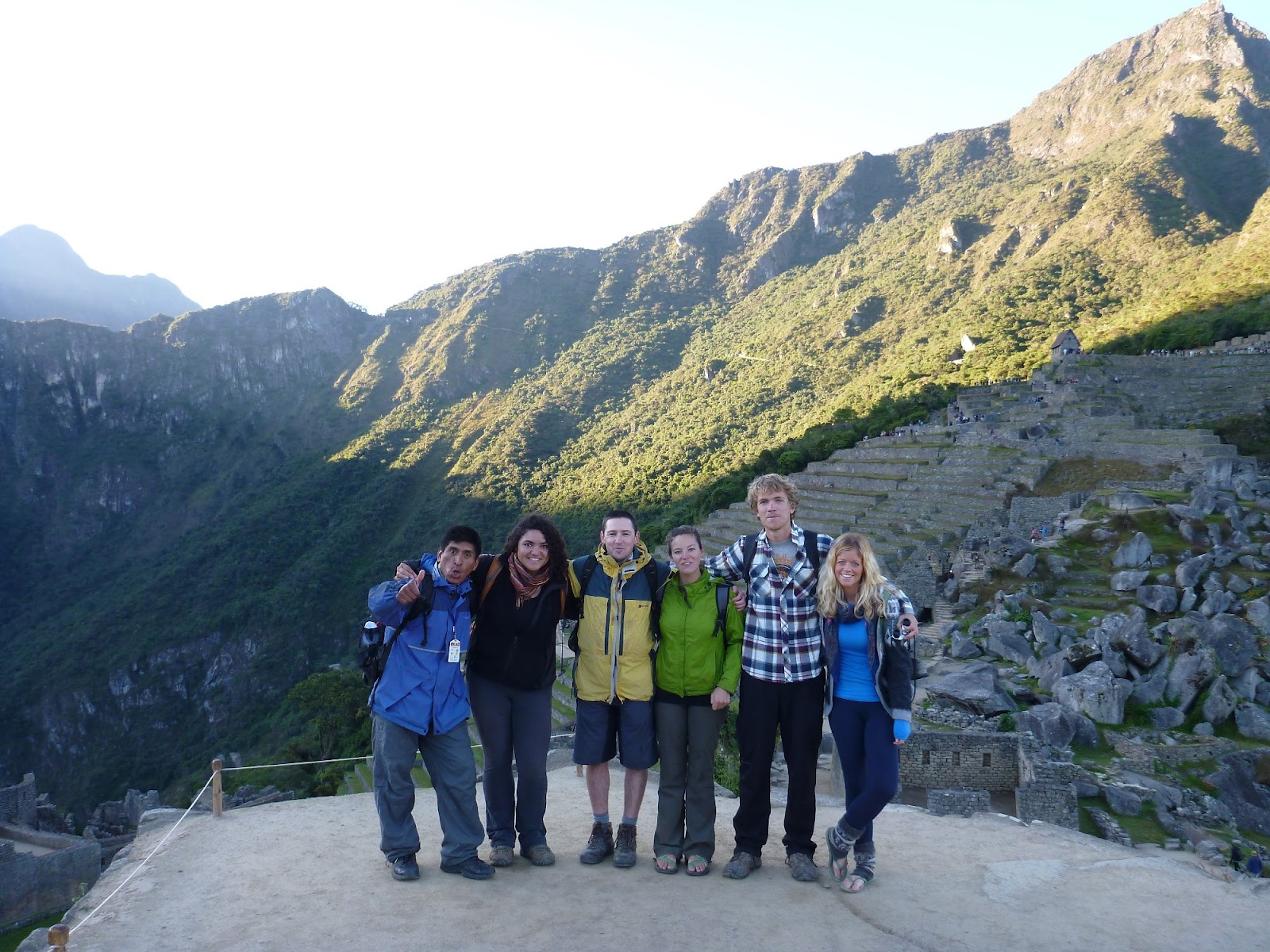 |
| Salkantay team...we made it! |

Bingham paid the son, 11-year old Pablito Alvarez, about a dollar to lead him to the ruin we now know as Machu Picchu. Mistaking it for the Vilcabamba, Bingham dubbed it the Lost City of the Inca and the name stuck.
 |
| Sunrise over the mountains |
What makes it so special, one of the seven wonders of the world, is that it survived intact, unlike most other Inca sites that were eventually plundered or destroyed by the Spaniards.
Legend says that upon learning about the advancing Spaniards, the Incas erased all signs of trails leading to Machu Picchu and abandoned it rather than allowing their most sacred of sites to fall into the hands of marauders.
 I am most grateful that they did. Sadly it did fall into the hands of Yale University, where Bingham took 74 boxes of treasures on the promise of returning them within a few months. Yale has them hidden away to this day much to the disgust of Peru - it was a brave man who we saw wearing his Yale jacket in the ruins.
Machu Picchu's other speciality is the mystery that enshrouds it. The Incas had no system of writing and left no written records, and archaeologists have been left to piece together bits of evidence as to why Machu Picchu was built, what purpose it served, and why it was so quickly vacated. There are so many questions left unanswered, and I like it that way.
 |
| Postcard view from the Guard's House |
Raoul pointed out the difference in the masonry: painstakingly polished stones were used for religious structures, while rough-hewn stones signalled structures used by commoners. Though theories abound, most now believe that Machu Picchu was a religious centre, occupied primarily by priests, members of the Royal family, and the commoners who served them.
 At 10:30am, after refuelling on some snacks outside the main gate (you aren't supposed to eat inside), we climbed to the Guard House, the original entrance to Machu Picchu, for the postcard-perfect view of one of the seven wonders of the world.
Then it was onwards and upwards to the Inca bridge, a very narrow, beautifully intact pathway that clings to a sheer cliff. Incredible to think it's survived earthquakes, storms and landslides over 600 years. Even more amazing was discovering that the Incas appeared to make their structures earthquake-proof.
 |
| The Inca bridge |
When I first lay eyes on Wayna Picchu, I had no idea how I’d get up it with my tired legs and throbbing toes. I’d heard there were ropes on the steep sections (actually they are steel cables), but from below, it looked impossibly steep.
But believe it or not, there is a trail that winds up the mountain face, and it only took me about 20 minutes to get up it. And what a view!
It is thought that priests and virgins made this climb every morning at dawn to welcome the new day. Once was enough for me, though.
 |
| The view from Wayna Picchu |
Before our final climb of the day, we sat cross-legged on one of the broad agricultural terraces and watched the day’s 2,500 (or more) visitors abandon the site. By 3 p.m, we had Machu Picchu almost to ourself as the grassy central plaza glistened an amber-green and the ruins turned a burnished gold in the retreating sun.
We climbed up slowly up to the Sun Gate, where one of the original Inca trails approaches the kingdom. The low sun was blinding, but the view was another of the amazing vistas that leave people speechless here.
 On our way back down, the llamas were back, surveying their land, making sure no tourists outstayed their welcome. We stayed right until we were asked to leave (and I was actually chased by one of the llamas!).
It is thought 60% of Machu Picchu still lies tangled in the roots of the jungle around us, so who knows what it will look like 50 years from now.
I hope that they keep it that way though: buried in layers of mystery and mostly reclaimed by Pachamama (Mother Earth).




.jpg)